Why Vintage Fashion Buyers Are Turning to AI-Powered Marketplaces (And Never Looking Back)
The thrill of the hunt has always defined vintage fashion — but what if you could keep the magic while cutting out the endless scroll? A new wave of AI-powered marketplaces is transforming how collectors and style lovers discover authentic pieces from every era, and the vintage community is taking notice.
The Old Way Was Thrilling — But Exhausting
Ask any devoted vintage shopper about their Saturday morning ritual, and you'll hear the same story: alarm set for dawn, coffee in hand, thumbing through rack after rack at the flea market, or clicking through hundreds of blurry listings on a generic resale platform. The joy of unearthing a perfectly preserved 1970s prairie dress or a sharply tailored 1940s wool blazer is real and intoxicating. But so is the fatigue.
For decades, the vintage marketplace was ruled by patience and luck. You either knew the right dealers, had a nose for hidden gems, or simply put in the hours. That model worked — until the internet exploded the supply of available vintage clothing into the millions. Suddenly, the hunt felt less like a treasure quest and more like searching for a needle in a haystack the size of a football stadium.
Enter artificial intelligence.
What AI Actually Does in a Vintage Marketplace
When most people hear "AI-powered marketplace," they picture cold, algorithmic efficiency — the opposite of the warm, tactile world of vintage fashion. But the reality is far more nuanced, and frankly, far more exciting for collectors.
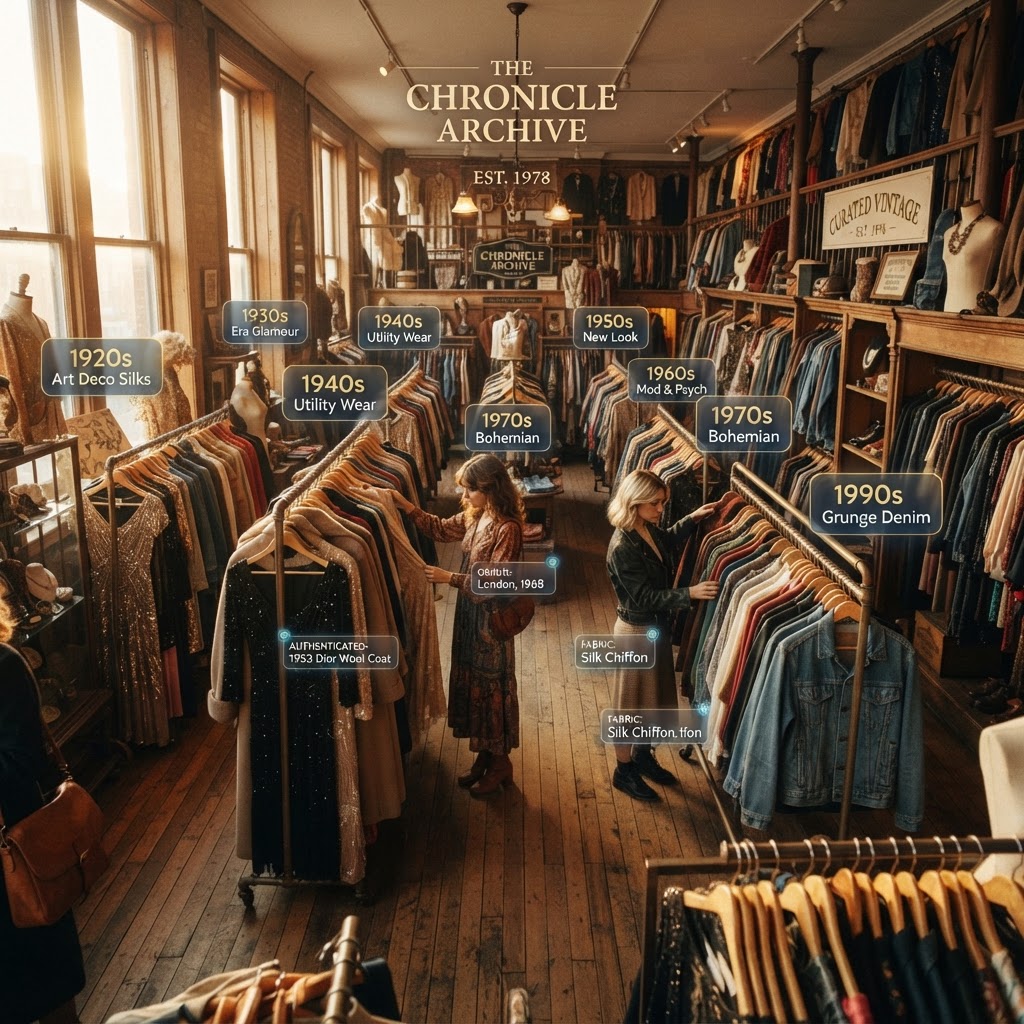
Modern AI tools applied to vintage fashion do several remarkable things at once. Visual recognition technology can analyze the construction details, silhouette, fabric patterns, and hardware of a garment photographed on a hanger or a body, and cross-reference those details against a vast database of fashion history to estimate its era, designer, and authenticity. A zipper pull, a label font, a particular type of French seam — these are the clues a seasoned vintage dealer reads instinctively after years of experience. AI is learning to read them too, and at scale.
Natural language search is another game-changer. Instead of typing "blue dress 1960s" into a search bar and hoping for the best, buyers can now describe what they're envisioning — "something Audrey Hepburn might wear in a Roman holiday, structured shoulders, midi length" — and receive curated results that actually match the aesthetic they're chasing. This kind of semantic search understands context, mood, and cultural reference in ways that keyword matching never could.
Then there's personalized discovery. AI systems learn your taste over time — the eras you gravitate toward, the silhouettes that appeal to you, the price points you're comfortable with — and surface pieces you might never have thought to search for but immediately recognize as yours the moment you see them.
Authenticity: The Problem AI Was Born to Solve
If there's one issue that has always haunted the vintage market, it's authenticity. The higher the demand for a particular era or label, the more counterfeit, misrepresented, or simply misdated pieces flood the market. A seller who doesn't know their fashion history might genuinely list a 1990s reproduction of a 1950s swing coat as an original. A less scrupulous one might do it deliberately.
This is where AI's encyclopedic, tireless nature becomes genuinely valuable. By training on thousands of authenticated examples — scrutinizing union labels, care instruction formats (which weren't required in the U.S. until 1971, for instance), zipper types, and fabric compositions — AI authentication tools can flag inconsistencies that even experienced buyers might miss on a casual scroll.
For buyers investing serious money in designer vintage — a Halston jersey gown, a Courrèges space-age shift, a Vivienne Westwood corseted jacket from the Portrait Collection — this layer of AI-assisted verification provides a confidence that the old "buyer beware" marketplace simply couldn't offer.
The Cultural Dimension: AI as Fashion Historian
Here's what often gets overlooked in the conversation about AI and commerce: these tools are also becoming remarkable repositories of fashion history. When an AI system learns to distinguish a 1920s flapper dress from a 1960s revival of the same silhouette, it's absorbing an enormous amount of cultural and historical context — the social movements, the textile technologies, the design philosophies that shaped each era's aesthetic.
This matters to vintage buyers who aren't just shopping; they're collecting history. The woman who seeks out Depression-era housedresses isn't just after a cotton frock — she's connecting with the ingenuity and resilience of women who made beauty out of scarcity. The collector hunting 1980s power suits is tracing the visual language of a generation of women entering corporate America on their own terms. Vintage fashion is wearable cultural memory.
AI-powered platforms are beginning to reflect this understanding. The best of them don't just show you a product listing — they tell you the story of the piece, situating it within its historical moment and explaining what makes it significant. This kind of contextual merchandising transforms a transaction into an education, and it's resonating deeply with a generation of buyers who want meaning alongside their purchases.
Why Younger Shoppers Are Leading the Charge
It might seem counterintuitive: younger shoppers, raised on fast fashion's endless churn, have become some of the most passionate advocates for vintage clothing. But the logic tracks perfectly. Gen Z and millennial consumers are acutely aware of fashion's environmental footprint, and they're drawn to the sustainability story that vintage inherently tells — every secondhand purchase is one fewer new garment manufactured.
They're also, crucially, digital natives who expect their shopping experiences to be intelligent, personalized, and responsive. They don't want to wade through 10,000 listings. They want a platform that knows them, learns from them, and delivers the unexpected find that makes them feel seen. AI-powered vintage marketplaces sit at the exact intersection of these values: sustainable, storied, and smart.
Social media has turbocharged this shift. When a 1990s slip dress or a Y2K butterfly clip goes viral on TikTok, the search traffic for that specific aesthetic spikes within hours. AI-powered platforms can respond to these cultural moments in near-real-time, surfacing relevant inventory and contextualizing trends within the longer arc of fashion history. Traditional vintage shops, however beloved, simply cannot move at that speed.
The Human Touch Remains Essential
For all of AI's capabilities, the vintage fashion community rightly insists that technology is a tool, not a replacement for human expertise and passion. The curators, the dealers, the historians, the obsessives who have spent careers learning to read a garment's story in its every seam and button — their knowledge is irreplaceable, and the best AI-powered platforms are built to amplify that knowledge rather than sideline it.
Authentication ultimately benefits from human final review. Curation benefits from a human eye attuned to beauty and cultural resonance. And the community that has always surrounded vintage fashion — the conversations, the shared discoveries, the collective expertise — that ecosystem thrives on human connection.
The ideal AI-powered vintage marketplace isn't one that removes humans from the equation. It's one that lets humans do what they do best — find, assess, contextualize, and love beautiful old things — while AI handles the scale, speed, and pattern recognition that humans simply cannot match.
A New Era for an Ancient Pleasure
Humans have been recycling clothing for as long as we've been wearing it. The vintage market is, in many ways, the formalization of an instinct as old as civilization: the recognition that beautiful, well-made things deserve to outlast their first owners. What's changing is the infrastructure that connects those things to the people who will cherish them next.
At Ensemble, we believe that technology should serve the story — not the other way around. Our AI-powered marketplace brings together authentic pieces from the 1920s through the 2010s, using intelligent discovery tools to help you find the garments that speak to you, backed by rigorous authentication and rich historical context. Whether you're hunting for a beaded Art Deco evening cape or a grunge-era flannel from a Seattle thrift store, Ensemble is where the past meets the future of fashion. The hunt just got a whole lot smarter.