Why Vintage Fashion Buyers Are Turning to AI-Powered Marketplaces — And Never Looking Back
The thrill of finding a perfect 1970s wrap dress or a pristine 1950s swing coat used to mean hours of scrolling through endless listings, hoping the sizing was accurate and the photos weren't deceiving. Today, a new wave of AI-powered vintage marketplaces is transforming that hunt into something smarter, faster, and far more satisfying. Here's why savvy vintage shoppers are making the switch — and what it means for the future of secondhand style.
The Vintage Boom That Changed Everything
Over the past decade, vintage fashion has evolved from a niche pursuit into a full-blown cultural movement. Driven by growing awareness of fast fashion's environmental toll, a hunger for individuality in an era of mass production, and a genuine appreciation for the craftsmanship of bygone eras, millions of shoppers now actively seek out clothing from the 1920s through the 2000s. The resale market, according to recent industry reports, is projected to surpass $350 billion globally by 2027 — and vintage sits at its glittering heart.
But with that boom came a problem: scale. The sheer volume of vintage listings across dozens of platforms became overwhelming. Buyers found themselves drowning in inaccurate descriptions, inconsistent sizing, vague provenance claims, and photographs that made a moth-eaten blazer look like a museum piece. The romance of vintage shopping was getting buried under the noise.
Enter artificial intelligence.
What AI Actually Does for the Vintage Shopper
When most people hear "AI-powered marketplace," they picture cold algorithms and robotic recommendations. But in the context of vintage fashion, AI is doing something far more nuanced — it's acting like the world's most knowledgeable vintage dealer, available to every shopper at any hour.
Intelligent search and discovery is perhaps the most immediate benefit. Traditional keyword searches fail vintage shoppers constantly. If you're looking for a 1940s bias-cut evening gown but don't know to call it that, you'll never find it. AI-driven platforms can interpret natural language queries — "something glamorous from the war era with a flowing silhouette" — and surface exactly what you mean, not just what you typed. It bridges the gap between a buyer's emotional vision and the technical vocabulary of fashion history.
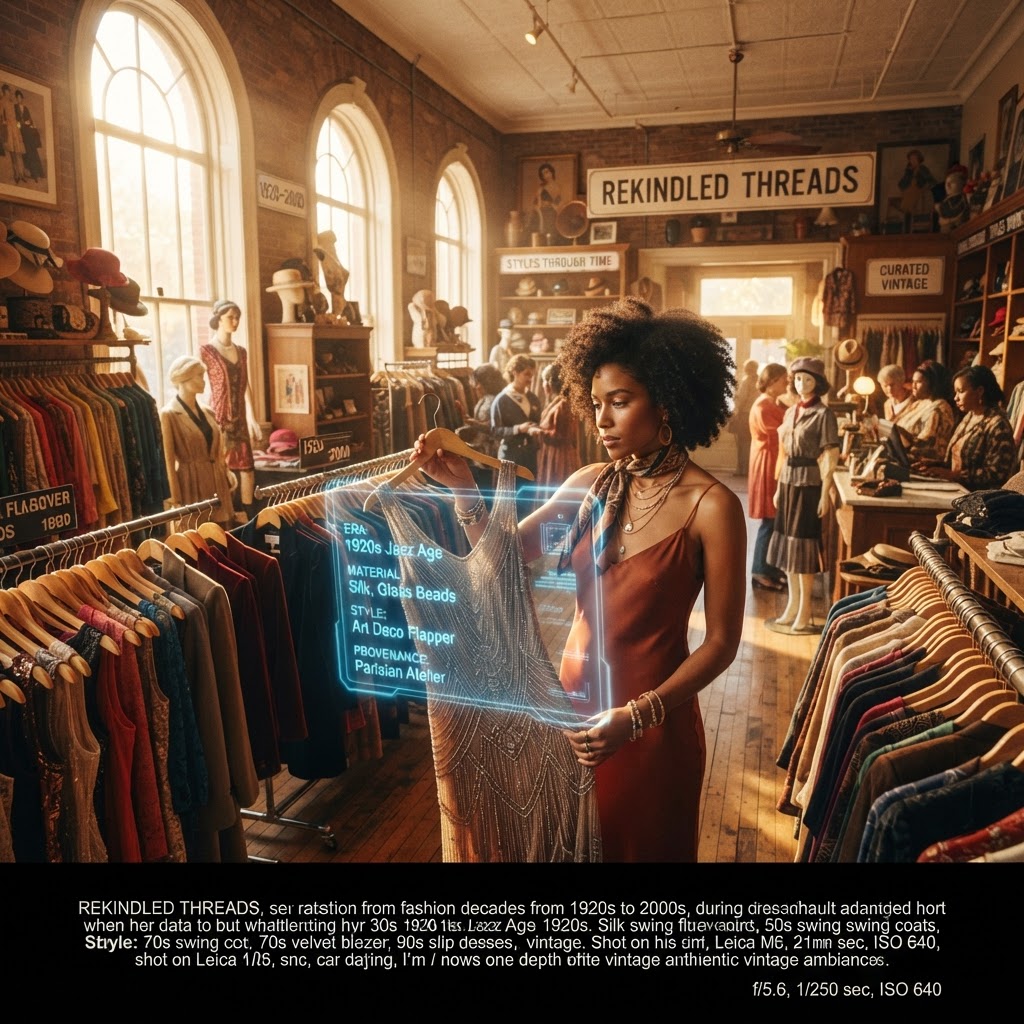
Then there's authentication and dating accuracy. One of the biggest pain points in vintage shopping has always been trust. Is that label genuinely from 1965, or was it sewn in later? AI tools trained on thousands of garment labels, stitching techniques, fabric compositions, and construction methods can cross-reference visual data to provide era verification with remarkable precision. This doesn't replace human expertise — it amplifies it, giving sellers a powerful tool to accurately date their pieces and giving buyers confidence in what they're purchasing.
The Sizing Problem — Finally Solved?
Anyone who has ordered vintage online has a horror story. A "medium" from 1958 bears almost no relationship to a modern medium. Vanity sizing, regional differences, and the sheer variation between decades have made vintage sizing a minefield.
AI-powered marketplaces are tackling this head-on through predictive fit technology. By analyzing a buyer's measurements, their past purchases, and the specific construction details of a listed garment — not just the tag size — these platforms can generate a personalized fit prediction. "This 1962 shift dress will fit like a modern size 8 in the bodice but runs small through the waist" is infinitely more useful than a cryptic tag reading "14½."
This kind of precision doesn't just improve satisfaction rates; it dramatically reduces the environmental waste of returned shipments — a value alignment that matters deeply to the eco-conscious buyers who are drawn to vintage in the first place.
Curation at the Speed of Taste
Beyond search and sizing, AI is reshaping the discovery experience itself. The best vintage marketplaces now use machine learning to understand not just what a buyer has purchased, but what they've lingered over, saved, and passed on. Over time, a platform's recommendations begin to feel less like an algorithm and more like a trusted stylist who truly gets your aesthetic.
This is particularly powerful across the broad sweep of fashion history that vintage encompasses. A buyer obsessed with 1970s bohemian silhouettes needs a fundamentally different curation experience than someone hunting for 1980s power-dressing or the clean minimalism of 1990s Calvin Klein. AI can hold all of those distinct aesthetic universes simultaneously and serve each buyer the version of the past that speaks to them.
Preserving Fashion History, One Listing at a Time
There's a cultural dimension to this technological shift that deserves recognition. Vintage clothing is, in a very real sense, wearable history. A beaded 1920s flapper dress carries within its construction the story of women's liberation, jazz culture, and post-war exuberance. A mod mini dress from 1966 speaks to the seismic social shifts of the Swinging Sixties. When these pieces are mislabeled, lost in algorithmic noise, or priced inaccurately due to lack of knowledge, cultural history slips through our fingers.
AI tools that help sellers accurately identify and describe their pieces aren't just improving commerce — they're preserving material culture. When a seller in rural Ohio can run a photograph of an unlabeled blouse through an AI identification tool and learn that it's likely a late 1930s rayon crepe house brand piece from a regional department store, that information gets attached to the garment permanently. The story travels with the piece to its next owner.
The Human Element Remains Essential
It would be a mistake — and a disservice to the vintage community — to suggest that AI replaces the human expertise, passion, and curatorial eye that has always defined the best vintage dealers. It doesn't. What it does is remove friction and democratize access.
The dealer with forty years of experience handling garments can still provide irreplaceable knowledge. But now, a passionate newcomer selling her grandmother's wardrobe can access tools that help her describe, date, and price those pieces with a level of accuracy that was previously impossible without years of study. AI levels a playing field that has historically been quite steep.
For buyers, this means a more trustworthy marketplace overall — one where the quality of a listing is less dependent on the seller's individual expertise and more consistently reliable across the board.
What Buyers Are Saying
The anecdotal evidence from the vintage community is striking. Shoppers who have experienced AI-assisted platforms consistently report three things: they find what they're actually looking for more quickly, they feel more confident in their purchases, and — perhaps most tellingly — they discover pieces they wouldn't have known to search for. That last point is the magic of genuinely intelligent curation. The best vintage find is often the one you didn't know you needed until it appeared in front of you.
Forums and social communities dedicated to vintage fashion are buzzing with converts. The consensus seems to be that AI doesn't remove the joy of the hunt — it redirects it. Instead of hunting through noise, you're hunting through a beautifully organized archive that keeps revealing new treasures.
The Road Ahead
We're still in the early chapters of AI's relationship with vintage fashion. Emerging capabilities — including augmented reality try-on features calibrated specifically for vintage silhouettes, deeper provenance tracking using blockchain-linked historical records, and AI-generated styling suggestions that pair a 1950s circle skirt with contemporary pieces — suggest that the experience will only deepen and improve.
The vintage market's fundamental appeal — authenticity, history, sustainability, individuality — is perfectly aligned with what thoughtful AI implementation can deliver: more accurate information, more personalized discovery, and more trust between buyers and sellers.
Conclusion
Vintage fashion has always been about more than clothing. It's about connection — to history, to craftsmanship, to a more intentional way of building a wardrobe. The best technology doesn't disrupt that connection; it deepens it.
At Ensemble, we've built our marketplace around exactly this belief. Our AI-assisted platform brings together authenticated vintage pieces spanning the 1920s through the 2010s, with tools designed to help you find the right piece, trust what you're buying, and understand the history you're wearing. Because every garment has a story — and you deserve to know it.