Why Vintage Fashion Buyers Are Turning to AI-Powered Marketplaces (And Never Looking Back)
The thrill of discovering a perfect 1970s wrap dress or an immaculate 1950s swing coat used to mean hours of scrolling through endless, poorly-described listings. Now, AI-powered marketplaces are transforming the vintage fashion hunt into something smarter, faster, and far more satisfying. Here's why buyers across every decade of style are making the switch.
The Old Way of Buying Vintage Was Broken
Anyone who has spent a rainy Sunday afternoon clicking through page after page of online vintage listings knows the particular frustration of the hunt. A blouse listed as "vintage blue top" could be from 1968 or 2008. A coat described as "retro" might be a fast-fashion knockoff from last year. The language of vintage shopping has historically been inconsistent, unreliable, and deeply dependent on the expertise — or lack thereof — of the individual seller.
For decades, serious vintage buyers had two options: develop encyclopedic personal knowledge of fabrics, silhouettes, labels, and construction techniques, or simply accept a high rate of disappointment. Neither option was particularly welcoming to newcomers, and even seasoned collectors regularly encountered misdated, misidentified, or misrepresented pieces.
That's changing — and changing fast.
What AI Actually Brings to the Vintage Marketplace
When people hear "AI-powered marketplace," they often picture cold, algorithmic efficiency stripping away the romance of the vintage hunt. In reality, the opposite is true. Artificial intelligence is restoring the integrity of vintage shopping by doing what human attention often cannot: analyzing thousands of data points simultaneously to accurately identify, date, and describe clothing with remarkable precision.
Modern AI tools can examine the construction details visible in a photograph — the type of zipper, the stitching pattern, the label font, the cut of a collar — and cross-reference them against vast databases of fashion history to pinpoint an era with confidence. A 1940s utility dress stitched under wartime fabric rationing looks measurably different from a 1950s New Look silhouette, and AI is increasingly capable of spotting those distinctions even when a seller cannot.
Beyond authentication, AI improves the search and discovery experience in ways that feel almost intuitive. Natural language search tools let buyers describe what they're imagining — "something with a Halston vibe, fluid, 1970s, earth tones" — and receive genuinely relevant results rather than a wall of keyword-stuffed listings.
The Authentication Problem — and Its Solution
Authenticity has always been the central anxiety of vintage buying. The market has long been shadowed by reproduction pieces sold as originals, by honest misdating, and by the genuine difficulty of distinguishing a well-preserved 1980s designer piece from a contemporary homage.
For high-value items — a Pucci silk blouse from the 1960s, a Halston jersey gown from the 1970s, a Vivienne Westwood punk-era original from the early 1980s — the financial stakes of misidentification are significant. Buyers have historically relied on third-party authenticators, which adds cost, time, and friction to every transaction.
AI-assisted authentication doesn't replace human expertise at the highest levels, but it dramatically raises the baseline quality of the entire marketplace. When every listing is run through an intelligent verification layer before it goes live, the percentage of misrepresented items drops substantially. Buyers develop trust in the platform itself, not just in individual sellers with strong feedback scores.
Decade Literacy: How AI Helps Buyers Learn While They Shop
One of the most underappreciated benefits of AI-powered vintage platforms is their educational dimension. Shopping on a well-designed AI-assisted marketplace is, in itself, a crash course in fashion history.
When a listing explains not just that a jacket is "from the 1960s" but that it reflects the Space Age aesthetic popularized by Pierre Cardin and André Courrèges — the geometric cut, the PVC trim, the mod proportions — buyers leave each transaction knowing more than when they arrived. This kind of contextual richness was previously available only to those who had invested years in self-education or had access to knowledgeable mentors.
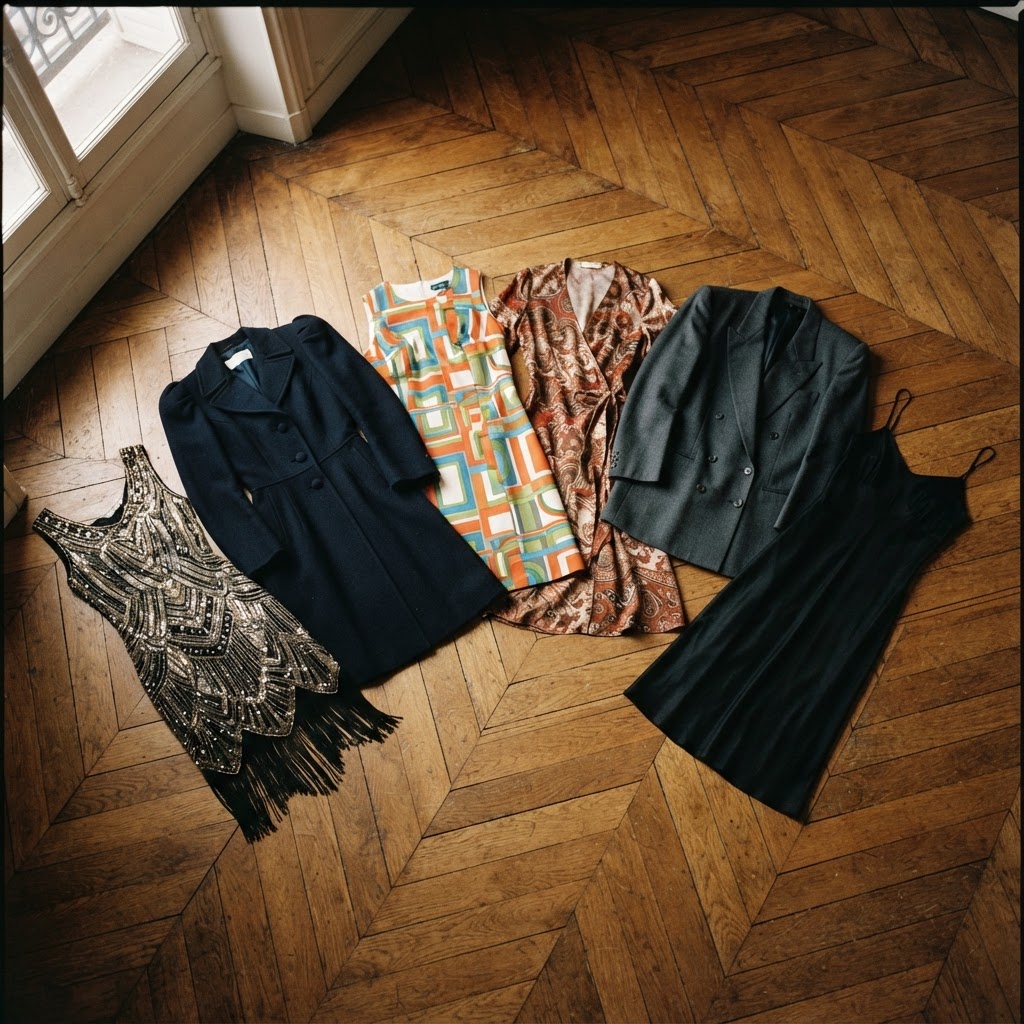
AI can surface those layers of meaning at scale. A 1920s beaded flapper dress becomes not just a garment but a window into the Jazz Age liberation of women's bodies from Victorian constraint. A 1990s grunge flannel tells a story about subcultural resistance and the mainstream co-optation of working-class aesthetics. The clothes carry history, and smart platforms are finally equipped to tell it.
Personalization: Finding Your Decade
Not every vintage buyer is chasing the same era. Some collectors are devoted to the structured elegance of the 1940s and 1950s. Others are drawn to the free-spirited maximalism of the 1970s. A growing community of younger buyers has developed genuine passion for 1990s and early 2000s pieces — what was once considered merely "old" has crossed the threshold into legitimate vintage territory.
AI-powered recommendation engines understand individual taste at a level no human curator could replicate across an entire marketplace. By learning from browsing behavior, saved items, and purchase history, these systems can surface a 1930s bias-cut satin slip dress for the buyer who gravitates toward Old Hollywood glamour, or a 1980s power-shoulder blazer for the collector assembling a statement work wardrobe.
This personalization removes the exhausting noise from the vintage shopping experience and replaces it with something that feels almost like having a knowledgeable friend who knows every item in the marketplace and knows your taste even better than you do.
Sustainability and the AI Advantage
The vintage fashion market sits at the intersection of style and conscious consumption. Buying secondhand is, at its core, an act of environmental responsibility — extending the life of garments that already exist rather than generating demand for new production. But the environmental argument for vintage has sometimes been undermined by the inefficiency of the experience itself: the hours spent searching, the carbon footprint of returns when items are not as described, the waste of poorly matched transactions.
AI-powered marketplaces make sustainable shopping more efficient. Better search means less browsing time. Better authentication means fewer returns. Better personalization means higher satisfaction rates and lower buyer regret. The ecological case for vintage gets stronger when the experience is genuinely good — and AI is making it genuinely good.
The Human Element Isn't Going Anywhere
It's worth being clear about what AI doesn't replace in the vintage marketplace. It doesn't replace the joy of the find — that particular pleasure when something you didn't know you were looking for appears as if it were waiting for you. It doesn't replace the stories that individual sellers bring to their pieces, the provenance details and family histories that turn a garment into an heirloom. And it doesn't replace the deep human hunger for connection to the past that drives vintage collecting in the first place.
What it does is clear the path. It removes the obstacles — the misdating, the poor search, the authentication anxiety, the overwhelming volume — so that the genuinely magical parts of the vintage experience can be reached more easily and more often.
A New Era for an Old Love
Vintage fashion has always been about more than clothing. It's about history, identity, craft, and the belief that something made well deserves to live beyond its original moment. The buyers who are turning to AI-powered marketplaces aren't abandoning that belief — they're finding that technology, used thoughtfully, can honor it more fully than the old tools ever did.
At Ensemble, we've built our marketplace around exactly this understanding. Our AI-assisted platform covers authentic clothing from the 1920s through the 2010s, bringing together the precision of intelligent authentication and search with the warmth of a community that genuinely loves what it does. Whether you're hunting a 1920s Art Deco evening gown or a 2000s Y2K statement piece, Ensemble is designed to make that search smarter, more trustworthy, and more joyful — because the clothes deserve it, and so do you.