Why Vintage Fashion Buyers Are Turning to AI-Powered Marketplaces (And Never Looking Back)
Finding authentic vintage has always been a treasure hunt — but what if the map got a whole lot smarter? AI-powered marketplaces are transforming how collectors and style-lovers discover, verify, and shop for clothing from every decade of the twentieth century. Here's why savvy vintage buyers are embracing the technology revolution without sacrificing an ounce of old-school soul.
The Old Way Was Charming — But Exhausting
For decades, hunting vintage fashion meant weekend pilgrimages to flea markets, hours of scrolling through poorly photographed eBay listings, and the gut-wrenching anxiety of bidding on a "genuine 1940s swing dress" that arrived smelling of fresh dye and disappointment. The thrill of the hunt was real, but so was the friction. Authentication was guesswork. Sizing was a gamble. And finding that specific late-1970s Halston jersey wrap dress in your size, in your budget, in wearable condition? Practically a miracle.
The vintage fashion world has always attracted passionate, knowledgeable buyers — people who can spot a French seam from across a thrift store aisle and identify a label's font change between 1962 and 1965. But passion alone doesn't scale. That's where artificial intelligence is quietly rewriting the rules of how we shop for clothes with history.
What AI Actually Does in a Vintage Marketplace
When most people hear "AI-powered marketplace," they picture cold algorithms stripping away the romance of vintage discovery. The reality is almost the opposite. Done well, AI handles the tedious and technical work so that buyers can focus on the joy of the find.
Here's what modern AI tools are doing behind the scenes:
Smart search and visual recognition allow buyers to upload a photograph — say, a screenshot from a 1985 music video — and instantly surface similar silhouettes, fabrics, and styles from verified inventory. No more fumbling for the right keywords. The technology understands that you want the vibe of that oversized blazer with the shoulder pads, not just items tagged "blazer."
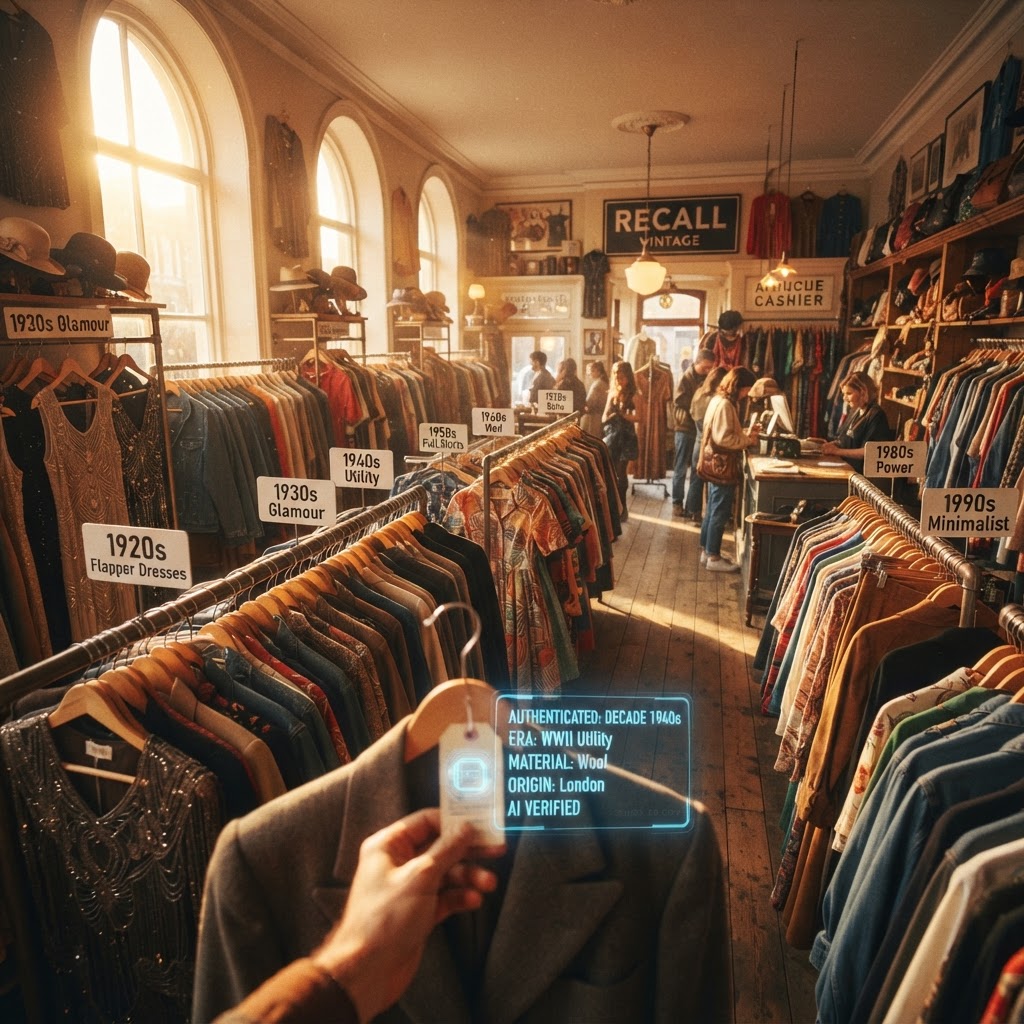
Automated era detection uses details like label typography, stitching patterns, hardware styles, and fabric composition metadata to help verify that a piece genuinely originates from its claimed decade. A system trained on thousands of authenticated garments can flag inconsistencies that even experienced buyers might miss — like a zipper style that wasn't manufactured until a decade after a dress's supposed origin.
Personalized curation learns your taste over time. If you consistently gravitate toward 1960s mod silhouettes in geometric prints, the platform surfaces more of what delights you and less of what doesn't. This kind of recommendation engine transforms endless browsing into something closer to having a personal stylist who actually understands your wardrobe.
Authentication: The Problem AI Is Solving
Counterfeit and misrepresented vintage is a genuine plague in the secondary fashion market. A "vintage" piece mislabeled by even a single decade can mean the difference between a collectible garment worth hundreds of dollars and a mass-market reproduction worth almost nothing. For buyers investing serious money in a 1920s beaded flapper dress or a documented piece of 1990s Versace, authenticity isn't a nice-to-have — it's everything.
Traditional authentication relied entirely on human expertise, which is expensive, inconsistent, and impossible to scale across thousands of daily listings. AI changes this equation dramatically. Machine learning models trained on authenticated archives can analyze high-resolution listing photographs and cross-reference details against decade-specific databases: the exact shade of Union label used between 1959 and 1974, the specific tooth pattern of a 1950s metal zipper, the weave density typical of pre-synthetic 1930s crepe.
This doesn't replace human expertise — the best platforms pair AI screening with expert human review for high-value items. But it creates a powerful first filter that catches misrepresentations early and gives buyers a meaningful layer of confidence before they ever enter their payment details.
Sizing Across the Decades: AI Bridges the Gap
Anyone who has bought vintage clothing knows that sizing labels are essentially decorative. A 1950s size 14 fits nothing like a contemporary size 14. A 1970s "small" can run enormous by modern standards. And pre-1940s clothing often carries no size label at all, just handwritten measurements in French.
This sizing chaos has historically been one of the biggest barriers to buying vintage online. You simply couldn't trust the number on the tag, and without being able to try something on, returns became inevitable.
AI-powered measurement mapping tools are solving this by translating vintage sizing into modern body measurements. Sellers input a garment's actual measurements — bust, waist, hip, sleeve length — and the platform's algorithm automatically generates a contemporary size equivalent and a fit-likelihood score based on the buyer's stored measurements. Suddenly, that 1963 cocktail dress lists not as a cryptic "vintage size 12" but as "fits modern US 6-8, 36" bust, structured boning, minimal ease." Buyers can shop with confidence. Returns drop. Satisfaction rises.
The Curation Problem — And Its Solution
One of the most underappreciated challenges in vintage fashion is the sheer volume of inventory. A well-stocked marketplace might carry tens of thousands of items spanning nine decades of fashion history. Even the most devoted vintage enthusiast cannot meaningfully browse that much clothing. Without intelligent curation, the experience becomes overwhelming rather than joyful.
This is where AI-driven personalization earns its keep most visibly. By analyzing browsing patterns, saved items, purchase history, and even the amount of time a user spends looking at specific listing photographs, a smart marketplace builds an increasingly accurate model of each buyer's aesthetic preferences. The result isn't just "you bought a 1970s piece, here are more 1970s pieces." It's genuinely nuanced: understanding that you love 1970s bohemian but not 1970s disco, that you prefer natural fibers regardless of decade, that you'll stretch your budget for a documented designer piece but want value pricing for everyday vintage basics.
This kind of adaptive curation transforms the vintage shopping experience from a haystack-and-needle problem into something closer to walking into a perfectly edited boutique curated just for you.
Sustainability and the AI Advantage
The vintage market sits at the intersection of fashion and sustainability — buying secondhand is one of the most impactful choices a consumer can make to reduce fashion's environmental footprint. But sustainability only wins if the experience is good enough to compete with the frictionless convenience of fast fashion.
AI-powered platforms are closing that experience gap. When finding an authentic, well-fitting, fairly priced vintage piece becomes as easy as ordering something new, the sustainable choice also becomes the convenient choice. That's a meaningful shift. Friction is the enemy of sustainable consumption, and every AI tool that reduces friction in the vintage buying experience is, in a real sense, an environmental tool as well.
What This Means for the Future of Vintage
The integration of AI into vintage marketplaces isn't a betrayal of the culture — it's an evolution of it. The knowledge, passion, and connoisseurship that have always defined the best vintage buying experiences aren't going anywhere. AI simply removes the barriers that kept those experiences inaccessible to less expert buyers, and gives experts sharper tools to work with.
We're moving toward a world where a first-time vintage buyer can shop with nearly the same confidence as a seasoned collector. Where authentication is transparent and traceable. Where sizing is no longer a leap of faith. Where discovery feels personal and delightful rather than overwhelming.
Finding Your Era at Ensemble
At Ensemble, we've built our marketplace around exactly this vision: authentic vintage clothing from the 1920s through the 2010s, powered by intelligent tools that make every decade's fashion accessible to every kind of buyer. Whether you're chasing a 1940s utility jacket, a 1980s power suit, or a perfectly worn-in 1990s band tee, our AI-assisted search, authentication support, and personalized curation are here to make your vintage journey feel less like a treasure hunt and more like coming home to your own style. The clothes have history. The shopping experience is the future. Welcome to Ensemble.