Vintage, Antique, or Retro? The Fashion Seller's Guide to Getting the Labels Right
If you've ever listed a piece as 'vintage' only to have a buyer question your description, you're not alone. The terms vintage, antique, and retro are tossed around constantly in the fashion world — but they don't mean the same thing. Getting these labels right isn't just about accuracy; it's about building trust, attracting the right buyers, and selling faster.
Why Terminology Matters More Than You Think
In the world of secondhand and collectible fashion, words carry weight. A mislabeled listing doesn't just confuse buyers — it can damage your reputation as a seller, lead to returns, and cost you repeat customers. Whether you're clearing out a grandmother's wardrobe or curating a carefully sourced collection, understanding the difference between vintage, antique, and retro is one of the most valuable tools in your seller's toolkit.
Let's break down each term clearly, explore how they apply across different decades, and give you practical tips for labeling your pieces with confidence.
What Does "Vintage" Actually Mean?
The term vintage is arguably the most misused word in fashion resale. In its truest sense, vintage refers to clothing that is at least 20 years old but generally no more than 100 years old. This means that as of 2024, any authentic garment produced between approximately 1924 and 2004 could technically qualify as vintage.
However, within the fashion and collecting community, most serious buyers and curators apply a slightly stricter standard. Many prefer to use vintage to describe pieces that are at least 25 to 30 years old, which helps distinguish genuinely aged garments from items that are simply used or recently out of style.
For sellers on a platform like Ensemble, this means your 1970s flared trousers, 1980s power-shoulder blazers, and even early 2000s Y2K slip dresses all fall comfortably under the vintage umbrella — provided they are authentic period pieces, not reproductions.
Key characteristics of vintage fashion:
- Made during the era it represents (not a later reproduction)
- Shows signs of age-appropriate wear, construction techniques, and materials
- Often features labels, stitching, and hardware consistent with the period
- Carries cultural or historical significance tied to its decade
What Makes Something "Antique"?
If vintage is the broad category, antique is its elder statesman. In most collecting fields — furniture, jewelry, ceramics — an item must be at least 100 years old to be classified as antique. Fashion follows the same general rule.
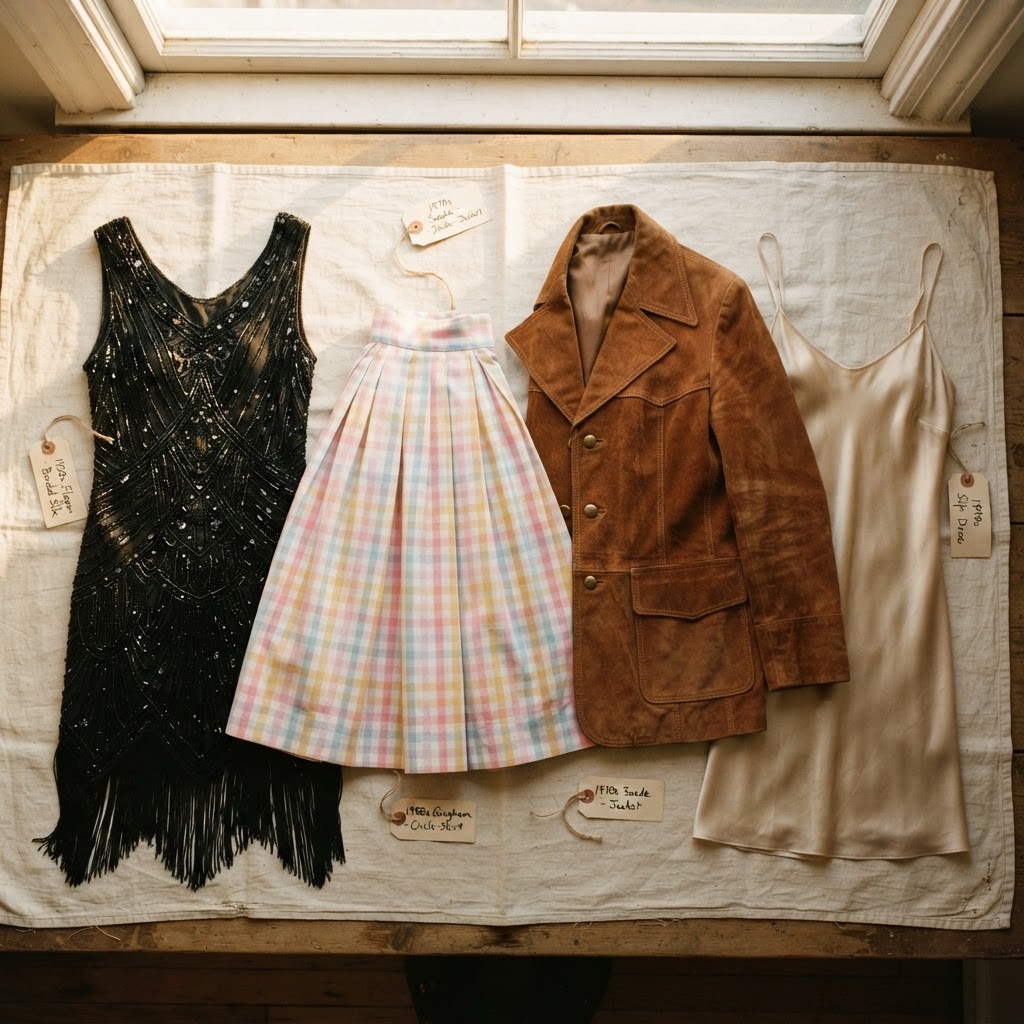
This means that true antique clothing includes garments from the 1920s and earlier. Think hand-sewn Edwardian blouses, beaded 1920s flapper dresses, and Victorian corsets. These pieces are rare, often fragile, and require special care both in storage and in how they're described and sold.
For Ensemble sellers working with pieces from the 1920s — the earliest decade our marketplace covers — you're potentially dealing with antique fashion. This distinction matters enormously to collectors and museum-quality buyers who are looking for historically significant garments.
What to keep in mind when selling antique fashion:
- Provenance matters: Where did the piece come from? Any documentation, photographs, or family history adds significant value.
- Condition is critical: Antique fabrics are delicate. Be honest about fragility, discoloration, or repairs.
- Construction details tell the story: Hand stitching, whalebone, jet buttons, and natural fiber fabrics like silk charmeuse or cotton voile are hallmarks of pre-1930s garments.
- Price accordingly: Antique pieces command higher prices, but only when properly authenticated and described.
So What Is "Retro"?
Here's where many sellers go wrong. Retro is not a synonym for vintage — it's almost the opposite. Retro refers to new or recently made items that are designed to look like they're from an earlier era. A dress sewn in 2020 with a 1950s silhouette and a full circle skirt? That's retro. A leather jacket made last year with 1980s-inspired hardware and a neon lining? Also retro.
Retro is about aesthetic inspiration, not actual age. It's a design philosophy, not a birthdate.
This distinction is crucial for sellers because listing a retro reproduction as vintage is one of the fastest ways to lose buyer trust. Savvy shoppers — especially those spending serious money on collectible fashion — know how to spot a reproduction. They check seam allowances, examine zipper types (metal versus nylon coil), look at care label formats, and assess fabric composition.
Retro vs. Vintage at a glance: | | Vintage | Retro | |---|---|---| | Age | 20–100 years old | New or recent | | Origin | Made in the era it represents | Inspired by a past era | | Value driver | Authenticity and rarity | Style and accessibility | | Buyer expectation | Original period piece | Modern wearability with nostalgic aesthetic |
That said, retro pieces absolutely have a place in the marketplace — just be transparent. Many buyers want the look of the past without the fragility or sizing challenges of true vintage. Label it honestly and you'll find your audience.
Decade-by-Decade Quick Reference for Sellers
Not sure how to categorize what you have? Here's a practical guide based on production decade:
- 1920s: Antique (approaching or exceeding 100 years). Handle with care; document everything.
- 1930s–1940s: Late antique to early vintage. Wartime construction details, utility fabrics, and bias-cut silhouettes are key identifiers.
- 1950s–1960s: Classic vintage. Full skirts, shift dresses, mod geometrics. Highly collectible and in strong demand.
- 1970s: Vintage. Bohemian influences, polyester blends, wide lapels. Check for original designer labels — they add significant value.
- 1980s: Vintage. Power dressing, bold prints, shoulder pads. A booming category with younger buyers entering the market.
- 1990s–early 2000s: Vintage (by the 20–25 year rule). Minimalism, grunge, and Y2K aesthetics. One of the fastest-growing segments right now.
- 2000s–2010s: Borderline vintage. Use discretion — label as "early 2000s" or "2010s era" rather than claiming full vintage status unless the piece is genuinely 20+ years old.
Practical Tips for Labeling Your Listings
Now that you understand the definitions, here's how to put them into practice:
-
Lead with the decade, not just the label. Instead of simply writing "vintage blouse," write "1960s vintage silk blouse" or "authentic 1980s vintage blazer." Specificity builds credibility.
-
Photograph the label. Original garment labels are some of the most compelling proof of authenticity. If your piece has a union label, a country-of-origin tag, or a designer label consistent with the period, photograph it clearly and include it in your listing.
-
Describe construction honestly. Mention zipper type (metal teeth are a strong indicator of pre-1970s pieces), stitching style, and fabric composition if known.
-
Never use "vintage-style" and "vintage" interchangeably. The former signals reproduction; the latter signals the real thing. Conflating them is a credibility killer.
-
When in doubt, describe rather than label. If you're unsure whether a piece qualifies as vintage, describe it by decade and era instead of applying a label you can't fully stand behind.
Conclusion: Labels Build Trust, and Trust Builds Sales
At the end of the day, accurate terminology isn't just about playing by the rules — it's about respecting your buyers and honoring the garments themselves. Each piece of clothing carries history, craftsmanship, and culture. Using the right language is how you communicate that value.
At Ensemble, we believe that great selling starts with great knowledge. Whether you're listing a delicate 1920s beaded gown that borders on antique, a boldly printed 1970s wrap dress, or a thoroughly modern retro reproduction, we give you the platform — and the community — to present your pieces accurately and beautifully. When sellers get the language right, everyone wins: buyers find exactly what they're looking for, and sellers build the kind of reputation that turns first-time buyers into lifelong customers.
So the next time you're writing a listing, pause for a moment. Is it vintage, antique, or retro? Now you know exactly how to tell the difference.