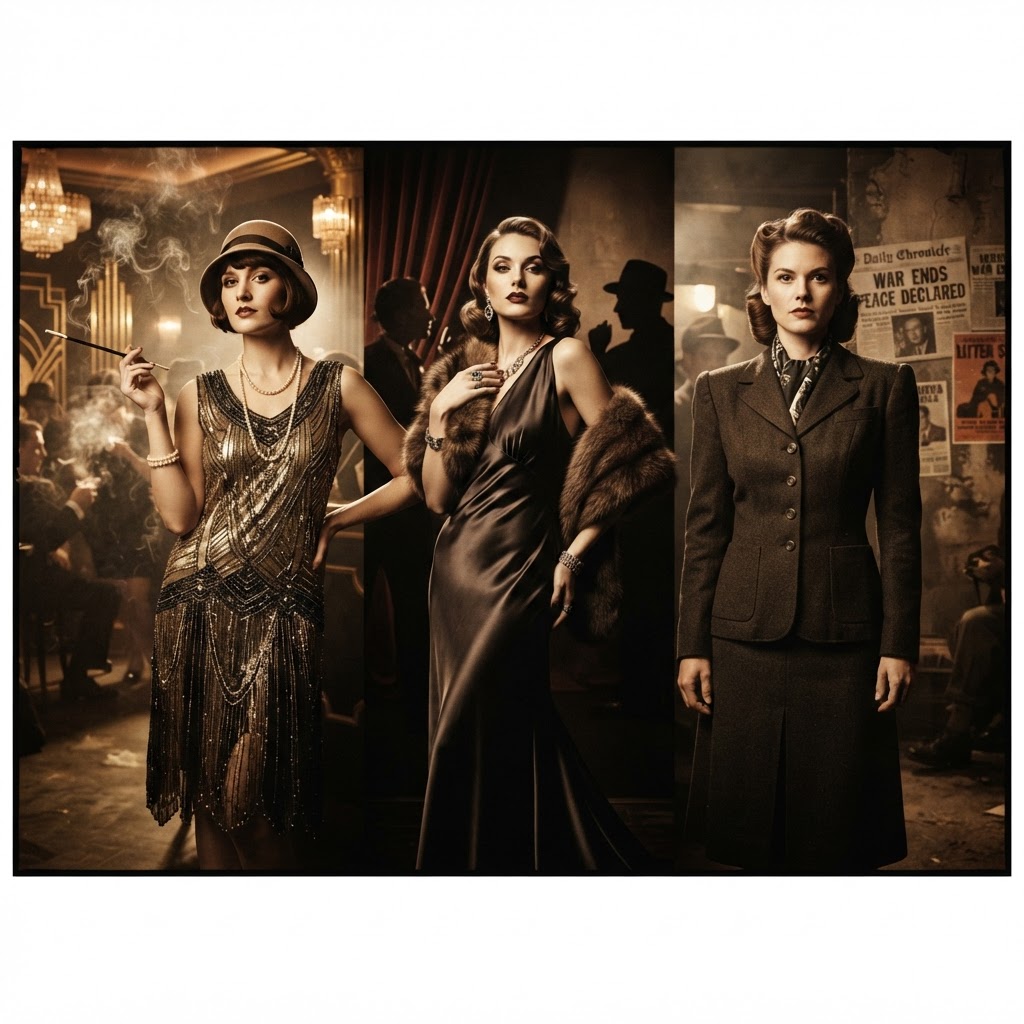
Threads Through Time: The Cultural Significance of 1920s–1940s Fashion and What It Tells Us Today
From the liberated hemlines of the Jazz Age to the utility-driven silhouettes of World War II, the fashion of the 1920s through 1940s tells a story far deeper than style. These decades were defined by seismic cultural shifts — and the clothes people wore were their loudest declarations. Understanding this history doesn't just make you a better vintage seller; it makes you a better storyteller.
The Roaring Twenties: Fashion as Liberation
When the 1920s arrived, they didn't just bring new hemlines — they brought an entirely new idea of what a woman could be. The flapper aesthetic wasn't simply a trend; it was a revolt. After the constraints of Victorian and Edwardian dress, with their corsets, long skirts, and rigid silhouettes, the dropped waistlines and knee-grazing hems of the 1920s were nothing short of revolutionary.
Women had just won the right to vote in the United States in 1920, and the fashion of the decade mirrored that shift in power. The boyish silhouette — flat-chested, narrow-hipped, and free — rejected the exaggerated feminine curves that had defined earlier eras. This wasn't an accident. It was a statement: women were stepping into public life, into speakeasies, into jazz clubs, and into the workforce, and they needed clothes that moved with them.
Key pieces from this era carry enormous cultural weight. The beaded evening dress, often made from silk charmeuse or chiffon and adorned with intricate Art Deco beadwork, represented both the prosperity of the era and its appetite for glamour. The cloche hat, hugging the head low over the brow, became a symbol of the modern woman. Even T-strap heels and long pearl necklaces weren't just accessories — they were the punctuation marks of a new identity.
For vintage sellers, understanding this context transforms how you describe and price these pieces. A 1920s beaded dress isn't just old clothing — it's a artifact of emancipation.
The Art Deco Influence: When Fashion Met Architecture
Running parallel to the social revolution of the 1920s was an aesthetic one. Art Deco — with its bold geometric patterns, symmetrical designs, and luxurious materials — saturated every corner of design culture, from the Chrysler Building to cigarette cases to evening gowns.
In fashion, this translated to geometric embroidery, angular beading patterns, and the use of lavish materials like lamé, velvet, and exotic feathers. Designers like Coco Chanel and Madeleine Vionnet were rewriting the rules of construction, with Vionnet's bias-cut technique creating garments that draped the body in an entirely new way.
When you're sourcing or selling pieces from this era, look for these hallmarks: zigzag or chevron beading, Egyptian Revival motifs (fueled by the 1922 discovery of Tutankhamun's tomb), and the characteristic dropped waist. Authenticity in construction — hand-sewn seams, glass beads rather than plastic, silk rather than synthetic — is a strong indicator of genuine 1920s provenance.
The 1930s: Elegance Under Pressure
If the 1920s were about liberation, the 1930s were about endurance. The Great Depression reshaped fashion in profound ways. Extravagance gave way to a quieter, more refined elegance. Hemlines dropped again — not as a return to Victorian constraint, but as a practical and psychological response to uncertainty. Longer, more modest silhouettes felt appropriate for hard times.
Yet paradoxically, Hollywood glamour reached its zenith in this decade. The bias-cut gown, perfected by designers like Vionnet and worn by silver screen icons like Jean Harlow and Greta Garbo, became the defining look of 1930s eveningwear. These gowns — typically made from silk satin or crepe — clung to the body's natural curves, a stark contrast to the flapper's deliberate shapelessness.
Daywear told a different story. Printed cotton house dresses, wide-leg trousers, and practical wool suits reflected the reality of a population making do. The era also saw the rise of sportswear as a legitimate fashion category, with Chanel championing jersey and casual separates for women who were increasingly active outside the home.
For sellers, 1930s pieces offer a compelling narrative: the tension between aspiration and austerity. A silk bias-cut dress represents the dream; a well-worn cotton housedress represents the reality. Both are historically significant, and both deserve to be framed within their economic context.
The 1940s: Utility as Aesthetic
World War II didn't just affect what people wore — it dictated it. Wartime rationing meant that fabric, metal, and leather were all restricted for civilian use. In the United States, the War Production Board's L-85 regulations of 1942 limited the amount of fabric that could be used in women's clothing. Skirts were shortened and narrowed, pleats were banned, and hems were regulated.
The result was a silhouette defined by sharp shoulders, nipped waists, and straight skirts — practical, structured, and unmistakably of its moment. The military influence was everywhere: epaulettes, structured lapels, utility pockets, and strong shoulder lines gave women's fashion a purposeful, even martial quality.
This wasn't experienced as deprivation by everyone. Many women embraced the utility aesthetic with creativity, customizing plain garments with embroidery, fabric paint, and repurposed materials. Rayon replaced silk (which was needed for parachutes), and platform shoes surged in popularity partly because they used less leather than traditional heels.
Men's fashion was similarly constrained. The zoot suit — with its oversized jacket and high-waisted, wide-legged trousers — was a deliberate act of rebellion against wartime restrictions, and was worn predominantly by young Black and Latino men as a assertion of identity and resistance. The government literally declared the zoot suit unpatriotic, and its wearers faced violent backlash in the Zoot Suit Riots of 1943. Few garments in American history carry as charged a political history.
For vintage sellers, 1940s pieces reward careful study. Look for the characteristic shoulder structure, label-reading for wartime manufacturers, and the substitution materials that mark the era. These details aren't flaws — they're historical fingerprints.
What These Decades Tell Us Today
Fashion has always been a mirror. The 1920s through 1940s compressed an extraordinary amount of social change into a short span of time, and clothing absorbed every shock: suffrage, prosperity, depression, war, resistance, and resilience.
Today, as conversations about sustainable fashion and conscious consumption reshape the industry, vintage clothing from these decades carries renewed relevance. These garments were made to last — from the hand-rolled hems of a 1930s bias-cut gown to the sturdy wool of a 1940s utility suit. They represent a pre-fast-fashion ethos that modern buyers increasingly crave.
There's also a growing cultural appetite for authenticity and narrative. Buyers aren't just purchasing a dress — they're purchasing a piece of lived history. As a seller, your job is to surface that story. Who might have worn this? What was happening in the world when it was made? What does the construction tell us about the era's constraints and values?
Seller Tips: How to Apply This Knowledge
1. Research before you list. Use construction details, labels, silhouette, and materials to accurately date your pieces. A well-dated listing builds buyer trust and commands better prices.
2. Tell the story. Don't just describe what a garment looks like — describe what it means. Connect it to the cultural moment it came from. Buyers are investing in history, not just fabric.
3. Photograph with context. Styling your 1930s bias-cut gown with period-appropriate accessories, or shooting your 1940s utility suit against a moody, wartime-era backdrop, helps buyers feel the era.
4. Be honest about condition. Pieces this old will show age. Frame wear honestly and within context — a stress mark on a 1920s beaded dress is evidence of a century of life, not a defect.
5. Price with knowledge. Understanding the cultural and historical significance of what you're selling gives you the confidence to price appropriately. Rare, well-preserved pieces from this era are genuinely scarce and should be valued accordingly.
Conclusion
The fashion of the 1920s through 1940s isn't just vintage — it's a visual archive of some of the most turbulent and transformative decades in modern history. Every beaded hem, bias-cut seam, and utility-stitched shoulder tells a story that resonates deeply with the world we're living in now.
At Ensemble, we believe that the best vintage marketplaces are also the best history classrooms. When you list your pieces here, you're not just selling clothing — you're preserving culture, one garment at a time. Dive deep into the history, bring that knowledge to your listings, and you'll find that the right buyers aren't just shopping. They're connecting.