Threads of Time: What 1920s–1940s Fashion Still Tells Us About Who We Are
From the liberated hemlines of the Jazz Age to the resourceful silhouettes of the wartime forties, the fashion of three transformative decades reveals far more than mere style. These garments were declarations — of freedom, identity, resilience, and reinvention. Understanding them isn't just a history lesson; it's a mirror held up to our own moment.
The Roaring Twenties: Fashion as Liberation
When the 1920s arrived, they did not knock politely. The decade exploded onto the cultural stage with jazz, speakeasies, and a generation of young people determined to shed the constraints of the Victorian and Edwardian eras that had come before. Nowhere was this rupture more visible — or more radical — than in what people chose to wear.
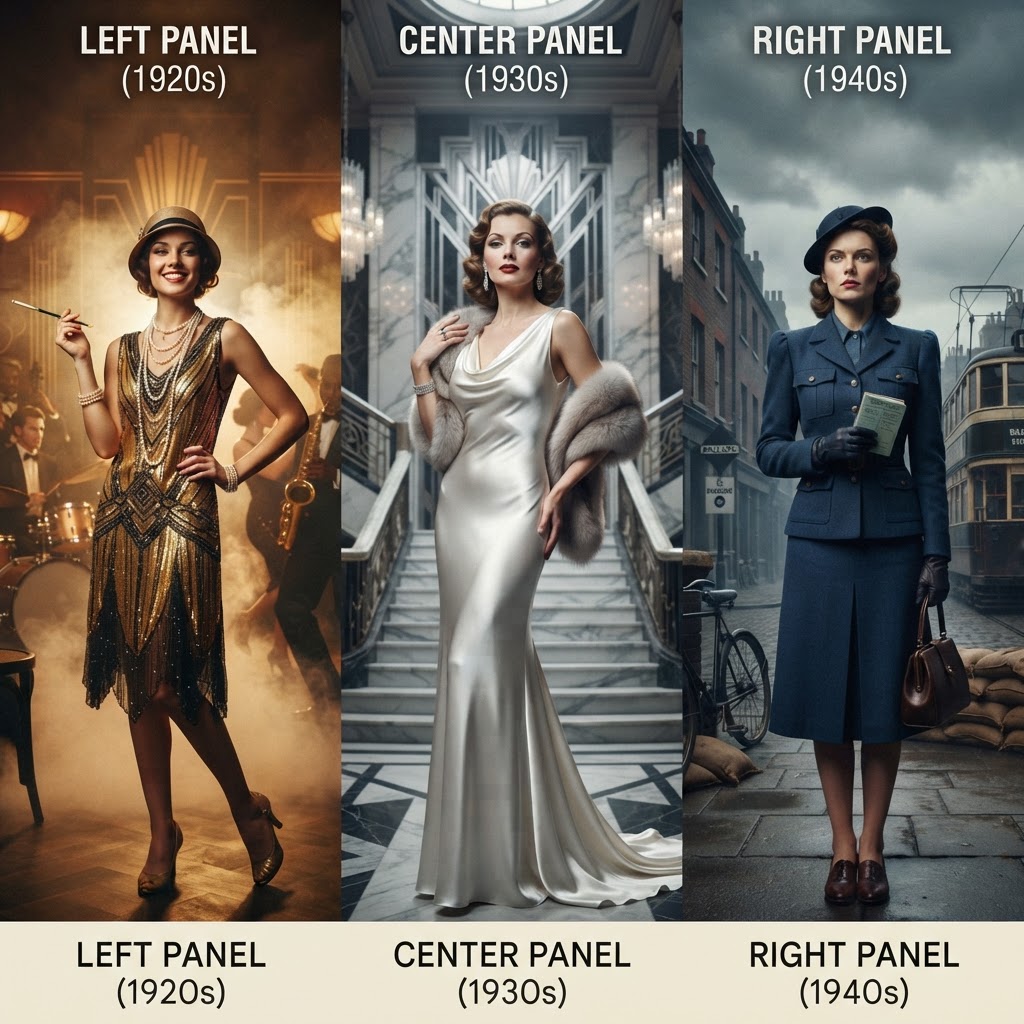
The most iconic silhouette of the decade was the flapper dress: dropped waist, shortened hemline, loose bodice, and an overall rejection of the corseted hourglass figure that had defined femininity for generations. This was not accidental. Women who wore these dresses were making an explicit statement about bodily autonomy and social freedom. The hemline, rising scandalously to the knee, became a kind of cultural thermometer measuring just how much society was willing to change.
The garçonne look — derived from a controversial 1922 French novel about an independent woman — celebrated androgyny, with bobbed hair, flattened chests, and straight cuts that deliberately blurred gender lines. In an era when women in the United States had only just won the right to vote in 1920, choosing to dress in ways that defied conventional femininity was an act of quiet but profound rebellion.
Accessories, too, carried meaning. Long pearl necklaces, cloche hats, and T-strap heels weren't simply ornamental — they signaled membership in a new social class of women who went out, who danced, who earned wages and spent them on themselves. Fashion had become a language of independence.
What does this tell us today? In an era when debates about gender expression, body autonomy, and personal identity still dominate cultural conversations, the flappers remind us that clothing has always been a frontline of social negotiation. When we reach for a vintage 1920s drop-waist dress, we're not just wearing history — we're wearing someone's courage.
The Thirties: Depression-Era Elegance and the Art of Making Do
If the twenties were about excess and liberation, the Great Depression of the 1930s demanded something different: ingenuity, restraint, and a kind of dignified beauty born of necessity. The economic collapse that began with the 1929 stock market crash forced the fashion world — from haute couture houses in Paris to home seamstresses in rural America — to fundamentally rethink what clothing could and should be.
Paradoxically, the thirties produced some of the most breathtaking fashion of the twentieth century. Bias-cut gowns, championed by French designer Madeleine Vionnet and immortalized by Hollywood stars like Jean Harlow and Greta Garbo, used the diagonal grain of the fabric to create garments that clung and flowed simultaneously, achieving sculptural elegance with minimal material. The bias cut was, in its way, a feat of Depression-era problem-solving: maximum beauty from minimum waste.
Hollywood's Golden Age played an enormous role in shaping thirties fashion. At a time when millions of Americans could not afford new clothes, the cinema offered a weekly dose of visual fantasy. Costume designers like Adrian and Travis Banton created looks so iconic that women would bring photographs to their local seamstresses and ask for homemade approximations. Fashion democratized itself through aspiration and imitation.
The thirties also saw the rise of sportswear as everyday clothing — casual, practical separates that could be mixed and matched — a concept that feels strikingly contemporary today. Designers like Claire McCardell began laying the groundwork for American ready-to-wear fashion, prioritizing comfort and versatility over ceremony.
The lesson here is one of creative resilience. When resources are scarce, human ingenuity doesn't disappear — it intensifies. The gorgeous, carefully constructed garments of the 1930s are testaments to what people can achieve when they refuse to let hardship diminish beauty.
The Forties: Utility, Sacrifice, and Unexpected Subversion
World War II reshaped virtually every aspect of daily life, and fashion was no exception. Across the United States, Britain, and occupied Europe, governments imposed wartime rationing on fabric and materials, restricting the amount of cloth that could be used in civilian clothing. The results were silhouettes defined by necessity: shorter skirts, narrower shoulders, fewer pleats, limited ornamentation.
In the United States, the L-85 regulations issued by the War Production Board in 1942 strictly governed garment construction. Cuffs, patch pockets, and full skirts were restricted. Yet American designers — and the women who wore their clothes — found ways to make utility feel elegant. The tailored suit, with its clean A-line skirt and structured jacket, became the defining look of the decade: sharp, capable, ready for a world in which women were filling factory floors, driving ambulances, and running households alone.
Perhaps the most quietly subversive fashion story of the forties belongs to women of color and working-class women who used clothing as a form of resistance and identity. The zoot suit, worn predominantly by young Mexican-American and African-American men, was an act of direct defiance against wartime rationing regulations and the cultural erasure that accompanied them. The oversized, high-waisted trousers and long draped jacket consumed far more fabric than the law technically permitted — and that was precisely the point. In 1943, the Zoot Suit Riots in Los Angeles demonstrated how powerfully a garment could provoke those in authority, and how deeply clothing is bound up with race, power, and belonging.
Meanwhile, women at home developed the art of make do and mend — repairing, repurposing, and reimagining garments rather than discarding them. Old curtains became skirts. Men's suits were taken apart and rebuilt as women's jackets. This ethos of care and reuse feels urgently relevant in our current era of fast fashion and environmental reckoning.
What These Decades Still Teach Us
Looking across these three transformative decades — the liberated twenties, the resilient thirties, the utilitarian forties — several powerful themes emerge that resonate with striking clarity today.
First, fashion is never just fashion. Every hemline, every silhouette, every fabric choice exists within a social, economic, and political context. The women who shortened their skirts in 1923 and the young men who wore oversized zoot suits in 1942 understood this intuitively. Clothing is one of the most immediate and personal ways human beings communicate who they are and what they stand for.
Second, constraint breeds creativity. Some of the most beautiful and innovative fashion of the twentieth century emerged not from abundance but from limitation. The bias-cut gowns of the Depression and the tailored suits of the wartime forties remind us that creativity flourishes when it must.
Third, vintage clothing carries living history. When you hold a thirties bias-cut dress or a forties utility suit in your hands, you are holding a physical artifact of someone's life — their aspirations, their daily realities, their acts of beauty and resistance. That weight is irreplaceable.
Finally, sustainability is not a new idea. The make-do-and-mend philosophy of the 1940s is simply good sense, dressed in period-appropriate clothing. Choosing vintage over new is a decision that honors both history and the future.
Discover These Stories at Ensemble
At Ensemble, we believe that every vintage garment is a chapter in a larger story — one worth reading, wearing, and preserving. Our curated marketplace brings together authentic clothing from the 1920s through the 2010s, allowing you to connect with the cultural moments that shaped the world you inhabit today. Whether you're drawn to the daring freedom of a Jazz Age flapper dress, the sculpted elegance of a Depression-era bias cut, or the sharp utility of a wartime suit, Ensemble is where those stories find new life. Browse our collection and wear history with intention.