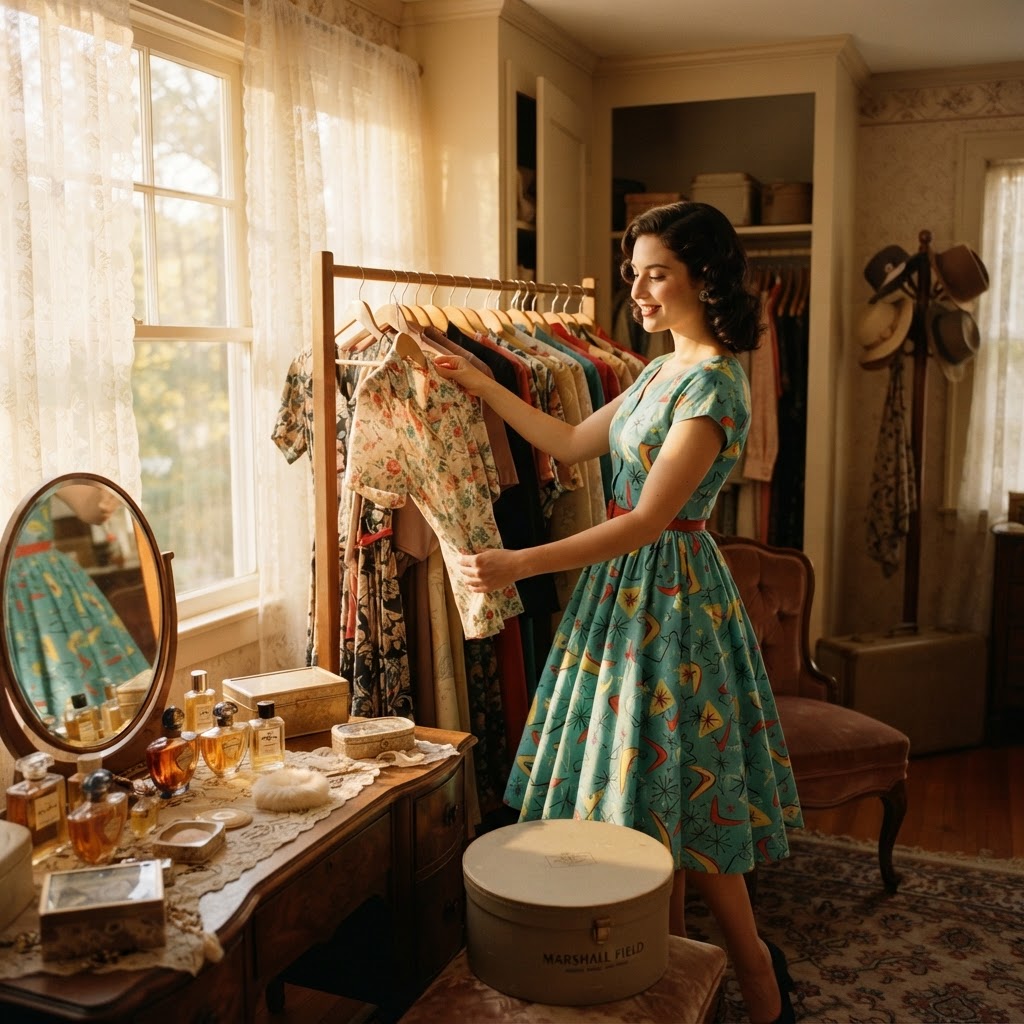
Real Deal or Reproduction? How to Identify Authentic 1950s Vintage Clothing
The poodle skirt era is having a major moment, but the surge in popularity has flooded the market with convincing modern reproductions. Before you invest in a piece of mid-century history, you need to know exactly what to look for. Here's your definitive guide to spotting the genuine article.
Why the 1950s Are So Hard to Fake — and So Easy to Get Wrong
The 1950s represent one of the most romanticized decades in fashion history. Full circle skirts, structured bodices, swing coats, and wiggle dresses have never really gone out of style — which means manufacturers have been reproducing them for decades. The result? A saturated vintage market where even seasoned shoppers can be fooled. Whether you're hunting for a party dress, a day suit, or a classic shirtwaist, knowing how to separate authentic 1950s vintage from a modern reproduction can save you money, heartbreak, and a whole lot of second-guessing.
Start With the Label — It Tells You Everything
The garment label is your first and most powerful clue. In the 1950s, labeling conventions were very different from today's.
Union labels are a golden ticket. The ILGWU (International Ladies' Garment Workers' Union) label is one of the most reliable authenticators for American-made pieces. The specific design of the ILGWU label changed over the decades — the version used from 1952 to 1959 features a particular font and layout that collectors have documented extensively. If you see this label, cross-reference its design with known examples online.
Care instruction labels are another dead giveaway. The FTC didn't require permanent care labels in American clothing until 1971. If a dress claims to be from the 1950s but has a sewn-in label reading "Machine Wash Cold" or "Dry Clean Only," it's almost certainly a reproduction or a later decade piece. Authentic 1950s garments either have no care label at all, or a simple paper hang tag that has long since disappeared.
Country of origin labeling became mandatory in the U.S. in 1971 as well. A label reading "Made in USA" on a sewn-in permanent tag suggests post-1971 manufacture. Pre-1971 American pieces often had the country of origin on a separate paper tag or not at all.
Fabric content labels weren't required until the Textile Fiber Products Identification Act of 1960. So a dress with no fiber content label could plausibly be from the late 1950s or earlier — but the absence alone isn't confirmation.
Examine the Fabric Itself
The textiles of the 1950s have a character that modern fabrics struggle to replicate authentically.
Nylon, rayon, and early acetate were the synthetic darlings of the era. These materials have a particular drape and sheen that differs subtly from their modern counterparts. Genuine 1950s rayon, for instance, often has a slightly heavier, more fluid quality than contemporary rayon blends. Hold the fabric up to light — older synthetics often have a distinctive luminosity.
Cotton was king for daywear. Authentic 1950s cotton shirtwaist dresses are typically made from a tightly woven, medium-weight cotton with a slight crispness — not the thin, almost translucent cotton used in many modern reproductions. Run your fingers over the weave. Does it feel substantial? Does it have a natural irregularity that mass-produced modern fabric lacks?
Look for original novelty prints. Atomic age motifs — boomerangs, starbursts, abstract geometric shapes — were enormously popular. Authentic prints from this era were screen-printed and may show very slight misregistration or color bleeding at close inspection. Modern digital reproductions of these prints are almost eerily perfect and uniform.
Construction Details Don't Lie
How a garment is put together is one of the most reliable indicators of its age.
Seam finishing in the 1950s was typically done with pinked edges, hand overcasting, or Hong Kong seams (bias tape bound edges). The modern serged or overlocked seam finish wasn't widely used in home sewing or ready-to-wear until the late 1960s and beyond. Turn that dress inside out — if you see clean, modern serging, be skeptical.
Zipper types are a fantastic dating tool. The metal zipper was standard through the 1950s. Look for zippers by brands like Talon or Conmar. These zippers have a specific weight and tooth size. Nylon coil zippers didn't become dominant until the 1960s. If a supposedly 1950s piece has a nylon zipper, it's either a later garment or a replacement zipper was installed at some point.
Hand stitching appears frequently in authentic 1950s garments, even in ready-to-wear. Hems were often hand-stitched with a blind hem stitch. Check the hem allowance — it was typically generous, 1.5 to 2 inches deep, reflecting an era when clothing was meant to be let out and altered rather than discarded.
Boning and structure in 1950s evening and cocktail dresses were architectural achievements. Authentic pieces often feature spiral steel boning, horsehair braid (crinoline) in hems, and built-in boning channels that are machine-stitched on the inside. Modern reproductions often substitute plastic boning, which is lighter and less rigid.
Sizing Will Surprise You
One of the fastest reality checks is vintage sizing. 1950s sizing ran dramatically smaller than modern sizing — and even smaller than the vintage sizing from the 1970s and 1980s. A dress labeled "14" from 1955 typically corresponds to a modern size 8 or even 6. If you find a 1950s-style dress labeled "14" that fits like a contemporary size 14, something doesn't add up.
Measure the garment rather than trusting labels. Authentic 1950s dresses typically have defined waists measuring 24–28 inches for the most common sizes found on the market today, with a corresponding hip measurement 8–10 inches larger.
Signs of Genuine Age and Wear
Authentic age leaves traces that are difficult to fake convincingly.
Underarm discoloration from aluminum-based deodorants and perspiration creates a distinctive yellowish staining pattern that's hard to replicate. Fading patterns on printed fabrics follow the natural path of light exposure — typically most faded at the shoulders and back neckline. Fabric stress points show tiny pulls or slight thinning at seam allowances and stress points like the underarm gusset.
Look at the snap fasteners and hooks and eyes. Original 1950s closures are often slightly tarnished or show a patina. Modern reproductions use bright, shiny closures that look factory fresh.
Watch Out for These Red Flags
- Spandex or Lycra content — these didn't exist in the 1950s
- Velcro closures — not invented for consumer use until the late 1960s
- Printed care symbols (the universal laundry symbols) — a post-1971 development
- Polyester — not in mainstream garment production until the mid-1960s
- Sizing labels that read XS, S, M, L, XL — this convention came much later
Building Your Eye Over Time
The single best way to become a confident authenticator is handling as many confirmed pieces as possible. Visit museum costume collections, attend reputable vintage fairs, and buy from established dealers who can speak to a garment's provenance. The more authentic 1950s clothing you hold in your hands, the more instinctively you'll recognize when something feels off.
Photograph labels, construction details, and fabric closeups for your own reference archive. Over time, patterns emerge that no written guide can fully convey — the specific way a Talon zipper pull catches the light, the particular hand of a 1955 cotton print, the satisfying weight of a fully-boned strapless bodice.
Find the Real Thing at Ensemble
At Ensemble, every piece listed in our 1950s collection is vetted by experts who know exactly what to look for. We believe that authentic vintage isn't just about aesthetics — it's about connecting with a real moment in fashion history. Our sellers provide detailed photographs of labels, construction, and condition so you can shop with confidence. Whether you're building a serious collection or searching for one perfect piece to wear, Ensemble is where the genuine article lives.