Mod Squad: The Untold Story of 1960s Mod Fashion and Why It Still Rules the Runway
Few style movements have cut as cleanly through fashion history as the mod revolution of the 1960s. Born in the boutiques of London's Carnaby Street and King's Road, mod fashion rewrote the rules of dressing — and decades later, its geometric lines, bold colors, and youthful energy refuse to fade. Here's everything you need to know about where it came from, what it meant, and why you're still seeing it everywhere.
The Birth of a Movement
To understand mod fashion, you have to understand the world it was rebelling against. The 1950s had given Western culture a rigid sartorial code: tailored suits for men, nipped-waist dresses for women, and a general expectation that clothing communicated respectability and conformity. Then came the 1960s — and with it, a generation of young people who had no interest in dressing like their parents.
The word mod is shorthand for modernist, a term originally applied to a British youth subculture obsessed with modern jazz, Italian scooters, and sharp continental tailoring. By the early 1960s, the movement had evolved into something far more visually explosive. Clustered around Carnaby Street in Soho and the King's Road in Chelsea, a new breed of boutiques began catering exclusively to young people hungry for something fresh, irreverent, and boldly contemporary.
The Designers Who Defined the Decade
No conversation about mod fashion is complete without Mary Quant. The Welsh-born designer opened her boutique Bazaar on the King's Road in 1955, and by the early 1960s she had become the high priestess of the movement. Her signature contribution? The miniskirt — a hemline so radical it was practically a political statement. Quant herself famously said she named the style after her favorite car, the Mini, because both represented the spirit of freedom and fun.
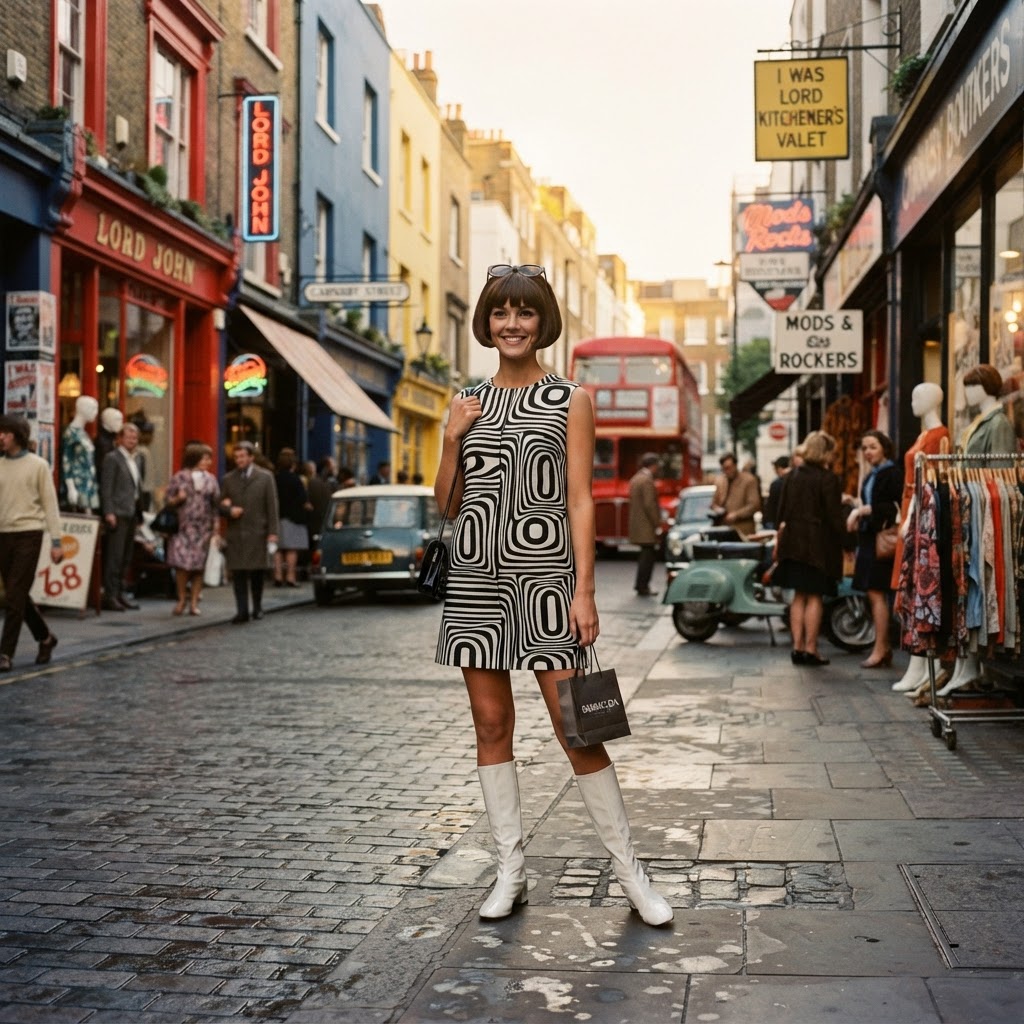
Across the Channel, André Courrèges was arriving at similar conclusions from a different angle. His 1964 Space Age collection introduced geometric silhouettes, white go-go boots, and a futuristic aesthetic that looked like it had been beamed in from another decade entirely. Meanwhile, Paco Rabanne was experimenting with chainmail dresses and plastic disc garments that seemed more architecture than clothing.
In London, boutiques like Biba (founded by Barbara Hulanicki) added a slightly darker, more romantic take on mod — think deep berry tones, art nouveau lettering, and a theatrical glamour that attracted everyone from Mick Jagger to Twiggy. Speaking of whom: no figure embodied the mod ideal more completely than Twiggy, the pixie-cropped, doe-eyed model from Neasden whose androgynous frame and wide-eyed look became the defining face of an era.
The Visual Language of Mod
Mod fashion had a very specific visual vocabulary, and once you learn to read it, you see it everywhere.
Geometric shapes were paramount. A-line skirts and dresses, boxy jackets, and shift dresses replaced the organic, body-hugging curves of 1950s fashion with clean, architectural lines. The silhouette was young, almost childlike — a deliberate rejection of grown-up sophistication.
Bold, graphic prints were equally essential. Op art — the optical illusion-driven fine art movement pioneered by Bridget Riley — translated almost perfectly into fabric. Black-and-white checkerboard patterns, bold stripes, and dizzying concentric circles appeared on everything from minidresses to tights. The fashion world and the art world had never been so openly in conversation.
Color played a starring role. While early mod skewed toward monochrome, the movement quickly embraced vivid, saturated hues: electric orange, acid yellow, cobalt blue, and hot pink. These weren't the muted pastels of the previous decade — they were colors designed to be seen, to announce your presence, to stake a claim on the future.
Materials mattered too. Mod designers embraced PVC, patent leather, and synthetic fabrics that would have been considered tacky by the establishment — which was precisely the point. The shimmer of a plastic raincoat or the squeak of a vinyl boot was a small act of transgression.
The Cultural Ecosystem
Fashion never exists in a vacuum, and 1960s mod style was deeply embedded in a broader cultural explosion. The British Invasion brought the Beatles, the Rolling Stones, and the Kinks to global audiences, and their tailored-but-rebellious look — slim-cut suits, Chelsea boots, mop-top haircuts — became a male counterpart to the miniskirt moment. Television amplified everything: programs like Ready Steady Go! broadcast the latest London looks into living rooms across Britain and America every Friday night.
The Twiggy effect can't be overstated. When she landed in New York in 1967 and was mobbed at the airport like a rock star, mod fashion officially went global. American department stores scrambled to stock their shelves with geometric dresses and white go-go boots. The look had escaped its London incubator.
Mod culture also had a democratic, DIY spirit that distinguished it from the haute couture world. Boutique prices were accessible to young working women with their own paychecks — a relatively new phenomenon. Fashion, for perhaps the first time, was genuinely being designed by young people for young people.
The Legacy: Mod Never Really Left
The strict mod moment burned bright and fast. By the late 1960s, psychedelia and hippie aesthetics had begun to pull fashion in a looser, earthier direction. But mod's influence didn't disappear — it went underground, resurfacing again and again in ways both obvious and subtle.
The 1980s saw a full-blown mod revival, driven partly by the Two Tone ska movement and bands like The Jam and Madness, whose sharp suits and scooter imagery were consciously nostalgic. In the 1990s, Britpop brought another wave of retrospection — Oasis and Blur wrapped themselves in Union Jacks and wore their Carnaby Street references openly.
On the runway, mod's geometric DNA has never fully disappeared. Miuccia Prada has returned to op art prints and A-line silhouettes repeatedly throughout her career. Nicolas Ghesquière at Louis Vuitton has mined the Space Age aesthetic for multiple collections. Marc Jacobs has riffed on Biba's dark glamour more than once. The shift dress — the most essential mod garment — is a perennial presence in every contemporary wardrobe conversation.
Street style tells the same story. Mod's core proposition — that clothing should be fun, graphic, youthful, and unapologetically bold — aligns perfectly with the maximalist tendencies of contemporary dressing. The mod girl's formula of a geometric minidress, block-color tights, and sculptural shoes could walk out of a 1966 Vogue editorial and onto a 2024 Instagram grid without skipping a beat.
How to Wear It Now
The beauty of authentic vintage mod pieces is that they're built to last — both literally and stylistically. A well-preserved shift dress from the mid-1960s in a bold op art print is a complete outfit in itself. Pair it with kitten heels or white ankle boots and you're done. A Biba-era maxi skirt in a deep jewel tone layers beautifully over a fitted turtleneck for a look that reads as thoroughly modern. Early mod-era tailoring — boxy blazers, slim-leg trousers in bold colors — integrates seamlessly into contemporary wardrobes that prize clean lines and confident color.
The key is to resist over-theming. One strong mod piece anchors an outfit; head-to-toe period costume overwhelms it. Let the garment do the talking.
Find Your Mod Moment at Ensemble
At Ensemble, we believe that the best fashion stories are already written — they just need to be discovered. Our curated marketplace brings together carefully authenticated pieces from the 1920s through the 2010s, and our 1960s mod collection is a particular point of pride. Whether you're hunting for a pristine op art shift dress, a pair of white go-go boots, or a piece of genuine Biba archive clothing, Ensemble's sellers understand provenance, condition, and the particular magic that makes a sixty-year-old garment feel startlingly alive.
Mod fashion's core conviction — that style should belong to everyone, that youth and creativity are the ultimate luxury — feels more relevant than ever. Browse our 1960s collection and find your piece of the revolution.