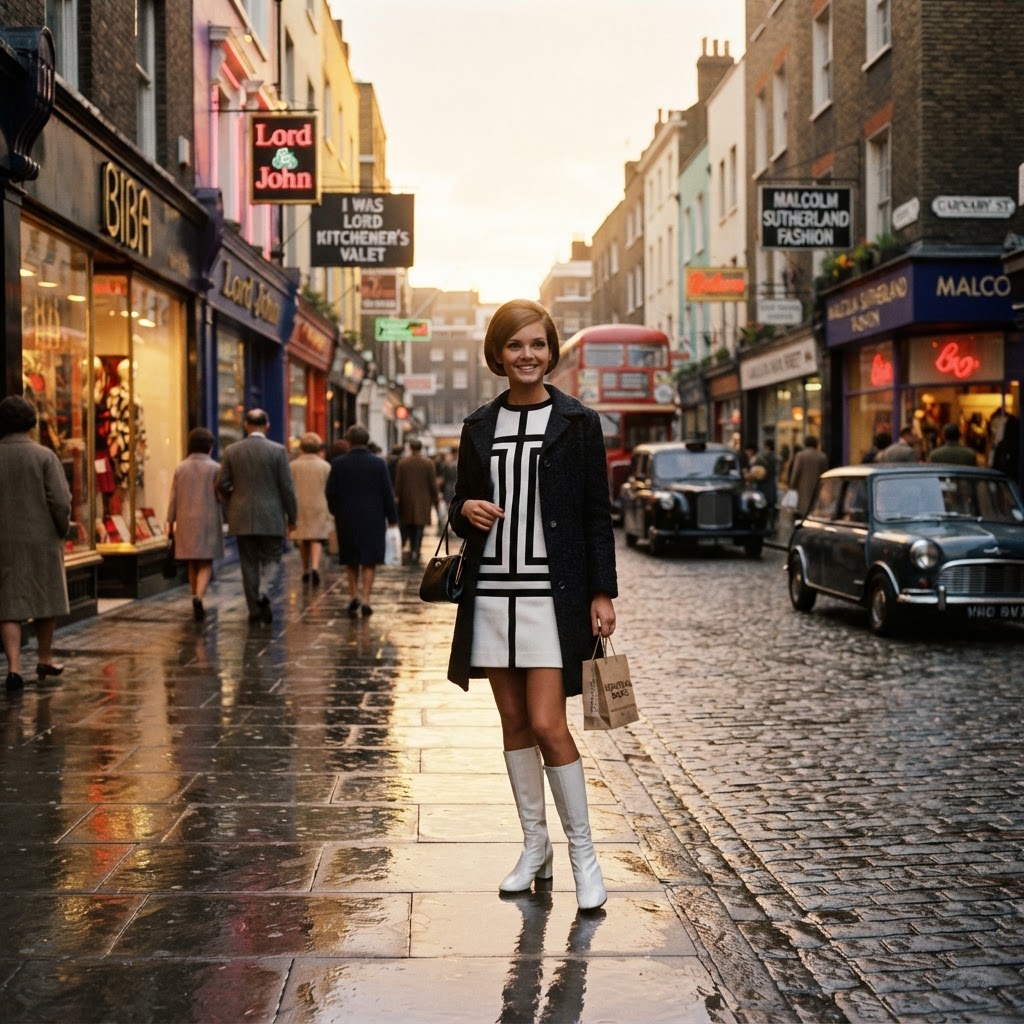
Mod Squad: The Story Behind 1960s Mod Fashion and Why It Still Sells Today
Few decades left as explosive a mark on fashion history as the 1960s, and at the heart of that revolution was the mod movement — a bold, youthful rebellion stitched in geometric prints and mini hemlines. From the boutiques of Carnaby Street to the runways of today's biggest designers, mod style has never truly gone out of fashion. If you're a vintage seller, understanding this movement isn't just a history lesson — it's a blueprint for curating pieces that buyers actively seek out.
The Birth of a Movement
To understand mod fashion, you have to understand the world it was born into. Post-war Britain in the late 1950s was a place of cautious optimism and quiet conformity. Young people, flush with more disposable income than any previous generation of youth, were hungry for something entirely their own. What emerged from the streets of London — particularly around Carnaby Street and King's Road in Chelsea — was a seismic shift in how young people dressed, thought, and moved through the world.
The term "mod" derived from "modernist," a label originally applied to jazz enthusiasts who favored a clean, Continental European aesthetic over the rougher edges of rock and roll culture. By the early 1960s, the word had expanded to describe an entire subculture defined by sharp tailoring, bold graphics, and an almost aggressive embrace of the new. Mod was not just fashion — it was a declaration of independence from the tweed-and-pearls world of their parents.
The Designers Who Defined the Decade
No conversation about mod fashion is complete without Mary Quant, the London designer widely credited with popularizing — if not outright inventing — the mini skirt. Her boutique, Bazaar, opened on King's Road in 1955 and quickly became a laboratory for the kinds of ideas that would define the decade. Quant's hemlines crept upward with the confidence of a generation that refused to apologize for taking up space. By 1965, the mini skirt wasn't just a garment — it was a manifesto.
Across the Channel, André Courrèges and Pierre Cardin were pursuing their own futurist visions, clothing women in structured trapeze dresses, vinyl accents, and space-age silhouettes that looked borrowed from science fiction. The A-line dress became the decade's defining shape: simple, structured, and supremely wearable. These designers collectively pushed fashion away from the corseted, hourglass ideals of the 1950s toward something freer, more geometric, and unapologetically modern.
Meanwhile, in America, the influence of Rudi Gernreich — creator of the topless swimsuit and tireless provocateur — and the broader cultural explosion happening in New York's downtown scene meant that mod aesthetics quickly crossed the Atlantic. Department stores began stocking Twiggy-inspired looks almost overnight, and the look filtered down to every level of the market.
The Visual Language of Mod
What made mod fashion so visually distinctive — and why it photographs so beautifully for vintage marketplace listings — was its commitment to a very specific graphic vocabulary. Op art, pioneered by artists like Bridget Riley, fed directly into textile design, producing dizzying black-and-white patterns of stripes, chevrons, and interlocking circles. These prints weren't subtle. They were designed to be seen, to move, to catch the eye in a crowded discotheque.
Key elements of authentic 1960s mod style include:
- Bold geometric prints: Op art patterns, large polka dots, abstract graphic shapes
- A-line and shift silhouettes: Structured but unfitted, often ending well above the knee
- Color-blocking: High-contrast combinations of white, black, orange, yellow, and cobalt blue
- Space-age materials: Patent leather, PVC accents, metallic fabrics
- Go-go boots: Low-heeled, white or silver, calf-high — the footwear equivalent of the era itself
- Minimal ornamentation: Clean lines over fussy detail; the cut did the talking
For sellers, these details are your best friends. When photographing and describing pieces, calling out a true op art print or a genuine A-line shift dress with a documented late-1960s label will immediately speak to buyers who know what they're looking for.
Mod's Cultural Ecosystem
Fashion never exists in a vacuum, and mod style was deeply intertwined with the music, art, and social movements of its moment. The British Invasion brought The Beatles and The Rolling Stones into American living rooms, and their evolving wardrobes — from sharp-collared Beatle jackets to psychedelic Nehru coats — tracked the decade's fashion arc in real time. Twiggy, with her cropped hair, enormous eyes, and boyish frame, became the visual embodiment of the mod ideal and the world's first true supermodel.
Television played a role too. Shows like Ready Steady Go! in the UK and Hullabaloo in the US beamed mod fashion into homes that were nowhere near Carnaby Street, democratizing a look that had started as subcultural and rapidly making it mainstream. By 1966 or 1967, you could find mod-influenced pieces in suburban American mall stores — a sign of the movement's total cultural saturation.
The Psychedelic Turn and the Movement's Evolution
By 1967 and 1968, mod's clean geometric lines began to blur and soften as psychedelia took hold. Paisley prints, flowing fabrics, Eastern influences, and a warmer, earthier color palette began to emerge alongside — and eventually replace — the cooler, harder-edged mod aesthetic. The Summer of Love pulled fashion in a more organic, handmade direction, and the Space Age optimism that had powered mod gave way to something more introspective.
For vintage sellers and collectors, this transition period — roughly 1967 to 1969 — produces some of the most interesting and collectible pieces: garments that blend mod structure with emerging hippie sensibility. A boldly printed shift dress in a swirling paisley fabric, or a sharply cut jacket in an unexpected jewel tone, can speak to both aesthetics at once.
The Lasting Influence: Why Mod Never Really Left
Decades of fashion history have proven that mod is one of those aesthetic languages that never fully disappears — it simply goes underground and resurfaces when the cultural conditions are right. The 1990s saw a massive mod revival, driven by the Britpop movement and bands like Oasis and Blur who self-consciously referenced 1960s style. Alexander McQueen, Prada, and Marc Jacobs have all sent mod-influenced collections down the runway at various points. And in the current era of maximalist, expressive dressing, the graphic confidence of a genuine 1960s op art print feels as fresh as ever.
On resale platforms and vintage marketplaces, authentic 1960s mod pieces — particularly those with original labels from brands like Quant's Ginger Group, Paraphernalia, or even well-preserved unlabeled pieces with period-correct construction details — consistently attract strong interest from both dedicated collectors and stylish buyers who simply want something no one else is wearing.
Seller Tips: Curating and Presenting Mod Pieces
If you're building a vintage shop with a focus on the 1960s, here's how to make your mod listings stand out:
Research your labels. Familiarize yourself with the brands and manufacturers active in the 1960s, both high-end and mass-market. Original labels add significant value and authenticity to a listing.
Photograph for graphic impact. Mod pieces are often about bold visual statements. Flat lays against a clean white or contrasting background let geometric prints speak for themselves. Include detail shots of patterns, zippers, buttons, and construction.
Be specific in your descriptions. "Op art inspired geometric print shift dress with exposed zip back, original acetate lining, Union-made label, circa 1965-1968" will outperform a generic description every time.
Condition is crucial. The structured fabrics common in mod garments — wool crepe, double-knit polyester, bonded fabrics — can hold their shape remarkably well. Highlight this. Buyers want to wear these pieces, not just display them.
Understand the buyer. Mod collectors are often highly knowledgeable. Authenticity, provenance, and accurate dating will earn you repeat customers.
Conclusion
The mod movement was one of fashion history's great democratic revolutions — young, bold, and utterly convinced that the future was worth dressing for. Decades later, those convictions are sewn into every shift dress, every op art print, every pair of white go-go boots that crosses a vintage seller's hands. At Ensemble, we believe that great vintage fashion deserves to find the people who will truly love it. Whether you're listing your first 1960s piece or building out a curated decade-focused shop, understanding the story behind what you're selling is the difference between a transaction and a connection. Bring the mod spirit to your listings — sharp, confident, and unafraid of standing out.