Mod Squad: The Story Behind 1960s Mod Fashion and Its Timeless Influence
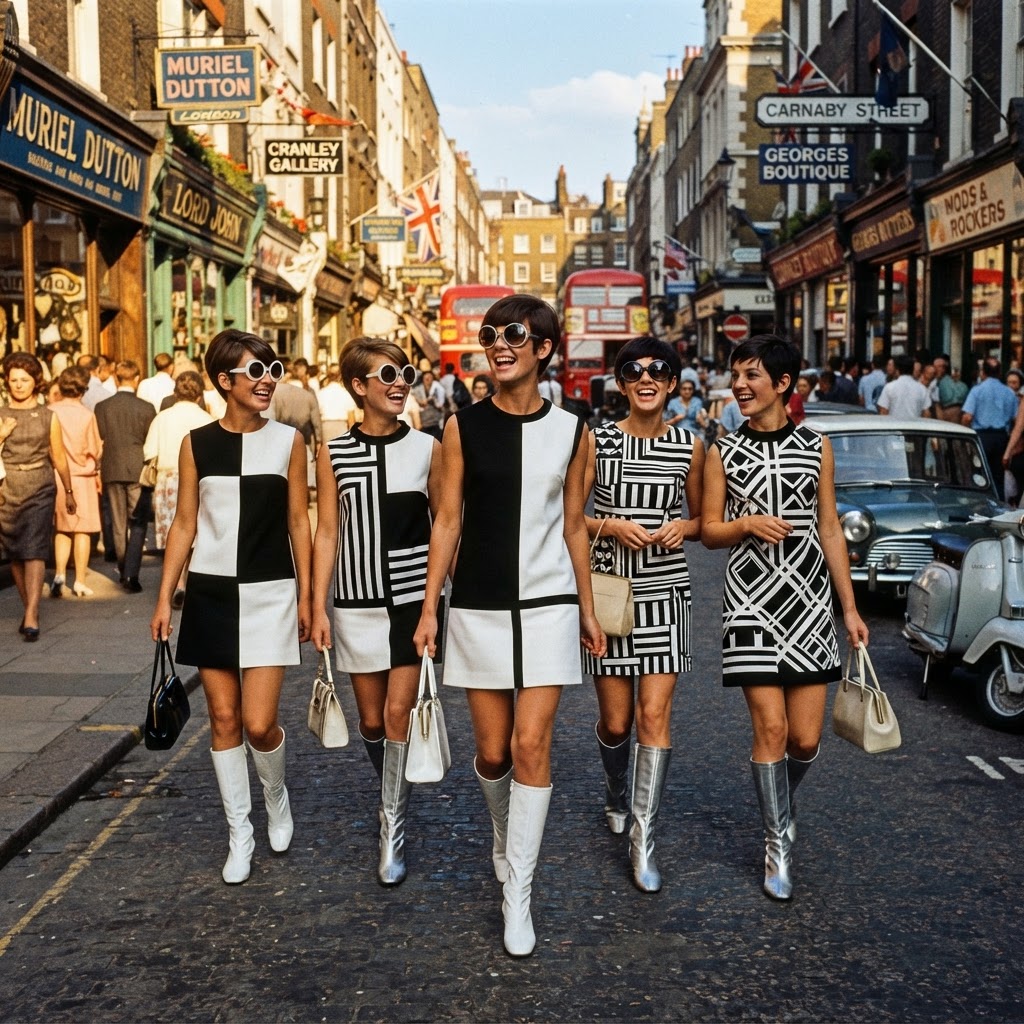
In the mid-1960s, a seismic shift rippled out from the streets of London's Carnaby Street and King's Road, rewriting the rules of fashion forever. Bold geometry, space-age silhouettes, and a defiant youthful energy collided to create the **mod movement** — one of the most visually electrifying decades in style history. Decades later, its influence still pulses through runways, vintage markets, and the wardrobes of the fashion-forward.
The Birth of a Movement
To understand mod fashion, you have to understand the world it was born into. Post-war Britain in the late 1950s was a society straining against its own conventions. A generation of young people with disposable income, access to new music, and a hunger for self-expression began carving out a cultural identity entirely their own. They were called modernists — soon shortened to mods — and they were obsessed with sharp tailoring, Continental style, and the emerging sounds of jazz and soul.
By the early 1960s, the mod aesthetic had crystallized into something unmistakable. Young men wore slim-cut suits, narrow ties, and Chelsea boots. Young women shed the restrictive hourglass silhouettes of the 1950s in favor of something radical: the miniskirt. When designer Mary Quant opened her boutique Bazaar on King's Road in Chelsea, she didn't just sell clothes — she sold a manifesto. The hemline rising above the knee wasn't a scandal; it was a declaration of freedom.
Carnaby Street and the Epicenter of Cool
If King's Road was mod fashion's creative laboratory, Carnaby Street was its beating heart. By 1965, this narrow Soho lane had become the most famous shopping street in the world, packed with boutiques selling the kind of clothing you simply couldn't find in department stores. Brightly colored shift dresses, bold geometric prints, patent leather go-go boots, and graphic-patterned tights transformed the street into a living runway.
The boutique culture itself was revolutionary. Shops like John Stephen's His Clothes and Biba — the latter founded by the visionary Barbara Hulanicki — understood that fashion needed to move at the speed of youth culture. Collections changed weekly. Prices were accessible. Shopping became an experience, not a transaction. This fast, democratic approach to style would echo forward through decades of retail innovation.
The Icons Who Defined the Look
No conversation about mod fashion is complete without Twiggy. Born Lesley Lawson in 1949, she became the face of the decade at just sixteen — her enormous eyes, boyish frame, and cropped hair a living rebuttal to every conventional beauty standard that came before her. Twiggy wasn't just a model; she was a symbol of the era's complete reimagining of femininity.
Alongside her stood Jean Shrimpton, whose effortless elegance in shift dresses and oversized sunglasses graced the covers of Vogue and Harper's Bazaar. Together, these women embodied a new archetype: young, confident, unbothered by tradition.
On the design side, André Courrèges brought the mod sensibility to high fashion with his space-age collection of 1964 — white vinyl boots, silver fabrics, and structured mini-dresses that looked like they'd been engineered for moon landings. Pierre Cardin followed with his own architectural explorations, turning garments into geometric sculptures. The future had arrived, and it was wearing a trapeze dress.
Op Art Meets the Wardrobe
One of the most distinctive visual signatures of 1960s mod fashion was its deep flirtation with Op Art — the optical illusion-based art movement pioneered by artists like Bridget Riley and Victor Vasarely. Black-and-white geometric patterns, concentric circles, and hypnotic grids migrated from gallery walls directly onto fabric. A mod dress wasn't merely something you wore; it was something you experienced.
This marriage of fine art and fashion reflected the decade's broader collapse of boundaries between disciplines. Mod was inherently cross-cultural — it absorbed influences from music, visual art, film, and architecture simultaneously. The result was a look that felt genuinely avant-garde rather than simply trendy.
The American Translation
While mod was born in Britain, it crossed the Atlantic with remarkable speed. American designers and retailers adapted the aesthetic for a stateside market, and cities like New York developed their own interpretations. The Youthquake movement — a term coined by Vogue editor Diana Vreeland — captured the American fashion industry's acknowledgment that young people were now driving culture, not following it.
Television accelerated the spread. Shows like The Avengers, with Honor Blackman and later Diana Rigg in her iconic catsuits, beamed mod style into living rooms across two continents. Films like Blow-Up (1966) and Georgy Girl (1966) made the look aspirational and cinematic. The mod moment was a genuinely transatlantic phenomenon.
Legacy: How Mod Rewrote Fashion's DNA
The mod movement's influence on fashion history cannot be overstated. Consider what it permanently changed:
The hemline was liberated forever. While skirt lengths have fluctuated since the 1960s, the idea that women's clothing must cover the knee was shattered beyond repair. The miniskirt remains one of the most enduring garments in fashion history, reinterpreted in every subsequent decade.
Youth as the primary consumer became the dominant commercial reality of the fashion industry. Before mod, fashion was designed for mature, established women of means. After mod, youth culture became the engine — a shift that still defines how brands market themselves today.
The boutique model transformed retail. The intimate, trend-driven, personality-led shop that Quant and Hulanicki pioneered gave way eventually to the concept store, the designer pop-up, and the curated vintage marketplace.
Geometric and graphic design in fashion became a permanent vocabulary. Every few years, Op Art prints and bold color-blocked silhouettes return to the runway — Versace, Prada, and Stella McCartney have all revisited the aesthetic in recent collections.
Wearing the 1960s Today
Authentic 1960s mod pieces are among the most sought-after vintage garments for good reason: they are immediately wearable, effortlessly contemporary, and crafted with a simplicity that holds up beautifully decades later. A genuine wool crepe shift dress from the era drapes with a precision that modern fast fashion rarely achieves. A pair of patent leather block-heeled pumps from the late 1960s pairs just as naturally with contemporary tailoring as it did with a Courrèges mini.
When shopping for authentic mod-era pieces, look for clean geometric cuts, A-line and trapeze silhouettes, bold monochromatic or Op Art prints, and the distinctive textiles of the period — double-knit wool, vinyl, and bonded fabrics. Labels to watch for include original Biba pieces, Mary Quant's Ginger Group diffusion line, and early American Youthquake designers like Betsey Johnson for Paraphernalia.
Finding Your Mod Moment
The enduring appeal of 1960s mod fashion lies in its optimism. It was style as a form of belief — a genuine conviction that the world could be remade, that the old rules didn't apply, that youth and creativity and color were enough. In an era of increasing uncertainty, there's something deeply compelling about clothing that carries that spirit.
At Ensemble, our curated collection of authenticated vintage pieces includes a carefully sourced selection of 1960s mod clothing — from graphic shift dresses to original go-go boots to razor-sharp mod suits for every gender. Every piece on our marketplace is verified for authenticity and era-accuracy, so when you wear it, you're wearing real history. Browse our 1960s collection and find the piece that lets you carry a little of that revolutionary optimism into your everyday life.