How to Spot Authentic 1950s Vintage Clothing vs. Modern Reproductions: A Collector's Guide
The 1950s gave us some of the most iconic silhouettes in fashion history — full circle skirts, cat-eye glamour, and perfectly tailored wiggle dresses. But with the decade's enduring popularity, the market is flooded with modern reproductions that can fool even seasoned shoppers. Here's how to tell the real deal from a convincing copy.
Why the 1950s Are So Heavily Reproduced
Few decades have inspired as much nostalgia-driven fashion as the 1950s. From the full-skirted "New Look" silhouettes championed by Dior to the snug, body-conscious wiggle dress, the era's aesthetic has never really gone out of style. Brands like Stop Stitch, Collectif, and Heartbreaker Fashion have built entire empires on lovingly crafted reproductions — and there's nothing wrong with that. But if you're investing in authentic 1950s vintage, you deserve to know exactly what you're getting.
Authentic pieces carry something reproductions simply cannot replicate: the history, the craftsmanship of a specific moment in time, and the subtle imperfections that make them genuinely one-of-a-kind. Let's break down exactly how to identify the real thing.
Start with the Label
The garment label is your first and most powerful clue. Authentic 1950s labels have several telltale characteristics:
- No care instructions. The FTC Care Labeling Rule wasn't enacted in the United States until 1971. If a label includes washing or drying instructions, the garment was made after that date — full stop.
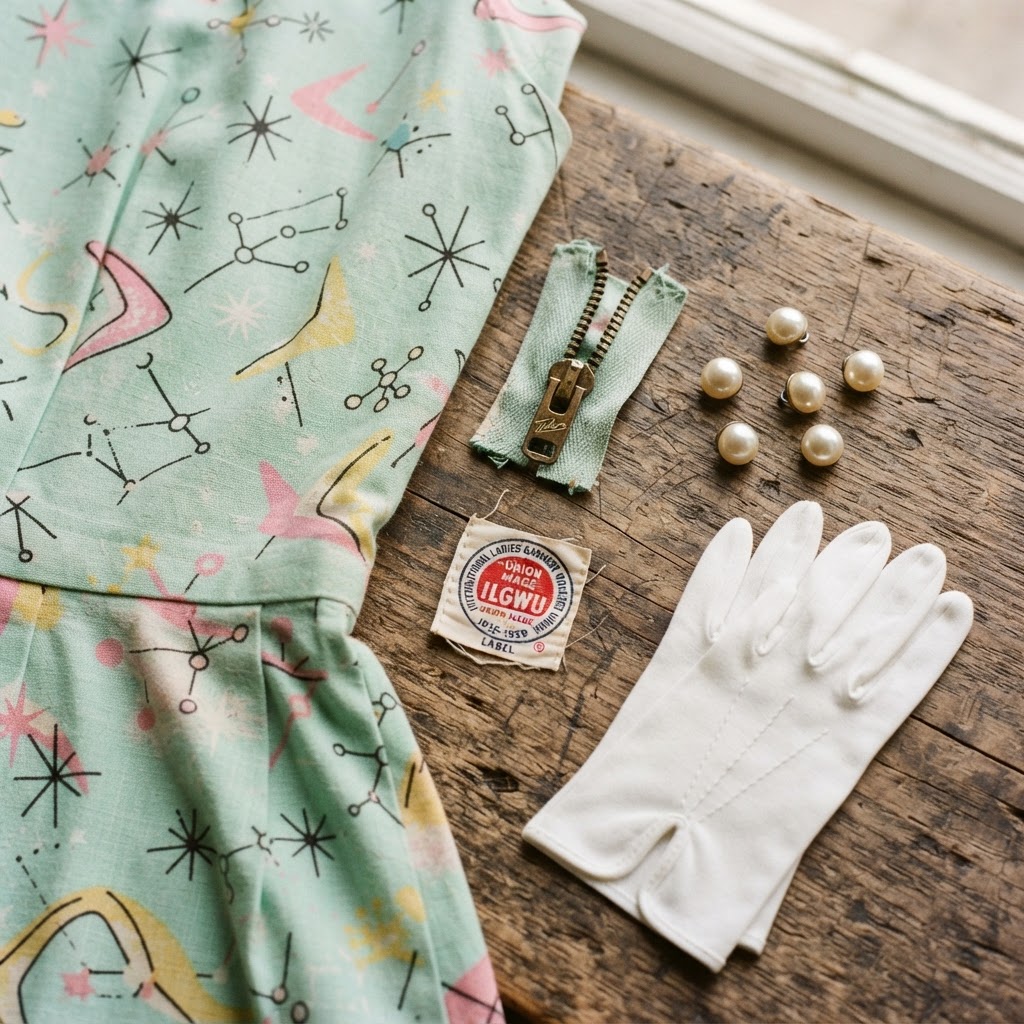
- Union labels. Many American-made garments from the 1950s carry a ILGWU (International Ladies' Garment Workers' Union) label. The style of this label changed over the decades, so cross-reference the specific design with a union label dating guide online.
- City of manufacture. Labels often read "Made in USA" or named specific cities like New York or Chicago. "Made in China," "Made in Vietnam," or similar origins are immediate indicators of a modern piece.
- Font and printing style. 1950s labels were typically woven in a serif or simple block font. Sleek, modern typography is a red flag.
- RN or WPL numbers. If a label carries a WPL (Wool Products Label) number, you can look it up in the FTC database to confirm the manufacturer and approximate date of registration.
Examine the Fabric
Fabric technology has changed dramatically since the 1950s, and your fingertips can tell a lot.
Common authentic 1950s fabrics include:
- Cotton broadcloth and piqué — crisp, tightly woven, and slightly stiff compared to modern cottons
- Rayon — a silky, drapey synthetic that was widely used; authentic 1950s rayon has a distinctive weight and slight sheen
- Wool and wool blends — suiting, swing coats, and pencil skirts were frequently made in heavier wool
- Early nylon and taffeta — often used in evening and cocktail wear, with a rustling, structured quality
- Novelty prints — atomic age motifs, abstract geometrics, and conversational prints (think: tiny teapots or boomerang shapes) were enormously popular
Modern reproductions often use polycotton blends or stretch fabrics that simply didn't exist in the 1950s. Run the fabric between your fingers — does it have the slight stiffness and natural breathability of mid-century textiles, or the soft, uniform stretch of modern fabric?
Be especially cautious of spandex or elastane content. These fibers weren't commercially available until the 1960s and weren't widely used in everyday clothing until the 1980s. Any stretch in the fabric of a claimed 1950s garment is a strong sign it's a reproduction.
Study the Construction
How a garment is put together is one of the most reliable dating methods available.
Authentic 1950s construction hallmarks:
- Metal zippers. Plastic (nylon coil) zippers weren't common until the mid-1960s. A metal zipper, often branded "Talon" or "Conmar," is one of the clearest signs of authenticity. Look for zippers inserted at the side seam of skirts and dresses — not center back, which became fashionable later.
- Hand-finished seams. Many 1950s garments were finished with hand-overcast or pinked seams rather than the serged (overlocked) edges ubiquitous in modern clothing.
- Interfacing. Period-correct interfacing is often woven cotton or linen — stiff and substantial. Modern reproductions use iron-on (fusible) interfacing, which has a slightly plasticky feel when you press it between your fingers.
- Boning and structure. Authentic 1950s strapless gowns and cocktail dresses often feature spiral steel or flat metal boning sewn into cotton twill casings. Modern reproductions frequently use plastic boning.
- Hand stitching details. Check hems, hook-and-eye closures, and lining attachment points. A surprising amount of hand stitching indicates genuine vintage craftsmanship.
- Buttons. Early plastic (Bakelite or Lucite) buttons, carved shell buttons, or fabric-covered buttons are period-correct. Modern shiny uniform plastic buttons are not.
Silhouette and Sizing
This is where many buyers get tripped up. 1950s sizing runs significantly smaller than both modern sizing and modern reproduction sizing. A dress labeled "Size 14" in 1950 corresponds roughly to a modern size 8 or 10. If a garment labeled as 1950s vintage fits like a contemporary piece without alteration, scrutinize it carefully.
Authentic silhouettes to know:
- The New Look / full skirt: nipped waist, padded hips, full skirt falling below the knee
- The wiggle or pencil dress: fitted through the hips with a kick pleat or slight flare at the hem
- The sheath dress: straight cut, often with a matching jacket
- Halter and strapless bodices for summer and evening wear
If the cut feels slightly imprecise or unique — a waistline that hits at an unusual point, a dart placement that seems unconventional — that's often the mark of genuine garment-by-garment craftsmanship rather than modern mass production.
Condition Clues That Confirm Age
Authentic vintage clothing ages in predictable ways. Look for:
- Fading consistent with the print or fabric — authentic fading is uneven, following light exposure and wear patterns
- Underarm perspiration staining — often yellowed or darkened; period dress shields (small fabric pads sewn inside armholes) are a genuine vintage indicator
- Slight shrinkage or distortion from decades of washing and wearing
- Moth damage or repairs in wool garments
- Snaps and hooks that show slight rust or patina
Be cautious of garments presented as 1950s vintage that look too pristine. Either they were exceptionally stored (possible but uncommon) or they're reproductions.
When in Doubt, Ask Questions
When shopping from a seller — whether at an estate sale, on a marketplace, or in a vintage shop — don't hesitate to ask:
- Where did this piece come from?
- Has the label been verified or researched?
- Can I see detailed photos of the zipper, label, and seam construction?
Reputable vintage sellers will welcome these questions. Hesitation or vague answers are a signal to proceed carefully.
Building Your Eye Over Time
The best tool you'll ever develop is simply handling a lot of genuine vintage clothing. Visit museum textile collections. Attend reputable vintage fairs. Handle pieces you know are authentic and train your hands and eyes to recognize the weight, construction, and feel of mid-century garments. Over time, a reproduction will feel "off" before you've even checked the label.
Find Authenticated 1950s Pieces on Ensemble
At Ensemble, every listing goes through a careful curation process designed to connect buyers with genuinely authentic vintage clothing — including a rich selection of 1950s pieces spanning everything from day dresses and swing coats to cocktail gowns and separates. Our sellers are vetted, our community is knowledgeable, and our commitment is to the real thing.
Whether you're building a collection, sourcing a one-of-a-kind wardrobe, or simply falling in love with the beauty of mid-century fashion, Ensemble is the place to shop with confidence. Browse our 1950s collection today and find something that has genuinely lived through the decade that gave us rock and roll, Audrey Hepburn, and some of the greatest dresses ever made.