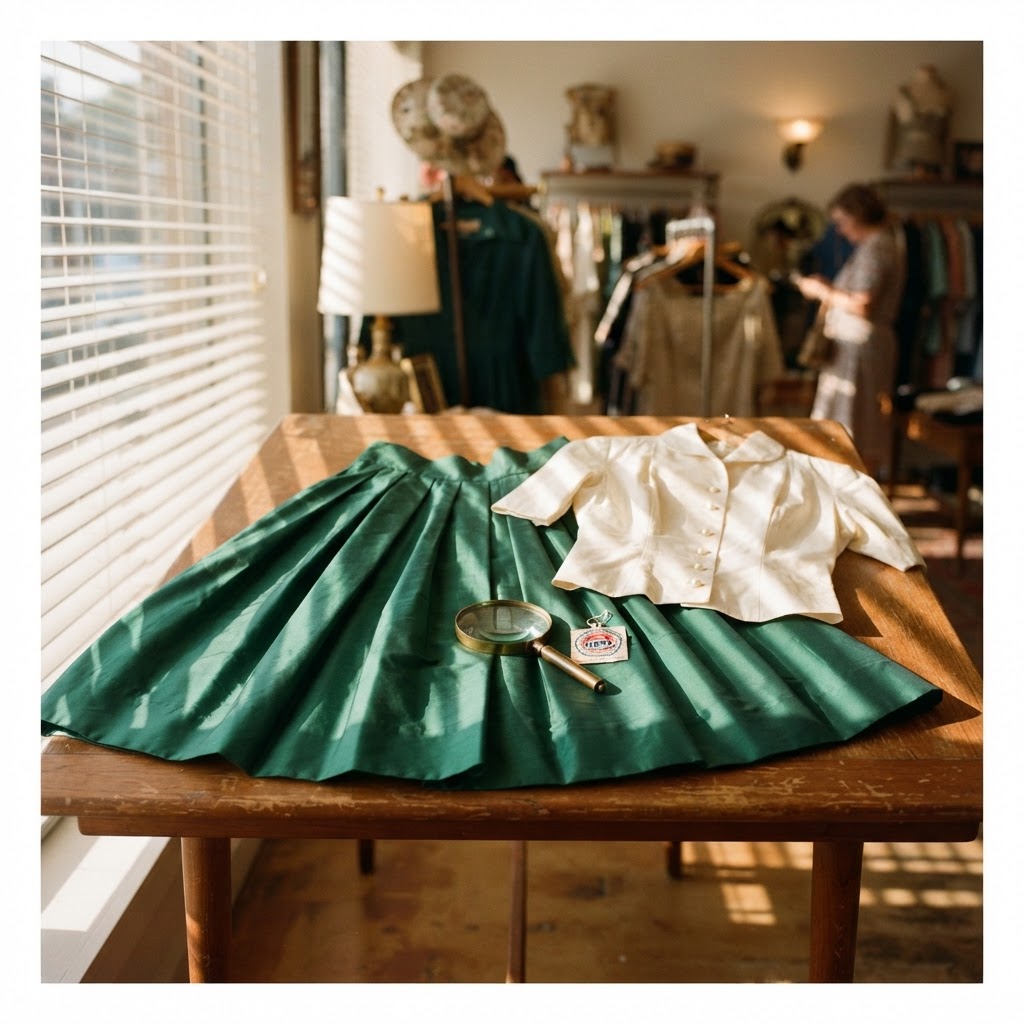
How to Identify Authentic 1950s Vintage Clothing vs. Modern Reproductions
The 1950s remain one of the most coveted decades in vintage fashion, which means the market is flooded with convincing reproductions designed to fool even seasoned collectors. Before you invest in that perfect circle skirt or boxy gabardine blazer, you need to know exactly what you're looking at. This guide breaks down every detail — from fabric and construction to labels and zippers — so you can shop with confidence.
Why the 1950s Are So Hard to Fake (And Why People Keep Trying)
Few decades carry the cultural magnetism of the 1950s. Nipped waists, full skirts, saddle shoes, and cat-eye silhouettes have never truly gone out of style — they've simply cycled in and out of mainstream fashion with relentless enthusiasm. That perpetual demand has given rise to a booming reproduction industry, with brands producing beautifully made, period-inspired garments that walk a very fine line between homage and deception.
The good news? Authentic 1950s clothing tells its own story through construction techniques, materials, and branding conventions that modern manufacturing simply cannot replicate at scale. Once you know what to look for, spotting a genuine piece becomes almost second nature.
Start With the Label
The care label is your single fastest diagnostic tool. Here's the key fact: the U.S. Federal Trade Commission did not require care labels on garments until 1971. If a piece is presented as authentic 1950s clothing and it has a sewn-in care label with washing instructions, walk away — it's either a reproduction or it's been mislabeled.
Authentic 1950s garments will instead feature brand or maker labels that reflect the typography, materials, and language of the era. Look for:
- Chain store labels from department stores like Sears Roebuck, Montgomery Ward, Macy's, or Lord & Taylor with mid-century serif fonts
- Union labels, particularly from the ILGWU (International Ladies' Garment Workers' Union), which used specific label designs that changed over the decades — the 1950s version features a particular typeface and border style that collectors have catalogued extensively
- "Made in USA" designations, which were standard rather than a marketing distinction
- Labels made from woven rayon or silk rather than the printed nylon labels common today
If a label reads "Made in China," "100% Polyester," or includes a recycling symbol anywhere on the garment, you're looking at a modern piece.
Read the Fabric
Fabric composition is one of the most reliable authenticity markers because synthetic fabrics as we know them today simply didn't exist in 1950s consumer fashion.
Authentic 1950s fabrics include:
- Cotton, in everything from broderie anglaise to chambray to heavy twill
- Wool, especially in suiting, pencil skirts, and outerwear
- Rayon, which was widely used and has a distinctive fluid drape and subtle sheen
- Silk, typically in blouses, scarves, and evening wear
- Early nylon, used primarily in hosiery and some lingerie, with a very different feel from modern nylon
- Acetate, a semi-synthetic with a crisp, occasionally stiff hand and a slight shine
What you will not find in a genuinely authentic 1950s garment: polyester, acrylic, spandex/elastane, or lycra. Polyester fabric didn't enter mainstream American clothing production until the mid-1960s, and stretch fabrics came even later. If a garment claiming to be from the '50s has any give or bounce, that's a red flag.
Modern reproductions — even high-quality ones from brands like Stop Stitch or Collectif — frequently use cotton-polyester blends for durability and ease of care. This alone disqualifies them from authenticity.
Examine the Zipper
Zippers are a surprisingly precise dating tool, and zipper technology changed significantly between the 1940s and 1970s.
In the 1950s, look for:
- Metal zippers, almost exclusively — Talon was the dominant American zipper brand and its name may be stamped on the pull
- Side or back placement on skirts and dresses, typically left side seam or center back
- Short zipper length — often just 6–9 inches, enough to get the garment on but no more
- Hand-stitched zipper tape sewn into the seam, often slightly uneven if done by a home seamstress
Plastic zippers, especially the molded nylon coil zippers ubiquitous today, were not in common use until the 1960s. An invisible zipper — the kind that disappears into the seam entirely — wasn't widely used in consumer clothing until the 1990s. If you see one on a claimed 1950s piece, that's a definitive red flag.
Inspect the Construction
Decades of fast fashion have dramatically changed how garments are assembled. 1950s clothing construction reflects a labor-intensive, pre-automation standard that is genuinely difficult to reproduce cheaply.
Authentic markers include:
- French seams or flat-felled seams on higher-end pieces — these fully enclose the raw edge and take significantly more time to sew
- Hand-sewn hems, identifiable by tiny, slightly irregular stitches that catch just a thread or two of the outer fabric
- Bound buttonholes on tailored jackets and coats — these are fabric loops that frame the buttonhole rather than the machine-stitched variety
- Horsehair or crinoline underlining in full skirts to maintain shape
- Padded or boned bodices in formal dresses, structured from the inside rather than relying on external shapewear
- Seam allowances of ½ inch or more, reflecting an era when garments were meant to be altered and worn for years
Modern reproductions, even expensive ones, typically use serged (overlocked) seams throughout, machine-stitched hems, and minimal internal structure.
Know the Silhouettes and Proportions
Authentic 1950s garments were designed around the New Look silhouette that Christian Dior introduced in 1947 and which dominated the decade: a defined, often nipped waist, a full or pencil skirt falling at or below the knee, and structured shoulders that were softer than the angular 1940s style.
Key proportional tells:
- Waist measurements run small — a labeled size 14 from the 1950s often corresponds to a modern size 6 or 8, because sizing conventions have shifted dramatically
- Skirt lengths hit the mid-calf or just below the knee on authentic day dresses
- Bodice darts are typically more numerous and precisely engineered than in modern dresses, often featuring both bust and waist darts
- Sleeve construction in blouses and dresses involves a fully set-in sleeve with a rounded sleeve cap — very different from the dropped shoulders common in modern cuts
If a 1950s-style dress has a waist that aligns with modern sizing expectations without alteration, or if the hem sits above the knee, question its provenance.
Watch for Wear Patterns That Tell the Truth
Authentic vintage garments carry the honest evidence of age. This isn't about damage — it's about patina and use. Look for:
- Slight fading or color variation at fold lines and hem edges
- Light pilling or wear at underarm seams and collar edges
- Oxidation or tarnishing on metal hardware, snaps, and zipper pulls
- A subtle mustiness or cedar scent consistent with long-term storage
Reproductions are new garments, and no amount of distressing technique fully replicates decades of actual use. A piece that smells like a retail store or has perfectly uniform color throughout is almost certainly not from the 1950s.
The Bottom Line: Authentic Has a Feel
Beyond the checklist, experienced collectors consistently describe authentic 1950s pieces as having a weight and intentionality that reproductions lack. The fabrics are denser, the construction is more deliberate, and the garment fits the body differently — because it was designed for a pre-Spandex world where structure came from the clothes themselves, not from stretch.
Developing that instinct takes time and handling, which is exactly why buying from a curated marketplace matters.
At Ensemble, every listing goes through a verification process designed to catch exactly the kinds of discrepancies described in this guide. Our sellers are vetted enthusiasts and specialists who understand the difference between a genuine 1952 circle skirt and a 2019 reproduction — and they stand behind their descriptions. Whether you're building a serious collection or hunting for that perfect piece to wear, Ensemble is the place to shop the 1950s with confidence.
Happy hunting.