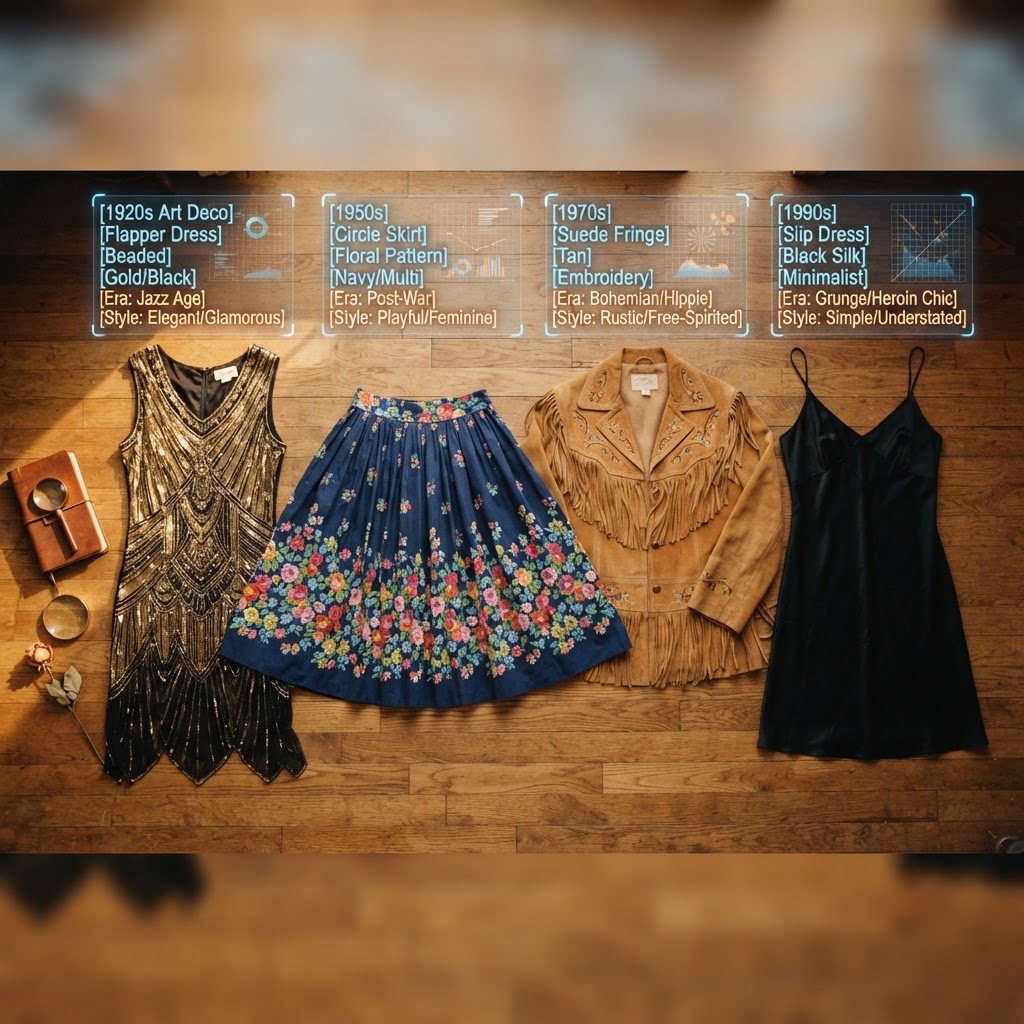
How AI Is Revolutionizing the Way We Buy and Sell Vintage Clothing
Artificial intelligence is quietly transforming the vintage fashion world, making it easier than ever to authenticate a 1960s mod dress or price a rare 1980s designer jacket. From smart search tools to image recognition, the technology reshaping retail is arriving at the vintage marketplace—and savvy shoppers and sellers are taking notice. Here's what you need to know about the AI-powered future of secondhand style.
The Vintage Fashion Boom Meets the AI Era
Vintage clothing has never been more popular. Whether you're hunting for a butter-soft 1970s leather jacket, a perfect 1990s slip dress, or a structured 1940s wool coat, the appetite for authentic, one-of-a-kind pieces is at an all-time high. At the same time, artificial intelligence is reshaping nearly every corner of the retail landscape—and vintage fashion is no exception.
For decades, buying and selling vintage clothing required deep personal expertise: the ability to read a label, feel a fabric, spot a reproduction, and intuitively price a piece against an ever-shifting market. That knowledge took years to accumulate. Today, AI tools are beginning to democratize that expertise, lowering the barriers for new sellers and helping buyers shop with greater confidence. But the technology also raises important questions about authenticity, human intuition, and what makes vintage shopping so special in the first place.
AI-Powered Image Recognition: Finding What You're Looking For
One of the most immediately useful applications of AI in vintage fashion is visual search technology. Traditional keyword searches struggle with vintage clothing because buyers often don't know the precise terminology for what they're seeking. How do you search for a blouse with a specific type of 1930s lace collar if you don't know it's called a "bertha collar"?
AI-driven image recognition tools allow shoppers to upload a photo—perhaps a screenshot from a vintage film, a scan from an old magazine, or even a picture of a beloved garment that has worn out—and find visually similar items. These tools analyze silhouette, pattern, color palette, and construction details to surface relevant matches across thousands of listings.
For sellers, the same technology can help with listing optimization. AI can scan a photo of a garment and suggest accurate descriptive tags, era classifications, and style categories, reducing the guesswork for someone who may be clearing out a grandmother's wardrobe and isn't sure whether a dress is from the late 1950s or early 1960s.
Smarter Pricing: Taking the Guesswork Out of Valuation
Pricing vintage clothing has always been more art than science. A 1980s Versace blazer in mint condition commands a very different price than the same blazer with a missing button and a faded lining—and market values shift constantly based on trends, celebrity influence, and collector demand.
AI-powered pricing tools are beginning to change this by analyzing vast datasets of completed sales across multiple platforms. These tools can factor in brand, era, condition, fabric, regional demand, and even seasonal trends to recommend a competitive listing price. For newer sellers, this kind of data-backed guidance can mean the difference between a piece sitting unsold for months and finding the right buyer quickly.
Of course, experienced vintage dealers will rightly point out that nuance still matters enormously. A deadstock 1960s mod shift dress with its original price tag attached is not the same as one that has been gently altered, even if an algorithm might struggle to weight that distinction appropriately. AI pricing tools are best understood as a starting point for research, not a final authority.
Authentication: Fighting Fakes with Machine Learning
Authentication is perhaps the highest-stakes application of AI in the vintage world. As vintage fashion has grown more valuable—with rare pieces from houses like Halston, Ossie Clark, or early Calvin Klein fetching serious money—the market for convincing reproductions and mislabeled items has grown alongside it.
Machine learning models trained on thousands of verified garments can now assist in spotting inconsistencies: stitching patterns that don't match a claimed era, label fonts that weren't used until a decade later, or zipper hardware that postdates the supposed manufacture. Some platforms are beginning to integrate these tools into their authentication workflows, using AI as a first pass before human experts make a final call.
This is genuinely exciting for buyers who have been burned by inaccurate listings. It's also reassuring for honest sellers, who want their carefully sourced, properly described pieces to stand out in a crowded marketplace. That said, human expertise remains irreplaceable at the highest levels of authentication. The feel of a fabric, the smell of genuine age, the subtle irregularities of true hand-finishing—these are things that even the most sophisticated AI hasn't fully learned to assess.
Personalization: Your Own AI Vintage Stylist
Beyond search and pricing, AI is beginning to reshape the discovery experience itself. Recommendation engines trained on browsing and purchase history can surface pieces a shopper might never have thought to search for—a 1950s novelty print blouse that happens to share the color palette and silhouette of items already in a buyer's cart, or a 1990s minimalist blazer from a lesser-known designer that mirrors the aesthetic of pieces they've favorited.
This kind of serendipitous discovery has always been one of the great joys of thrift shopping—the unexpected treasure found by chance in a crowded rack. AI-driven personalization is attempting to replicate that feeling in a digital environment, using pattern recognition to engineer happy accidents at scale.
For vintage sellers, personalization algorithms also mean that well-described, accurately categorized listings are more likely to surface in front of exactly the right buyer. Investing time in detailed, honest descriptions isn't just good ethics—it's increasingly good business strategy.
The Human Heart of Vintage Fashion
For all its promise, it's worth pausing to consider what AI cannot replicate in the vintage shopping experience. When you buy a vintage garment, you're not just acquiring clothing—you're acquiring history, story, and human connection. The thrill of discovering a 1970s halter dress with a monogram stitched inside, or a 1940s overcoat with a theater ticket still tucked in the pocket, is something no algorithm can manufacture.
The best use of AI in vintage fashion is as a tool that amplifies human expertise, not a replacement for it. Experienced sellers who know their eras, their labels, and their fabrics will always have an edge. Buyers who have developed a personal aesthetic and a feel for quality will always find things that a recommendation engine would never think to suggest.
What AI can do is handle the more mechanical aspects of the transaction—the searching, the pricing research, the preliminary authentication checks—freeing up both buyers and sellers to focus on what they love most: the clothing itself.
What This Means for the Future of Vintage Marketplaces
As these tools become more sophisticated and more widely integrated, the vintage fashion marketplace is likely to become more transparent, more accessible, and more efficient. Buyers will be able to shop with greater confidence. Sellers will be able to reach more precisely matched audiences. Fakes and misdated pieces will become harder to pass off undetected.
But the soul of vintage fashion—the sustainability ethos, the love of craft, the belief that beautiful things deserve to outlast their first owner—will remain stubbornly, wonderfully human.
Shop Smarter with Ensemble
At Ensemble, we believe that technology should serve the story of every garment, not obscure it. That's why we're thoughtfully exploring how AI tools can help our community of buyers and sellers connect more easily with the pieces that matter—while keeping the expertise, passion, and curatorial care that make vintage shopping extraordinary at the heart of everything we do. Whether you're listing your first piece or hunting for a grail from a specific decade, Ensemble is built for people who understand that fashion is never just clothing. It's culture, memory, and art—and it deserves to be treated that way.