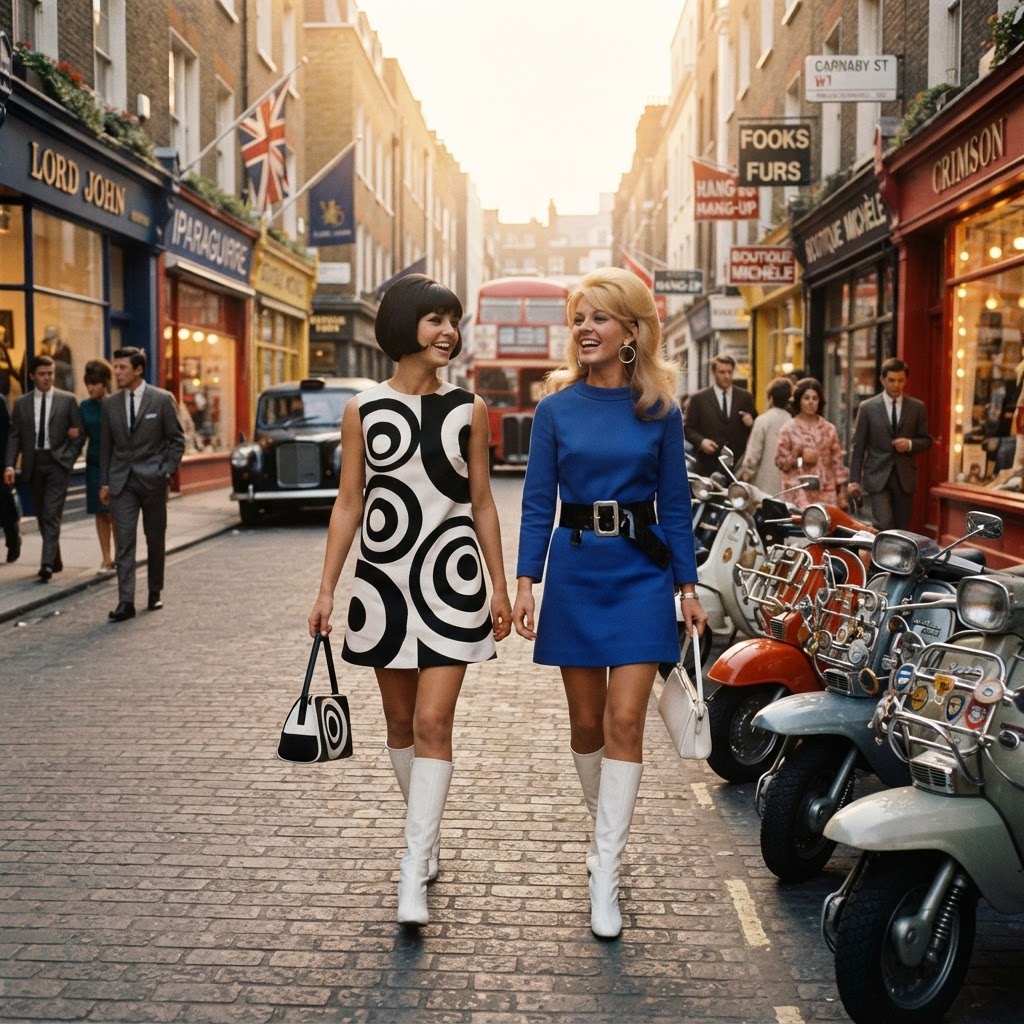
Go-Go and Beyond: The Story Behind 1960s Mod Fashion and Its Lasting Influence
Few style movements have left as indelible a mark on fashion history as the mod revolution of the 1960s. Born in the boutiques of London's Carnaby Street and King's Road, mod fashion shattered every convention that came before it — and its DNA lives on in runways, street style, and vintage wardrobes to this day. Here's the story of how a youth-driven aesthetic changed the way the world got dressed.
A Revolution Sewn in Swinging London
To understand mod fashion, you have to understand the world it was reacting against. The 1950s had been defined by structured silhouettes, conservative tailoring, and a rigid dress code that mirrored the social hierarchies of the postwar era. Then the 1960s arrived — and with them, a generation of young people who had absolutely no interest in dressing like their parents.
The epicenter of this sartorial uprising was London's Carnaby Street, a narrow road in Soho that transformed, almost overnight, into a catwalk for the counterculture. Independent boutiques like Hung On You and I Was Lord Kitchener's Valet began selling clothes that looked like nothing the fashion establishment had ever sanctioned: sharp geometric cuts, bold primary colors, and hemlines that crept further and further above the knee. A new tribe — the mods — adopted this look as a badge of identity, pairing it with scooters, soul music, and an attitude of cool, deliberate rebellion.
Across town on the King's Road in Chelsea, a young designer named Mary Quant was doing something equally radical. Often credited with pioneering — or at least popularizing — the miniskirt, Quant's boutique Bazaar became a pilgrimage site for fashion-forward women who wanted clothes that celebrated youth rather than camouflaging it.