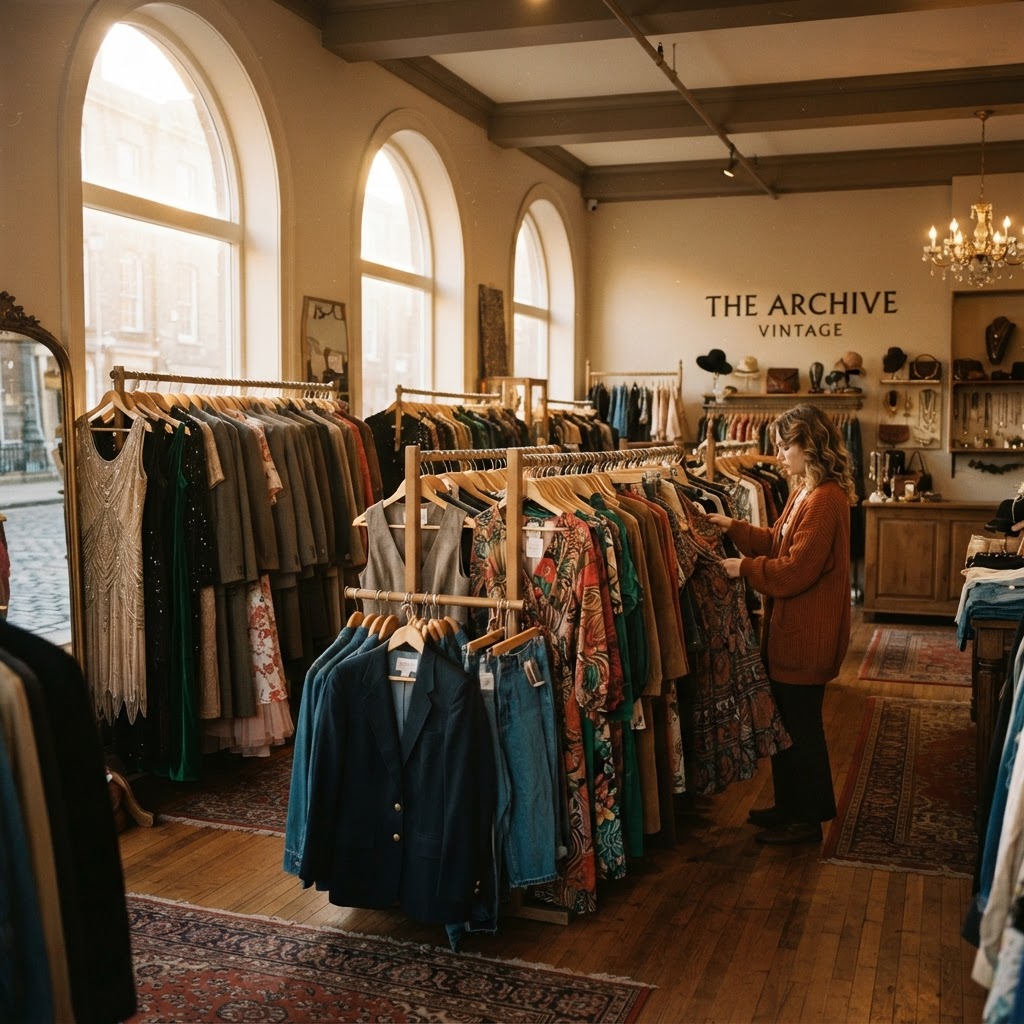
From Thrift Bins to Digital Boutiques: The Rise of Vintage Fashion Marketplaces and Why Ensemble Is Leading the Next Wave
Vintage fashion has exploded from a niche hobby into a multi-billion-dollar global movement — and the marketplaces powering that shift are evolving fast. As shoppers grow savvier and more sustainability-conscious, the bar for curation, authenticity, and trust has never been higher. Here's how we got here, and what makes Ensemble a different kind of destination entirely.
The Vintage Boom: A Cultural and Commercial Shift
Not long ago, buying vintage clothing meant Saturday mornings at dusty thrift stores, sifting through racks of forgotten polyester in hopes of striking gold. It was a subculture — beloved by fashion insiders, costume designers, and committed individualists, but largely invisible to mainstream consumers.
That world has changed almost beyond recognition.
Today, the global secondhand and vintage clothing market is valued at over $40 billion, with projections suggesting it could nearly double within the next five years. Platforms dedicated to pre-owned fashion have multiplied rapidly, and major retailers have begun launching their own resale arms. Vintage isn't a trend anymore — it's a permanent fixture of how people think about getting dressed.
So what happened? And more importantly, what does it mean for the people who actually care about clothes?
How We Got Here: The Forces Behind the Vintage Renaissance
Several converging forces turbocharged vintage fashion's mainstream arrival.
First, sustainability awareness shifted consumer behavior at scale. As the environmental cost of fast fashion became harder to ignore — overflowing landfills, exploitative labor practices, carbon-intensive supply chains — a growing segment of shoppers began looking for alternatives. Buying vintage became a form of conscious consumption: stylish, affordable, and genuinely better for the planet.
Second, social media democratized style discovery. Platforms like Instagram, Pinterest, and TikTok gave vintage enthusiasts a global stage. A teenager in rural Ohio could discover 1970s prairie dresses through an influencer in London. Aesthetic communities — cottagecore, dark academia, Y2K revival — built entire visual identities around specific vintage eras, driving demand for pieces that mainstream retailers simply couldn't supply.
Third, nostalgia became a design language. The fashion industry itself began mining its own archives aggressively, with luxury houses referencing their archival decades and streetwear brands borrowing liberally from the past. When high fashion signals that history is worth revisiting, consumers follow — except many of them bypass the expensive reproductions and go straight to the originals.
Finally, the pandemic reshuffled priorities. Stuck at home, people rediscovered personal style as a form of self-expression and creativity. Online vintage shopping surged. Sellers who had operated primarily at flea markets moved online. A generation of new buyers entered the market and never left.
The Marketplace Landscape: Crowded, Chaotic, and Inconsistent
The explosion in demand gave rise to a crowded ecosystem of resale platforms. Some are general secondhand marketplaces — massive, democratic, and often overwhelming. You can find genuine treasures, but you're equally likely to wade through mislabeled fast fashion, inaccurately dated pieces, or listings with photographs so poor they tell you almost nothing about the actual garment.
Other platforms have positioned themselves as luxury resale destinations, but their definition of vintage often skews recent, and their authentication processes prioritize high-ticket accessories over the broader sweep of fashion history.
Then there are the specialist dealers and independent vintage shops operating on general e-commerce infrastructure — often deeply knowledgeable, but fragmented and difficult to discover unless you already know where to look.
The result is a marketplace landscape that mirrors the early days of any maturing industry: full of energy and product, but short on consistency, trust, and genuine expertise. Buyers frequently report frustration with inaccurate dating, vague condition descriptions, and the inability to verify whether a piece is truly from the era it claims to represent. For casual shoppers, this is an inconvenience. For serious collectors and fashion lovers, it's a genuine barrier.
What Authentic Curation Actually Requires
Here's what most general platforms miss: vintage fashion is not simply old clothing. It is material history. A well-preserved 1930s bias-cut evening gown tells a story about labor, craft, and cultural aspiration that no reproduction can replicate. A 1980s power suit carries the social DNA of a specific moment in women's professional life. A 1990s Japanese streetwear piece is a primary document of a global subcultural exchange.
Authenticating and contextualizing these objects requires real knowledge — of construction techniques, fabric composition, label history, silhouette evolution, and the broader cultural narratives each decade produced. It requires understanding the difference between a genuine 1950s circle skirt and a faithful 1980s reproduction of one. It means knowing which designers were doing what, when, and why it matters.
Curation at this level isn't algorithmic. It's human. It's slow. And it's exactly what the majority of large-scale platforms are structurally unable to provide.
Decade by Decade: Why Era Matters
One of the great joys — and great complications — of vintage fashion is that each decade demands its own fluency.
The 1920s and 1930s offer extraordinarily rare surviving pieces: beaded flapper dresses, silk bias cuts, and early ready-to-wear that bridged couture craft with emerging mass production. These are collector's items as much as wearables.
The 1940s and 1950s introduced the structured silhouettes that continue to influence contemporary fashion: nipped waists, full skirts, tailored menswear with a confidence born from post-war optimism. Quality of construction during this era is often exceptional.
The 1960s and 1970s exploded convention — mod geometry, bohemian prints, denim as political statement, the first stirrings of what we now call streetwear. Pieces from this era are among the most actively collected.
The 1980s and 1990s are the current frontier of serious vintage interest. What was once considered too recent to be truly vintage is now recognized as historically significant — and the Y2K moment has made early 2000s pieces objects of genuine desire for younger shoppers discovering them as their equivalent of the 1970s revival.
Each of these eras requires different expertise. A platform that claims to cover all of them authentically is making a significant promise.
What Makes Ensemble Different
Ensemble was built from a single animating conviction: that the people who love clothes deserve a marketplace that loves clothes back.
That means expert authentication across every decade, from the 1920s through the 2010s. Every piece listed on Ensemble has been assessed for accurate dating, condition, and provenance — not by an algorithm, but by people who have spent years developing genuine fluency with the material.
It means honest, detailed condition reporting that tells you not just that a piece shows "light wear," but exactly what that means and where it appears — because fit and condition are everything when you're buying something that can't be returned to a factory for remanufacture.
It means contextual storytelling — helping buyers understand not just what they're looking at, but why it matters. Who was wearing this silhouette, and why? What moment does this fabric represent? Great vintage shopping is an education as much as a transaction.
And it means building a community of sellers who meet the same standard — independent dealers and collectors who share the commitment to accuracy, transparency, and genuine knowledge that the platform is built on.
The Future of Vintage Is Intentional
The vintage fashion market will keep growing. That's not in question. What is in question is whether that growth produces more noise or more signal — more listings or more meaning.
The next phase of this market belongs to platforms that treat vintage fashion with the seriousness it deserves. Not as a category of secondhand goods, but as a living archive of human creativity, craft, and culture.
Ensemble exists at that intersection. Whether you're a seasoned collector hunting a specific 1940s silhouette or a first-time buyer curious about where to start, the promise is the same: every piece here has been chosen with care, verified with expertise, and offered with honesty.
The clothes already have the stories. Ensemble makes sure you can trust them.