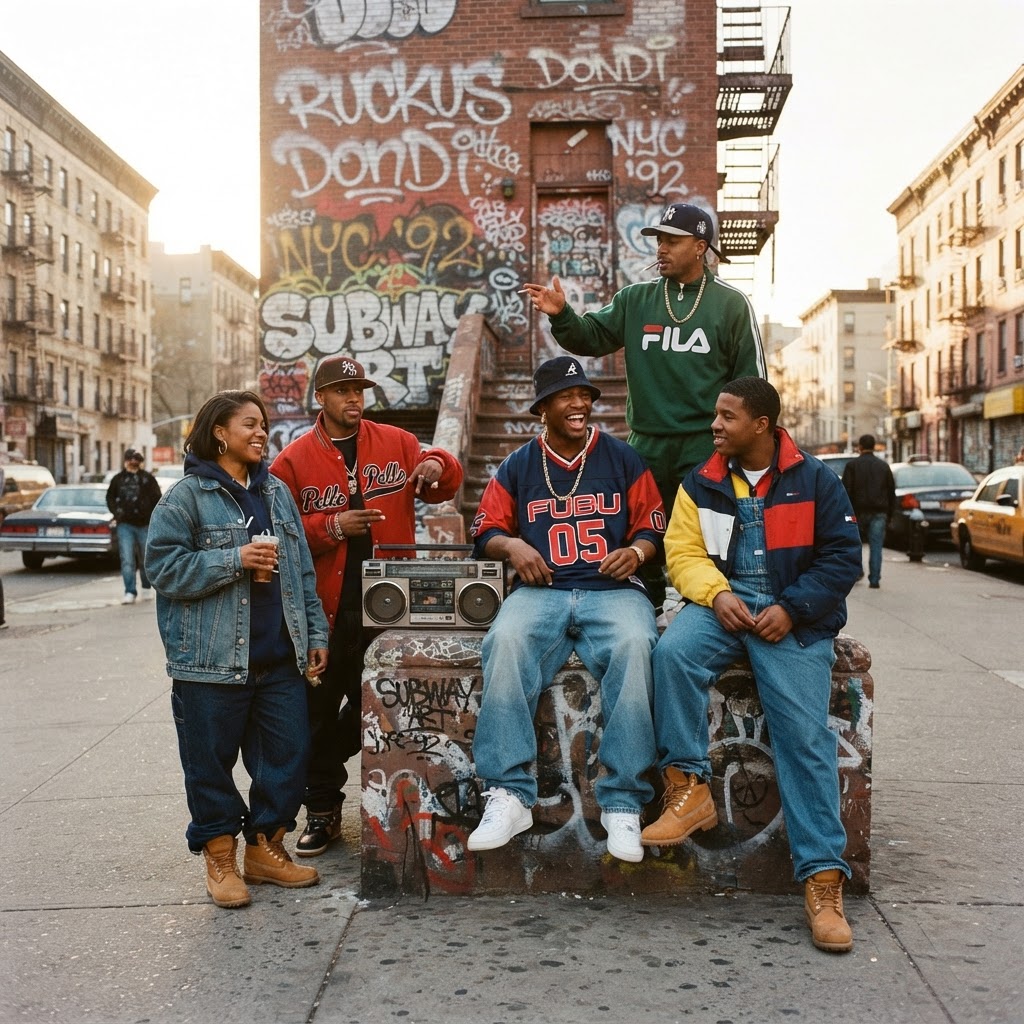
From the Block to the Runway: The History and Cultural Impact of 1990s Hip-Hop Streetwear
Few style movements have reshaped global fashion as profoundly as 1990s hip-hop streetwear. What began as self-expression on the streets of New York, Los Angeles, and Atlanta evolved into a multi-billion-dollar industry that still dictates trends today. Understanding where it came from—and what it meant—makes every vintage piece from that era infinitely more powerful.
The Streets as a Runway
Before streetwear had a name, it had a neighborhood. In the late 1980s and early 1990s, young Black and Latino communities in cities like New York's South Bronx, Compton in Los Angeles, and Atlanta's Westside were forging an aesthetic entirely their own. With limited access to high-end fashion, these communities remixed what was available—athletic gear, workwear, military surplus—and elevated it into something entirely new. The result was hip-hop streetwear, a visual language as expressive and layered as the music that accompanied it.
This wasn't fashion for fashion's sake. Every silhouette, logo, and color choice carried meaning. Clothing was identity, allegiance, and attitude all at once.
The Brands That Built a Movement
Certain labels became synonymous with the era, not through traditional advertising but through cultural co-sign. When rappers wore a brand, it became gospel.
Tommy Hilfiger is perhaps the most iconic example. The preppy, all-American brand was unexpectedly adopted by hip-hop artists and their fans, who styled oversized Hilfiger rugby shirts and color-blocked jackets in ways the designer never imagined. When Aaliyah wore a Tommy crop top on TRL and Snoop Dogg donned Hilfiger gear on Saturday Night Live in 1994, the brand's sales exploded almost overnight.
FUBU—For Us, By Us—told a different story. Founded by Daymond John and his friends in Hollis, Queens, FUBU was explicitly created by Black entrepreneurs for Black consumers. It was a declaration of economic self-determination. When LL Cool J, a Queens native, wore FUBU gear in a Gap commercial (famously smuggling in the brand without Gap's knowledge), the label became a household name.
Karl Kani pioneered the oversized denim aesthetic that became a cornerstone of the decade. His baggy jeans and color-blocked sets dressed everyone from Tupac Shakur to Notorious B.I.G. Meanwhile, Cross Colours made its politics explicit, printing messages of Black unity and peace directly onto garments in vivid, eye-catching hues.
Sportswear giants also played a massive role. Adidas had already been immortalized by Run-DMC in the 1980s, but the 90s saw Nike Air Jordans become sacred objects, Champion hoodies become everyday staples, and Timberland boots transform from workwear into one of the decade's most defining silhouettes.
Silhouettes, Staples, and Style Rules
The 1990s hip-hop wardrobe had a distinct visual grammar. Understanding it helps collectors and vintage enthusiasts identify and appreciate authentic pieces.
Oversized everything was the foundational principle. Baggy jeans—often several sizes too large, worn low on the hips—were paired with equally voluminous hoodies, jerseys, and flannel shirts. This wasn't sloppiness; it was a deliberate rejection of the fitted, tailored look associated with mainstream (read: white) corporate culture.
Athletic jerseys became street staples. NBA and NFL jerseys, particularly from teams like the Chicago Bulls, LA Raiders, and Dallas Cowboys, were worn as fashion statements far beyond the arena. The Starter jacket—a quilted, logo-heavy athletic shell—was so coveted it was reportedly stolen at gunpoint in some cities, a grim testament to its cultural currency.
Accessories completed the look. Bucket hats (popularized by artists like LL Cool J and later Da Brat), Kangol caps, doorknobber hoop earrings, nameplate necklaces, and rope chains were essential finishing touches. Footwear ranged from Air Force 1s and Reeboks to the aforementioned Timberlands, depending on region and affiliation.
For women in hip-hop, the 90s offered its own powerful aesthetic vocabulary. Artists like TLC, Missy Elliott, Lil' Kim, and Foxy Brown pushed boundaries constantly—mixing baggy sportswear with body-conscious cuts, platform sneakers with silk sets, and construction gear with haute couture references.
East Coast, West Coast, and the Regional Divide
Geography shaped style in meaningful ways. East Coast hip-hop fashion, rooted in New York, favored dark color palettes, heavy boots, Carhartt work jackets, and a harder, more utilitarian edge. The Wu-Tang Clan's affinity for Wallabee crepe-sole shoes and Champion sweats reflected a no-frills, street-tested aesthetic.
West Coast style was sunnier and more relaxed. Oversized flannel shirts worn open over white tees, Dickies work pants, low-rider aesthetics, and Converse Chuck Taylors defined the Compton and Long Beach look. Artists like Dr. Dre, Snoop Dogg, and Warren G made this palette global.
The Dirty South brought its own energy, with artists like OutKast and Goodie Mob mixing traditional sportswear with Southern workwear influences and a funkier, more eclectic sensibility that would later explode into mainstream consciousness.
High Fashion Takes Notice
For much of the decade, the fashion establishment ignored or dismissed hip-hop style. That began to change as the decade progressed. Versace's bold prints and gold hardware were embraced by hip-hop royalty—Biggie Smalls in a Versace shirt became iconic imagery. Gucci and Louis Vuitton logos started appearing in lyrics, casting luxury brands in a new aspirational light.
By the late 90s, designers like Tom Ford at Gucci and John Galliano at Dior were clearly absorbing streetwear influence into their runway collections. The relationship was rarely acknowledged at the time, but the debt was real. Hip-hop had done the cultural work that made logomania, oversized tailoring, and athletic-luxury crossover not just acceptable but desirable on the highest runways in the world.
Legacy and Why It Still Matters
The influence of 1990s hip-hop streetwear is impossible to overstate. Virgil Abloh, Kanye West's Yeezy, Pharrell's Billionaire Boys Club, and the entire streetwear luxury boom of the 2010s all trace a direct lineage back to those Queens block parties and Compton block corners. Supreme, Off-White, and the hypebeast economy are built on a foundation laid in the 90s.
Beyond commerce, this era of fashion represented something rare: a marginalized community authoring its own image on its own terms, forcing the world to pay attention and eventually pay tribute. The clothes were never just clothes. They were resistance, pride, creativity, and community stitched together.
Find Your Piece of the Era at Ensemble
Authentic 1990s hip-hop streetwear is increasingly rare and increasingly valuable—not just monetarily, but historically. A vintage FUBU jersey, an original Starter jacket, or a pair of deadstock Timberlands isn't just a great outfit. It's a artifact of one of the most culturally significant fashion movements of the twentieth century.
At Ensemble, we curate authentic vintage clothing from the 1920s through the 2010s, with careful attention to provenance and condition. Whether you're a dedicated collector, a stylist researching the era, or someone who simply wants to dress with intention and historical depth, our marketplace is the place to find the real thing. Browse our 1990s collection today and wear a piece of history that still has something to say.