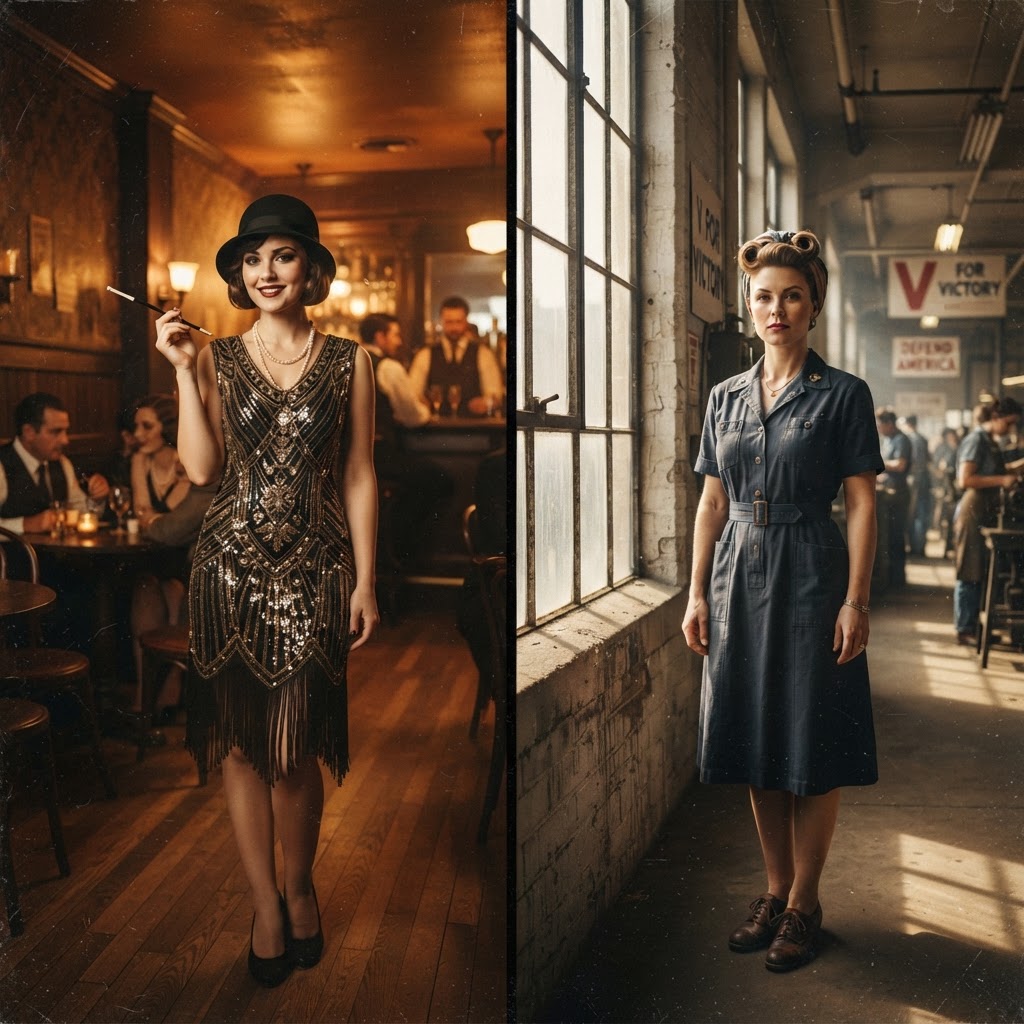
From Flappers to Victory Rolls: The Cultural Significance of 1920s–1940s Fashion
Between the roaring euphoria of the Jazz Age and the quiet resilience of the wartime home front, fashion between 1920 and 1949 told stories that no history book could fully capture. These were decades of radical self-reinvention, political upheaval, and extraordinary creativity — and the clothes people wore were the most intimate record of all. What can the hemlines, silhouettes, and fabrics of this era still teach us today?
The 1920s: Dressing for a World Reborn
The First World War had ended, and with it, a rigid Victorian world that had corsetted not just bodies but entire ways of being. The 1920s arrived like a deep, gasping breath. Women who had worked in factories, driven ambulances, and managed households alone while men were at war were not about to return to floor-length skirts and whale-bone constraints. Fashion reflected this seismic shift with startling speed.
The flapper silhouette — drop-waisted dresses, hemlines climbing daringly toward the knee, loose boyish cuts that abandoned the hourglass entirely — was nothing short of revolutionary. To wear a flapper dress in 1923 was a political act. It said: I own my body. I will move freely. I will dance.
Coco Chanel became the era's most important architect of liberation, introducing jersey fabrics borrowed from menswear and stripping away ornament in favor of ease. Meanwhile, the rise of Art Deco aesthetics brought geometric beading, bold metallic embroidery, and architectural structure to eveningwear — a visual language that borrowed from ancient Egypt, Cubism, and Modernist design all at once.
The cultural significance here is profound: the 1920s proved that fashion is never just decoration. The short hair, the cigarette holders, the cloche hats pulled low over newly-bobbed cuts — these were symbols of a generation demanding to be seen differently. When we wear or collect pieces from this era today, we carry that declaration forward.
The 1930s: Elegance Under Pressure
The Great Depression shattered the giddy optimism of the 1920s with brutal efficiency. By 1930, breadlines stretched around city blocks, and yet — perhaps because of this — fashion did something unexpected. It became more beautiful.
The bias cut, perfected by designer Madeleine Vionnet and immortalized by Jean Harlow on the silver screen, transformed simple fabric into liquid sculpture. Gowns clung and draped and moved with the body in ways that were simultaneously more sensual and more sophisticated than anything the previous decade had produced. The hemline dropped back to the floor, but this was no retreat — it was a reimagining.
The 1930s also saw the rise of Hollywood glamour as a democratizing force. When millions of Americans couldn't afford new clothes, they could still go to the cinema and study how Katharine Hepburn wore wide-leg trousers or how Greta Garbo draped a coat. Department stores and home dressmakers worked furiously to translate silver-screen style into affordable replicas. Fashion became aspirational in a new way — not about class signaling so much as shared dreaming.
For collectors, 1930s pieces carry a particular emotional weight. A bias-cut crepe evening gown or a pair of high-waisted wool trousers from this period represents not just extraordinary craftsmanship but an act of hope — the insistence on beauty even when beauty felt unaffordable.
The 1940s: Fashion as Resistance and Resilience
If the 1930s were about hope under hardship, the 1940s were about ingenuity under constraint. World War II transformed the fashion industry overnight. Fabric rationing meant that designers and home sewers alike had to do more with less — shorter skirts, narrower shoulders (temporarily abandoning the 1930s' broad silhouette), fewer pleats, simpler construction.
And yet the creativity that emerged from these restrictions was extraordinary. The utility dress, mandated by the British government's CC41 scheme, forced designers to prove that good design didn't require excess. Norman Hartnell and Hardy Amies created Utility collections that were elegant, functional, and democratic — clothing that looked good whether you were filing documents or volunteering as an air-raid warden.
In America, Claire McCardell was quietly inventing what would become sportswear as we know it — comfortable, practical, affordable separates that suited women who were now working in shipyards and munitions factories. Her popover dress, designed to be worn while doing housework, was a direct response to wartime life and an ancestor of every casual wardrobe that followed.
Then there was the counter-culture of fashion-as-defiance. The zoot suit, worn primarily by young Black and Latino men in American cities, was a conscious act of resistance against both racial inequality and wartime austerity norms. Its exaggerated proportions — high-waisted, wide-legged trousers, long draped jackets — used the language of fashion to claim space and visibility. The Zoot Suit Riots of 1943 showed just how threatening that act of sartorial self-determination could be to those who wished to suppress it.
Across the Atlantic, French women under Nazi occupation found their own forms of resistance. Parisians wore towering, elaborately constructed hats — not because materials were available (they weren't), but precisely because they weren't. Made from scraps, bicycle parts, and whatever could be salvaged, these hats were a refusal to be diminished. To dress with flair was to refuse the occupier's attempt to demoralize.
What These Decades Tell Us Today
Looking back at fashion from 1920 to 1949, several truths emerge that resonate with particular urgency in our current moment.
First, fashion has always been political. The idea that clothing is trivial or purely aesthetic is a myth. Every era of significant social change — women's suffrage, economic collapse, world war, civil rights struggle — has been accompanied by a parallel revolution in dress. What people wear signals who they believe themselves to be and who they insist the world acknowledge them as.
Second, constraint breeds creativity. Some of the most technically brilliant and artistically daring garments in fashion history were created during the Depression and wartime rationing. When resources are limited, ingenuity flourishes. The bias-cut gown and the utility dress are both monuments to what human creativity does under pressure.
Third, clothes carry memory. A beaded 1920s flapper dress is not merely a garment — it is a time capsule. It contains within its construction and its wear the body of someone who danced in it, the social world they inhabited, the freedoms they were fighting for. When we wear vintage clothing, we enter into a conversation with that history.
Fourth, fast fashion is the exception, not the rule. For most of human history, clothing was made to last. The extraordinary quality of construction in garments from the 1920s through the 1940s — the hand-stitched seams, the carefully matched plaids, the reinforced buttonholes — reflects a relationship with clothing that was intimate, careful, and long-term. Rediscovering that relationship through vintage fashion is one of the most meaningful ways to push back against today's disposable culture.
Finding Your Own Piece of History
At Ensemble, we believe that every vintage garment is a conversation waiting to happen — between the past and the present, between the person who made it and the person who wears it now. Our curated collection of authentic pieces from the 1920s through the 2010s includes garments from each of the decades explored in this post: the luminous beadwork of Jazz Age eveningwear, the fluid bias-cut pieces of the Depression era, and the beautifully constructed utility and workwear of the 1940s.
When you wear a piece from this era, you're not just making a style choice. You're making a statement about what you value: quality over quantity, story over novelty, and the radical idea that the best things — like the best moments in history — are worth preserving.