From Flappers to Utility Suits: What 1920s–1940s Fashion Still Tells Us Today
The decades between the two World Wars were among the most turbulent—and most stylish—in modern history. Fashion didn't just reflect the chaos and transformation of that era; it actively shaped it. Understanding what people wore between 1920 and 1949 is understanding how society negotiates freedom, crisis, and identity.
A Stitch in Time: Why These Three Decades Still Matter
Fashion is never just clothing. It is a living document, a wearable archive of everything a society fears, desires, mourns, and celebrates. Nowhere is this more vividly illustrated than in the extraordinary span of years between 1920 and 1949—a period bookended by the aftermath of one world war and the recovery from another, with a global economic collapse wedged dramatically in between.
To study the clothes of this era is to study the human spirit at its most resilient and inventive. And to wear them—or pieces inspired by them—is to carry that history forward.
The Roaring Twenties: Liberation Stitched Into Every Seam
When World War I ended in 1918, it left behind not just grief and reconstruction, but a radical appetite for reinvention. Women had entered the workforce in unprecedented numbers. They had proven themselves capable, independent, and adaptable. The corset—both literally and figuratively—was ready to come off.
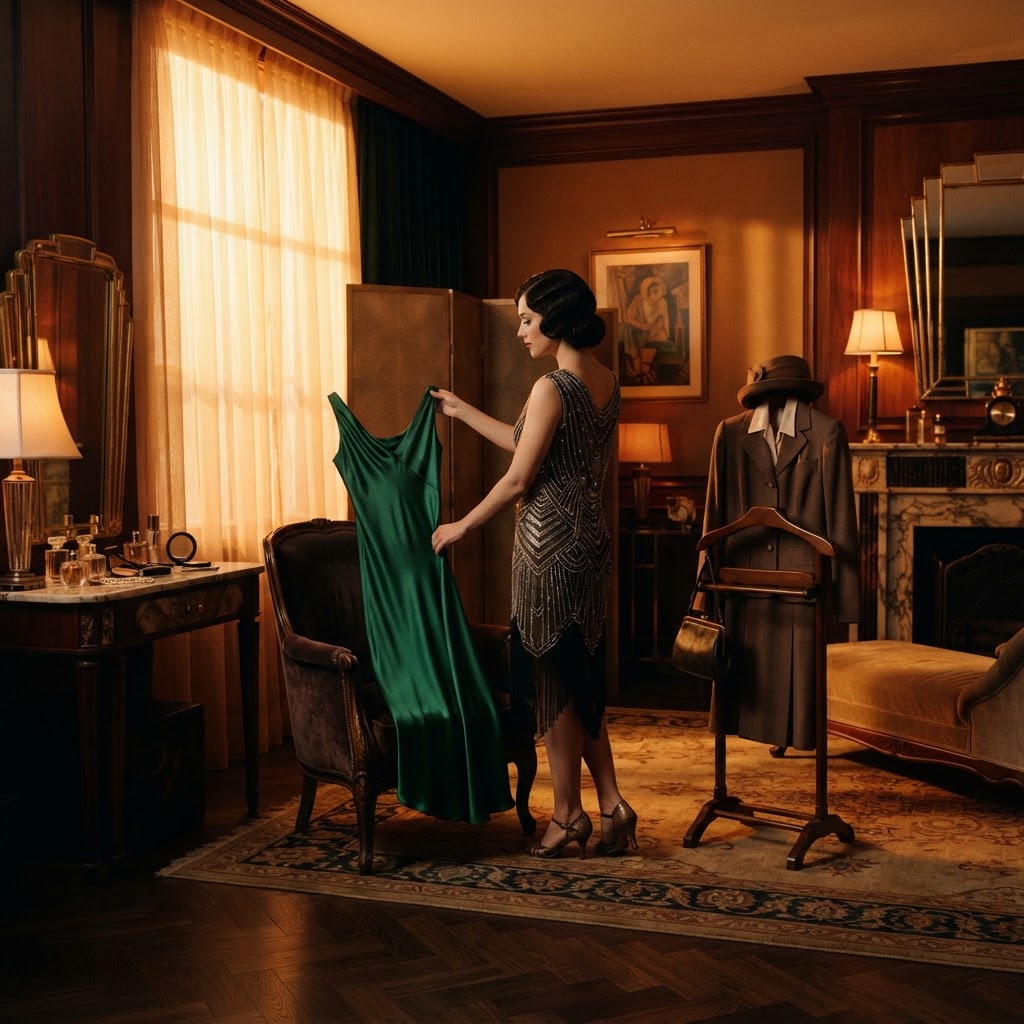
The flapper aesthetic that emerged in the early 1920s was nothing short of revolutionary. Hemlines climbed to the knee. Waistlines dropped to the hip. Hair was cropped into bobs and shingles. The silhouette shifted from the exaggerated hourglass of the Victorian and Edwardian eras to something deliberately boyish, linear, and free. Designers like Coco Chanel championed jersey fabrics—previously considered too casual and working-class—and draped them on the bodies of the elite. The message was unmistakable: comfort and movement were no longer luxuries reserved for men.
The cultural significance here is enormous. The flapper wasn't simply a fashion trend; she was a political statement made in silk and fringe. When young women rolled their stockings below the knee, wore sleeveless dresses, and danced the Charleston until dawn, they were actively rewriting the social contract. The clothing enabled the behavior, and the behavior demanded the clothing.
Beading, fringe, and intricate embroidery on evening wear weren't merely decorative—they were expressions of newfound abundance and optimism. Art Deco motifs, with their geometric precision and gilded symmetry, brought an almost architectural sensibility to fashion, reflecting a society dazzled by modernism, technology, and the promise of perpetual progress.
The Great Depression: Elegance as Resistance
Then the stock market crashed in October 1929, and everything changed.
The 1930s are one of the most paradoxical decades in fashion history: a period of devastating poverty that somehow produced some of the most breathtakingly beautiful, technically sophisticated clothing ever made. How do we explain that?
The answer lies in the psychology of crisis. When external circumstances are dire, people often cling to beauty as an act of resistance—a refusal to surrender dignity. Hollywood became the great democratizing force of 1930s style. Bias-cut gowns, pioneered by the legendary designer Madeleine Vionnet, cascaded down the bodies of screen goddesses like Jean Harlow and Greta Garbo, and the women sitting in darkened cinemas watched and dreamed and adapted what they saw.
The bias cut—fabric cut diagonally across the grain—was a genuine technical innovation. It allowed cloth to cling and flow simultaneously, creating a fluid, sensuous silhouette that required extraordinary skill to execute. This was aspirational fashion functioning as emotional sustenance. When you couldn't afford much, you could still aspire to grace.
At the everyday level, 1930s fashion was defined by practicality and ingenuity. Women learned to re-cut old dresses, add new collars and cuffs to refresh a tired garment, and sew from home patterns with fierce creativity. The house dress—a simple, utilitarian garment for domestic work—became a staple, and its very plainness was a kind of dignity too. You wore what you had, and you wore it well.
Men's fashion in this era similarly reflects the tension between hardship and aspiration. The broad-shouldered suit with its structured chest and tapered waist projected authority and capability at a time when both were desperately needed. The suit was armor for the job interview, for the breadline, for the business meeting that might save everything.
World War II: Fashion Under Constraint
If the 1930s asked fashion to survive scarcity, the 1940s asked it to serve the nation.
With World War II came rationing, restrictions, and an entirely new aesthetic vocabulary. In Britain, the Utility Clothing Scheme, launched in 1941, strictly regulated how much fabric could be used in a single garment. Skirts could not exceed a certain number of pleats. Trouser turn-ups were banned. Decorative stitching was limited. Fashion was, in the most literal sense, conscripted.
And yet—creativity flourishes under constraint. The 1940s silhouette, with its nipped waist, padded shoulders, and knee-length A-line skirts, is one of the most enduring and imitated in fashion history. The restrictions that wartime imposed paradoxically created an aesthetic of clean, confident simplicity that designers still return to today.
Women's trousers became widely accepted during this period, largely because women were filling factory and field roles vacated by men at war. This was a seismic cultural shift. The practical demands of war work accelerated a sartorial evolution that might otherwise have taken decades. Fashion, once again, was both mirror and engine of social change.
The Victory suit, the Land Girl's uniform of breeches and heavy boots, the turban worn by factory workers to keep hair safely away from machinery—these weren't just functional choices. They were symbols of participation, of shared sacrifice, of a new kind of womanhood that could no longer be unseen once the war was over.
What These Decades Teach Us Now
Looking back at 1920–1949 through the lens of fashion, several truths emerge that feel urgently relevant today.
First: clothing has always been political. Every generation that has told women what to wear—or told them they are frivolous for caring about what they wear—has missed the point entirely. What we put on our bodies communicates who we are, who we wish to be, and what we refuse to accept.
Second: constraint breeds creativity. The most innovative fashion moments of the 20th century didn't emerge from unlimited budgets and total freedom. They emerged from rationing, from poverty, from necessity. There is a lesson here for our current era of fast fashion excess: limits can liberate.
Third: vintage clothing is primary source material. When you hold a 1930s bias-cut dress, you are holding the hands of the woman who wore it—her hopes, her circumstances, her taste. That is irreplaceable.
Finding Your Own History at Ensemble
At Ensemble, we believe that authentic vintage clothing from these remarkable decades deserves more than a museum case. It deserves to be worn, appreciated, and understood.
Whether you're drawn to the beaded exuberance of a 1920s flapper dress, the sophisticated drape of a 1930s crepe evening gown, or the sharp, purposeful tailoring of a 1940s utility jacket, each piece in our marketplace carries a story that no reproduction can replicate. Browse our curated 1920s–1940s collection and bring a little living history into your wardrobe. Because the best way to honor the past is to wear it forward.