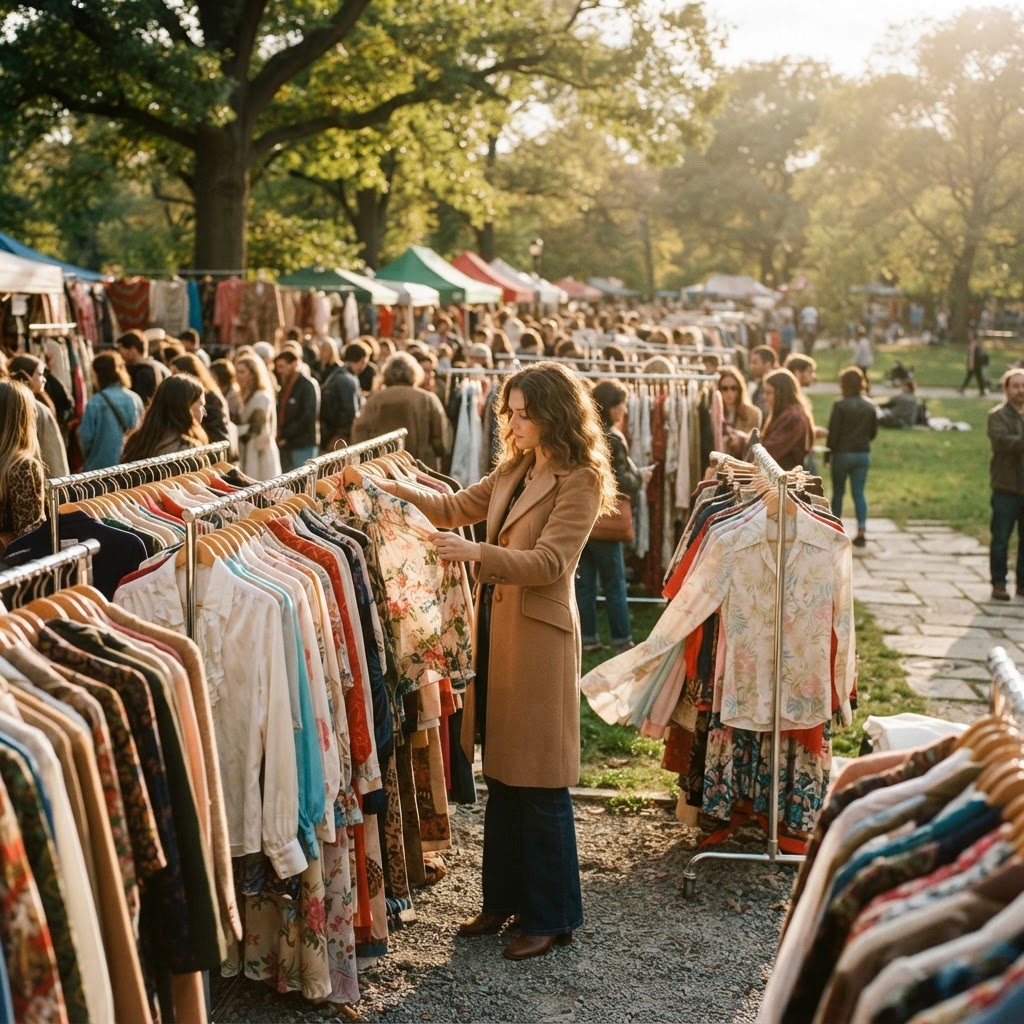
Dressed in the Past, Saving the Future: How Vintage Fashion Is the Ultimate Eco-Conscious Choice
In a world drowning in fast fashion waste, the most radical style statement you can make is wearing something that already exists. Vintage fashion isn't just aesthetically rich — it's one of the most powerful tools we have for building a sustainable wardrobe. Here's why shopping vintage is good for the planet, your personal style, and the soul of fashion itself.
The Fashion Industry's Dirty Secret
The global fashion industry is responsible for approximately 10% of annual carbon emissions worldwide — more than international aviation and maritime shipping combined. Every year, an estimated 92 million tonnes of textile waste ends up in landfills, and the relentless churn of fast fashion production cycles only accelerates the damage. Synthetic dyes poison waterways. Polyester microfibers infiltrate ocean ecosystems. Garment workers in developing countries bear the human cost of our hunger for cheap, disposable clothing.
But there's a quieter revolution happening in wardrobes across the world — one stitched together from decades past. Vintage fashion, the practice of wearing pre-loved clothing from the 1920s through the early 2010s, is emerging not just as a style trend but as a genuine act of environmental resistance.
What Makes Vintage Fashion Inherently Sustainable?
At its core, vintage fashion operates on the most fundamental principle of sustainability: using what already exists. When you purchase a 1970s suede jacket or a 1990s silk slip dress, you are extending the life of a garment that has already been manufactured. No new raw materials were harvested. No new factory emissions were generated. No new packaging was produced and discarded.
This concept is known as circular fashion — keeping clothing in use for as long as possible, thereby reducing the demand for new production. Every vintage piece that finds a new home is one fewer item destined for a landfill and one fewer order placed with an exploitative supply chain.
Consider the math: the average American throws away approximately 81 pounds of clothing per year. If even a fraction of shoppers redirected a portion of their clothing budget toward vintage and secondhand markets, the cumulative environmental impact would be staggering.
The Carbon Cost of "New" vs. The Carbon Savings of "Pre-Loved"
Producing a single new cotton T-shirt requires roughly 2,700 liters of water — enough drinking water for one person for 2.5 years. A pair of jeans demands nearly 10,000 liters. When you choose a vintage Levi's denim jacket from the 1980s instead of a newly manufactured alternative, you're effectively saving all of the water, energy, and emissions that would have gone into creating its replacement.
Studies suggest that extending the life of a garment by just nine additional months reduces its carbon, water, and waste footprint by around 20–30%. Vintage clothing, by definition, has already outlived multiple wardrobe cycles. A dress from the 1950s that still turns heads today has been doing sustainability work for seven decades.
Vintage as a Rejection of Planned Obsolescence
One of fast fashion's most insidious strategies is planned obsolescence — designing clothes to feel out of style within a season, manufacturing them to fall apart within a year, and flooding the market with micro-trends that render last month's purchases feel instantly dated.
Vintage fashion rejects this entirely. A 1940s wool coat is not subject to the whims of a trend cycle engineered by a corporate marketing team. A 1960s mod shift dress doesn't become irrelevant because a fast fashion retailer decided florals were "out." Vintage pieces carry their own internal logic of beauty — one built on craftsmanship, material quality, and design intention that transcends seasonal noise.
When you invest in vintage, you're also investing in slow fashion values: buying less, choosing well, and making it last. This mindset shift is arguably just as important as the environmental metrics.
The Quality Argument: Built to Last vs. Built to Fail
There's a reason that mid-century garments from the 1940s and 1950s still exist in wearable condition today. Manufacturing standards before the rise of mass-market fast fashion demanded genuine quality. Natural fibers — wool, silk, cotton, linen — were used because synthetic alternatives hadn't yet flooded the market. Seams were reinforced. Hems were deep enough to let out and re-let as needed. Buttons were sewn with intention.
Modern fast fashion, by contrast, is often constructed from low-grade polyester blends engineered to pill, shrink, and unravel within months. The environmental tragedy here is double: not only does fast fashion consume enormous resources to produce, but it also fails so quickly that consumers are forced back into the purchasing cycle almost immediately.
Choosing vintage is choosing durability by default. The piece you find at a vintage marketplace has already proven itself across decades of wear, washing, and storage. It's a garment that earned its place in the world.
Decades of Eco-Conscious Inspiration
Different eras of vintage fashion offer unique entry points for the sustainability-minded shopper:
- 1920s–1930s: Bias-cut silhouettes and luxurious natural fabrics. Pieces from this era are rare and precious, representing the apex of handcraft in womenswear.
- 1940s–1950s: Wartime rationing culture produced remarkably efficient, well-constructed garments. The "make do and mend" ethos of the 1940s is practically a sustainability manifesto.
- 1960s–1970s: The rise of counterculture brought with it a celebration of individual expression over conformity — a spirit deeply aligned with anti-consumerist values.
- 1980s–1990s: Power shoulders, grunge, and minimalism all coexist in this era's rich output, much of it made before fast fashion fully took hold.
- 2000s–2010s: Early Y2K pieces are now entering the vintage market, offering accessible price points and a nostalgic aesthetic with growing collector appeal.
Vintage Fashion and the Ethics of Consumption
Beyond carbon and water metrics, vintage fashion asks us to reckon with the ethics of consumption itself. Fast fashion's business model depends on manufacturing in countries with weak labor protections, paying poverty wages, and externalizing environmental costs onto communities with little political power to resist.
Shopping vintage decouples your spending from that system. When you purchase a secondhand garment, your money goes to individual sellers, small vintage businesses, and curated marketplaces — not to corporations profiting from exploitation. It's an imperfect solution to a systemic problem, but it's a meaningful one.
Styling Sustainably Without Sacrificing Aesthetic
One of the most persistent myths about sustainable fashion is that it requires sacrificing style. Vintage shopping demolishes that myth entirely. The breadth of aesthetic possibilities across nine decades of fashion history means that whether your style leans toward minimalist 1990s elegance, bold 1970s maximalism, or structured 1940s tailoring, the vintage market has something extraordinary waiting for you.
The key is knowing where to look — and shopping with intention rather than impulse. Build a wishlist of pieces that fill genuine gaps in your wardrobe. Prioritize natural fibers and quality construction. Think in terms of cost-per-wear rather than sticker price. A $120 vintage blazer you'll wear 200 times is infinitely more sustainable — and economical — than a $30 fast fashion alternative you'll discard after five wears.
Conclusion: Shop the Archive, Save the Planet
The most sustainable garment in the world is the one that already exists. Vintage fashion isn't a compromise or a sacrifice — it's a richer, more intentional, more beautiful way to dress that happens to be one of the most eco-conscious choices available to modern consumers.
At Ensemble, we believe that every decade of fashion history has something irreplaceable to offer — not just aesthetically, but ethically. Our curated marketplace connects lovers of authentic vintage clothing from the 1920s through the 2010s with pieces that have already proven their worth across time. When you shop Ensemble, you're not just finding something beautiful to wear. You're participating in a living archive, extending the story of a garment, and casting a vote for a fashion future that values craft, longevity, and the planet over disposability and excess.
The past has never looked so forward-thinking.