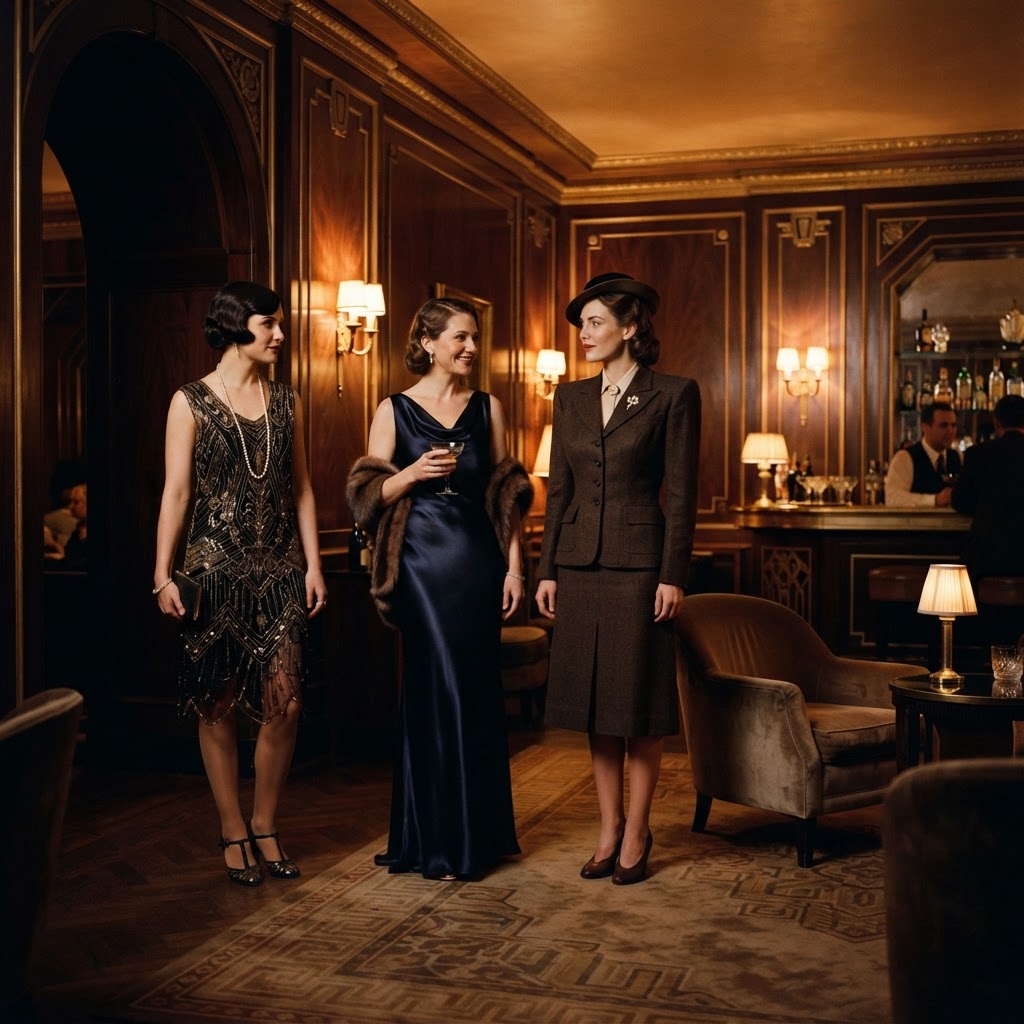
Dressed for the Times: What 1920s–1940s Fashion Reveals About the Modern World
From the liberated hemlines of the Jazz Age to the resourceful silhouettes of wartime rationing, the fashion of the 1920s through 1940s was never just about clothes. These decades dressed some of history's most seismic cultural shifts — and the garments that survived tell stories we're still learning to read. Here's why vintage fashion from this era matters more than ever.
The Roaring Twenties: Liberation Stitched into Every Seam
When we think of 1920s fashion, the image that surfaces is almost cinematic: a flapper in a beaded drop-waist dress, bobbed hair gleaming under chandeliers, cigarette holder in hand. But this image is far more than aesthetic nostalgia. It is a portrait of revolution.
The aftermath of World War I reshaped Western society in ways that are almost impossible to overstate. Millions of women had entered the workforce while men were at the front. They had driven ambulances, managed factories, and run households entirely on their own. When peace came, the expectation that they would simply lace themselves back into corsets and domestic invisibility was no longer tenable.
Fashion responded accordingly. The silhouette of the 1920s was a radical departure from everything that came before it. Hemlines climbed to the knee. Waistlines dropped to the hip. The rigid, hourglass corset was abandoned in favor of the boyish, androgynous figure championed by designers like Coco Chanel and Jeanne Lanvin. This wasn't mere stylistic whimsy — it was the body itself declaring autonomy. To dress like a flapper was to reject the ornamental femininity of the Victorian and Edwardian eras.
The materials told the story too. Jersey knit — a fabric previously considered too casual and masculine for womenswear — became a Chanel signature. Practicality was chic. Movement was chic. Being able to dance the Charleston without fainting was, finally, chic.
What does this tell us today? It reminds us that fashion has always been political, even when it masquerades as frivolous. Every time a dress code is contested, every time a silhouette shifts dramatically, there is a social negotiation happening underneath the fabric.
The Glamour of the 1930s: Beauty as Resistance
The Great Depression arrived like a curtain dropping on the party, and the fashion world shifted again — this time toward something more complex. You might expect an era of economic devastation to produce dull, austere clothing. Instead, the 1930s gave us some of the most breathtaking garments ever made.
Bias-cut gowns, perfected by the visionary designer Madeleine Vionnet, clung to the body like liquid. Hollywood became fashion's most powerful engine, and stars like Jean Harlow, Marlene Dietrich, and Greta Garbo became global style icons. The silhouette returned to the body — but in a way that was sensuous rather than restrictive, glamorous rather than corseted.
This tension between hardship and beauty is enormously instructive. When people have very little, the desire to feel beautiful, dignified, and seen does not disappear — it intensifies. Women of the Depression era made do with what they had. Feed sacks were turned into dresses. Patterns were shared between neighbors. Garments were let out, taken in, turned inside out, and remade. The ingenuity embedded in 1930s clothing is a testament to human creativity under constraint.
The rise of menswear-influenced fashion for women also accelerated during this decade. Dietrich's famous tuxedo suit scandalized and thrilled in equal measure. The boundaries of gendered dressing were being tested in ways that feel remarkably contemporary.
When we hold a bias-cut 1930s evening gown today, we are holding a paradox — depression-era desperation and extraordinary artistry occupying the same seams.
The 1940s: Utility, Sacrifice, and the Power of Making Do
If the 1930s produced glamour from scarcity, the 1940s formalized scarcity into a doctrine. World War II brought rationing, utility regulations, and material restrictions that fundamentally changed how clothing was designed, produced, and worn.
In the United Kingdom, the Utility Clothing Scheme dictated strict limits on fabric use. Skirts could only be so full. Pockets were rationed. Embellishments were largely prohibited. In the United States, War Production Board restrictions similarly mandated narrower silhouettes, shorter skirts, and the elimination of cuffs and pleats in trousers.
And yet — the fashion of the 1940s is remarkable. The broad-shouldered, nipped-waist silhouette of the early decade has an almost architectural power to it. Women's suits conveyed competence and authority at a time when, once again, women were filling roles previously reserved for men. The shoulder pad was not just a style choice; it was a statement of capability.
Homefront fashion also gave rise to extraordinary DIY culture. Victory suits were assembled from whatever could be sourced. Silk stockings, diverted to parachute production, were replaced by leg paint — women literally drawing seam lines up the back of their bare legs with eyebrow pencils. This kind of creative adaptation is both humbling and inspiring.
The end of the war brought Christian Dior's New Look in 1947 — a deliberately opulent response to years of austerity, featuring impossibly full skirts, tiny waists, and extravagant fabric use. The reaction was as divided as you'd expect. Some women wept with joy at the return of femininity and luxury. Others, accustomed to utility and practicality, found it retrograde and wasteful. The debate about what women should wear — and who gets to decide — was as fierce in 1947 as it is in any comment section today.
What These Decades Teach Us About Fashion's Deeper Purpose
Looking across the arc from 1920 to 1949, several truths emerge that resonate with startling clarity in the present moment.
First, fashion is a chronicle of power. Every shift in silhouette, every new material or construction method, maps onto a shift in who holds power and who is demanding more of it. The dropped waist of the 1920s, the bias cut of the 1930s, the utility suit of the 1940s — each was a response to a world in flux.
Second, clothing is a record of resilience. The women who dyed flour sacks and drew stocking seams on their legs were not making a fashion statement in the Instagram sense. They were insisting on dignity and self-expression in conditions designed to strip both away. That insistence is woven into every surviving garment from the era.
Third, vintage fashion connects us to real lives. A 1940s utility dress was worn by a specific woman, in a specific city, during a specific moment of world history. When you wear it or own it today, you are in some sense in conversation with her — with her choices, her constraints, her creativity.
Finally, the sustainability lessons are undeniable. The 1930s and 1940s demonstrated, under duress, what the fashion industry is only beginning to reckon with voluntarily: that clothing can be made to last, repaired, remade, and passed on. The throwaway culture that would come to define fast fashion was unthinkable to a generation that mended everything.
Wearing History: Why It Matters Now
We are living through our own period of upheaval — environmental, political, technological. The questions being asked about identity, gender, labor, and sustainability are not new ones. They were being asked, in fabric and thread, a hundred years ago.
That's part of what makes authentic vintage fashion from this era so compelling. These pieces are not costumes. They are primary sources. To wear a genuine 1920s beaded dress or a 1940s utility suit is to wear evidence — of a world transforming itself, one hemline at a time.
At Ensemble, we believe that vintage fashion is one of the most honest forms of cultural memory we have. Our collection of authenticated pieces from the 1920s through the 2010s exists not just to dress you beautifully, but to connect you to the continuum of human expression that clothing has always represented. When you find your piece on Ensemble, you're not just shopping — you're inheriting a story. And that story, as these decades remind us, is always worth telling.