Dress Through the Decades: How Vintage Fashion Can Help You Discover Your True Personal Style
Your personal style isn't something you find overnight — sometimes it takes a journey through the past to understand who you are today. Vintage fashion offers a unique portal into different eras, aesthetics, and attitudes that can unlock something deeply personal about the way you present yourself to the world. Whether you're drawn to the glamour of the 1940s or the grungy rebellion of the 1990s, the decades have something powerful to teach you about yourself.
Why Vintage Fashion Is the Ultimate Style Laboratory
In a world of fast fashion and algorithm-driven trend cycles, it can feel impossible to carve out a look that's genuinely yours. Everything on the high street starts to blur together, and before long, you're wearing the same five silhouettes as everyone else in your city. This is exactly why so many style-conscious individuals are turning to vintage clothing as a means of self-discovery.
Vintage fashion isn't just about nostalgia. Each decade produced a distinct visual language — a set of silhouettes, fabrics, colors, and attitudes that reflected the cultural moment. When you try on a 1970s wrap dress or slip into a 1950s circle skirt, you're not just wearing old clothes. You're trying on a philosophy, an era's answer to the question: What does it mean to be alive and stylish right now?
The beauty of shopping vintage is that it forces you to slow down and ask yourself what genuinely resonates — not what's trending on social media this week.
A Decade-by-Decade Guide to Finding Your Aesthetic
The 1920s & 1930s: Drama, Sophistication, and Art Deco Glamour
If you find yourself drawn to bias-cut silk gowns, intricate beading, and an air of Old Hollywood mystery, the 1920s and 1930s might be calling your name. The flapper aesthetic of the '20s was revolutionary — it liberated women from corsets and introduced a breezy, boyish silhouette that felt radical at the time. By the '30s, fashion had grown more languid and seductive, with floor-length gowns that clung to the body like liquid.
This might be your decade if you love: statement jewelry, luxurious fabrics, theatrical entrances, and the idea that getting dressed is a performance.
The 1940s & 1950s: Structure, Femininity, and Postwar Optimism
The 1940s utility silhouette — broad shoulders, nipped waists, A-line skirts — speaks to those who value practicality without sacrificing elegance. Wartime rationing created a fashion philosophy of doing more with less, and the results were surprisingly chic. By the 1950s, that restraint gave way to full-blown New Look femininity: petticoats, patent leather kitten heels, and polished coordinates that felt like a celebration.
If you feel most yourself when you're put-together, polished, and a little retro-cute, this era deserves a place in your wardrobe. Circle skirts, Peter Pan collars, and wiggle dresses are timeless pieces that translate beautifully into contemporary dressing.
The 1960s & 1970s: Freedom, Color, and Self-Expression
Perhaps no two decades were more stylistically adventurous than the '60s and '70s. The mod movement of the 1960s introduced geometric prints, op-art patterns, and the mini skirt — a garment that was essentially a political statement. Meanwhile, the counterculture brought peasant blouses, fringe, and a deliberately anti-establishment approach to dressing.
The 1970s expanded on that freedom with boho maxi dresses, wide-leg trousers, platform shoes, and an earthy, eclectic palette of mustard, rust, and forest green. If you're the type who mixes prints confidently and believes fashion should feel like play, you'll find a spiritual home somewhere in these two decades.
The 1980s: Power, Excess, and Unapologetic Boldness
Love it or mock it, the 1980s produced some of the most memorable fashion in modern history. Power shoulders, electric neon, oversized blazers, animal prints, and Dynasty-worthy sequins defined a decade that refused to whisper. This era is perfect for the person who believes more is more — who isn't afraid to walk into a room and be seen.
Beyond the excess, the '80s also gave us incredible street style innovation: the emergence of hip-hop fashion, the punk-to-mainstream pipeline, and a proliferation of subcultures each with their own strict aesthetic codes. Finding a well-preserved vintage blazer with structured shoulders or a sequined cocktail dress from this era is like finding wearable cultural history.
The 1990s & 2000s: Cool, Ironic, and Effortlessly Undone
For many younger vintage shoppers, the 1990s represent the sweet spot — close enough to feel familiar, far enough to feel fresh. Grunge aesthetics (flannel, combat boots, slip dresses over band tees), minimalist Calvin Klein-esque tailoring, and 90s logomania all coexist within the decade, making it one of the most stylistically diverse eras to mine.
The 2000s, meanwhile, are having a full-blown renaissance. Low-rise denim, velour tracksuits, tiny structured handbags, and butterfly clips are no longer relics — they're fashion-forward choices reclaimed by a new generation. If you're someone who leans into nostalgia with a knowing wink, the early aughts have plenty to offer.
How to Build a Cross-Decade Wardrobe That Feels Cohesive
One of the most exciting things about developing a personal style through vintage is the freedom to mix decades. Some of the most compelling dressers aren't loyal to any single era — they layer a 1940s silk blouse under a 1990s oversized blazer, or pair 1970s flared trousers with a 2000s strappy heel.
Here are a few principles to keep your cross-decade wardrobe from feeling chaotic:
- Anchor with neutrals. Vintage pieces in black, cream, camel, and navy tend to play well across eras.
- Let one statement piece lead. If you're wearing a dramatic 1960s printed shift dress, keep the rest understated.
- Pay attention to proportion. Mixing decades successfully often comes down to balancing volume — a full 1950s skirt pairs beautifully with a slim 1990s turtleneck.
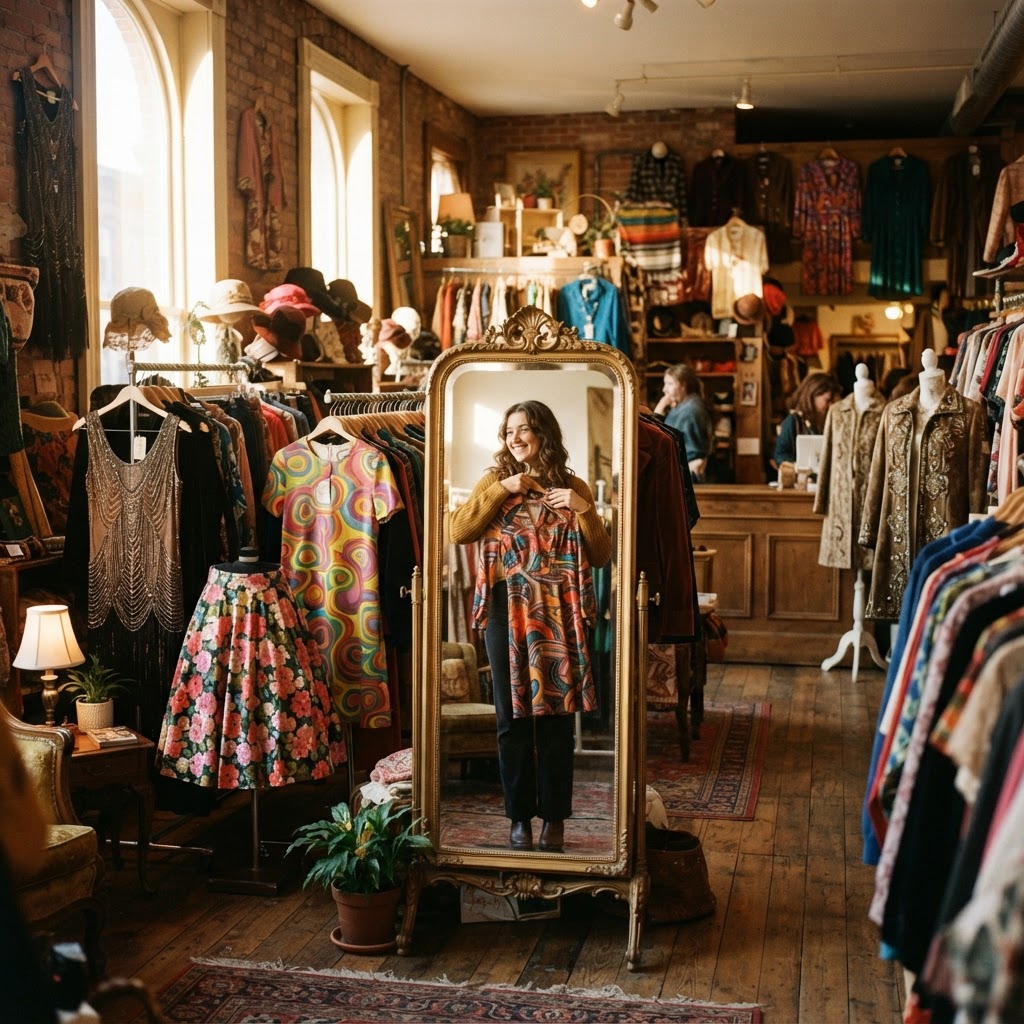
- Follow your gut. If two pieces make you feel electric when you hold them next to each other in the mirror, trust that instinct.
The Deeper Work: What Does Your Style Say About You?
Personal style, at its best, is a form of self-knowledge. When you notice that you keep gravitating toward the structured tailoring of the 1940s, that tells you something about how you want to move through the world — with intention, with formality, with a sense of occasion. When you can't resist a psychedelic 1960s print, that might be your inner life asking for more color and playfulness.
Vintage shopping invites this kind of reflection precisely because it removes the noise of current trends. You're not asking what's fashionable? You're asking what do I love? — and those are very different questions.
Take your time with it. Try pieces you wouldn't normally consider. A 1980s oversized blazer might feel absurd on the hanger and transformative on your body. A 1930s silk slip dress might unlock a version of yourself you hadn't met before. This is the magic of vintage: it expands your sense of what's possible.
Start Your Journey with Ensemble
Finding authentic, high-quality vintage pieces used to require hours of thrift store digging and a lot of luck. That's why Ensemble exists — to bring together a carefully curated marketplace of authentic vintage clothing spanning the 1920s through the 2010s, so you can explore the full spectrum of fashion history from one trusted destination.
Whether you're just beginning to experiment with vintage or you're a seasoned collector looking for that rare 1950s cocktail dress or 1970s denim jacket, Ensemble makes the hunt joyful. Because finding your personal style should feel like discovery — and every great discovery deserves the right place to begin.