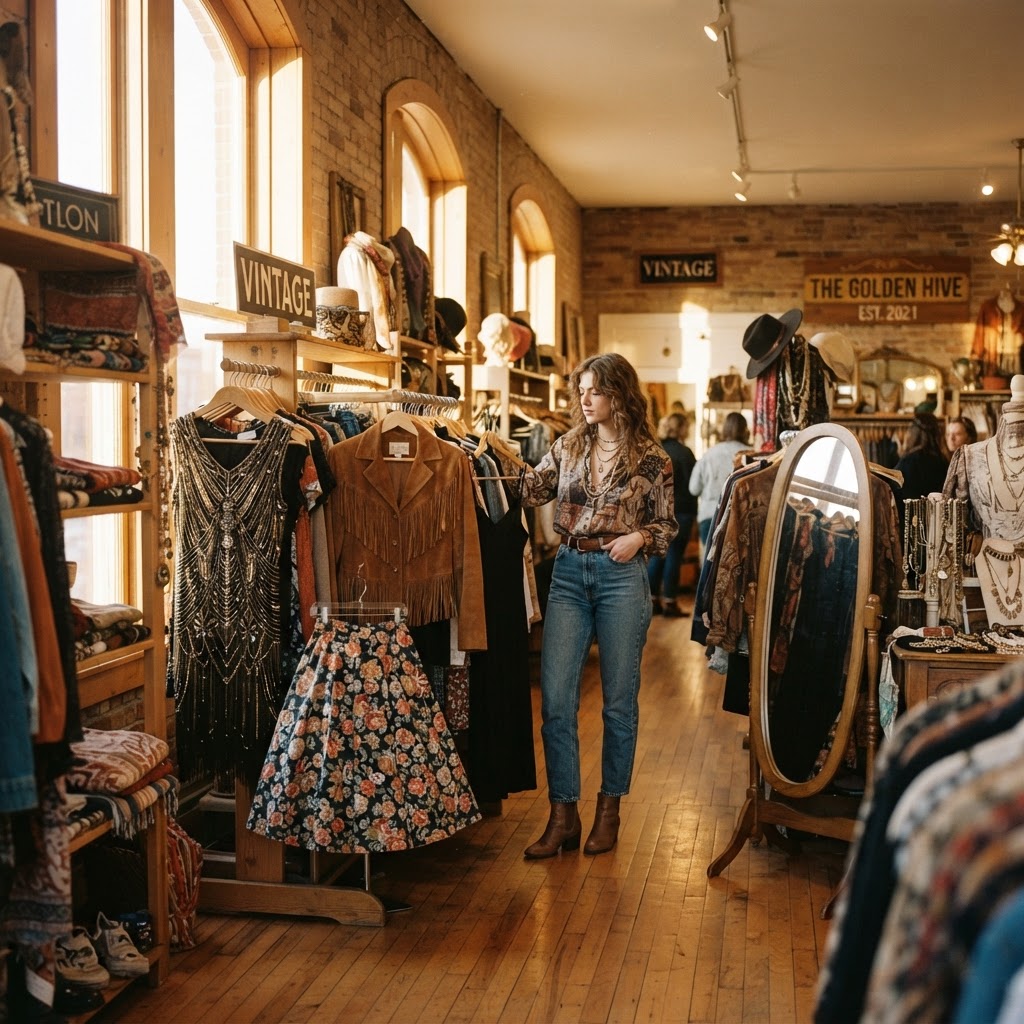
Dress Like Yourself: How to Find Your Personal Style Through Vintage Fashion
Your personal style isn't something you invent — it's something you uncover. Vintage fashion, with its rich tapestry of decades, silhouettes, and subcultures, is one of the most powerful tools you have for that discovery. Here's how to use the past to dress like your most authentic self.
Why Vintage Fashion Is the Ultimate Style Laboratory
Fast fashion hands you a uniform. Vintage fashion hands you a time machine. When you browse pieces from the 1930s through the 1990s, you're not just shopping — you're conducting a deeply personal experiment in aesthetics, identity, and self-expression. Every decade had its own visual language, and somewhere in that century-spanning conversation, your personal style is waiting to be found.
The beauty of vintage is that nothing is trend-dependent. A 1940s swing dress doesn't care what's on the runway this season. A 1970s shearling coat isn't trying to be relevant — it simply is. This freedom from the present moment gives you space to ask a more honest question: not what's in style, but what is my style?
Start With a Decade That Calls to You
Before you think about rules or body types or color theory, start with feeling. Flip through images of fashion from each decade and notice where your eye lingers. Do the sharp-shouldered power suits of the 1980s make you feel powerful just looking at them? Does the delicate beadwork of 1920s flapper dresses feel like a language you've always spoken? Your gut reaction is data.
Each decade carries a distinct emotional signature:
- 1920s–1930s: Glamour, deco geometry, languid elegance. Think drop waists, bias-cut silk, and art nouveau embellishment.
- 1940s–1950s: Structure, femininity, and optimism. Nipped waists, full skirts, and tailored menswear-inspired separates dominate.
- 1960s: Mod rebellion and Space Age playfulness. Mini hemlines, graphic prints, and bold color blocking.
- 1970s: Earthy bohemia meets Studio 54 glam. Flared denim, peasant blouses, wrap dresses, and luxurious textures.
- 1980s: Maximalism as a philosophy. Power shoulders, neon, animal print, and the unapologetic pursuit of more.
- 1990s: Cool-girl minimalism alongside grunge chaos. Slip dresses, oversized flannels, Calvin Klein simplicity, and combat boots.
- 2000s–2010s: Irony, logomania, and the beginning of vintage self-awareness. Low-rise denim, velour tracksuits, and indie sleaze.
There's no wrong answer here. The decade that excites you most is the right starting point.
Build a Foundation With Iconic Silhouettes
Once you've identified your decade of emotional resonance, focus on silhouette before anything else. Silhouette is the architecture of an outfit — it's what reads from across the room before anyone registers the fabric or print.
If you're drawn to the 1950s, experiment with full circle skirts and fitted cardigans. If the 1970s speak to you, try a high-waisted wide-leg trouser paired with a simple knit top. If you love the 1990s minimalist aesthetic, hunt for clean-lined blazers and slip dresses in muted tones.
The key exercise here is to wear these silhouettes in real life — not just admire them on a screen. Something that looks perfect on a 1965 model might feel completely wrong on your body, or might feel like coming home. You won't know until you try.
Mix Decades Like a Pro
Here's the secret that separates vintage collectors from people who look like they're in costume: decade-mixing. The most compelling personal styles are almost never mono-decade. They're conversations between eras.
Try pairing a 1940s structured blazer with 1990s straight-leg jeans and simple loafers. Layer a 1970s printed blouse under a 1980s oversized wool coat. Wear a 1960s mod shift dress with contemporary white sneakers. These pairings create something that feels both nostalgic and entirely modern — a visual signature that is distinctly you.
When mixing decades, follow one guiding principle: let one era lead and the other support. If your 1950s full skirt is the star, keep everything else understated. If your 1980s statement coat is doing the heavy lifting, let the pieces underneath breathe.
Identify Your Style Anchors
As you experiment, you'll start noticing patterns in what you reach for repeatedly. These are your style anchors — the recurring elements that feel most authentically you. Maybe it's always a cinched waist. Maybe it's a consistent love of texture over print. Maybe you always gravitate toward menswear-influenced pieces regardless of the decade.
Make a list. These anchors become your personal style criteria, and they make shopping — especially vintage shopping — infinitely more efficient and intentional. Instead of being overwhelmed by a rack of 500 pieces, you're scanning for the three or four qualities you know work for you.
Style anchors also help you bridge the gap between your aesthetic inspirations and your actual life. A 1920s beaded gown is magnificent, but if your anchors include ease of movement and practicality, you might love the embellishment detail but need it translated into something wearable — a beaded blouse or embellished loafer, for example.
Color, Fabric, and the Sensory Side of Style
Vintage fashion offers something modern clothing increasingly does not: exceptional fabric quality. A 1960s wool coat, a 1970s silk blouse, a 1950s cotton sundress — these pieces were built to last decades, and they have. Part of finding your personal style is understanding what fabrics feel right against your skin and what colors genuinely light up your face.
Spend time with color palettes by decade. The 1950s loved pastels and candy tones. The 1970s embraced warm earth tones — rust, mustard, olive, chocolate. The 1980s went electric. The 1990s went neutral. Notice which palette makes you feel most alive when you're wearing it, not just when you're admiring it.
Fabric matters too. If you consistently feel most comfortable in soft, drapey materials, 1930s and 1970s pieces in crepe, chiffon, and jersey will resonate. If you love structure and crispness, 1950s and 1960s tailoring is your playground.
Style Is Not Static — Let It Evolve
One of the most liberating truths about personal style is that it's allowed to change. The 1990s minimalist phase of your life might give way to a 1940s maximalist chapter. Your bohemian 1970s era might transition into a sleek 1960s mod period. This is not inconsistency — it's growth.
Vintage fashion supports this evolution beautifully because good vintage pieces hold their value. Unlike fast fashion, which deteriorates and becomes landfill, a well-made vintage blazer or dress can be resold, traded, or passed on when your style shifts. Building a wardrobe around vintage means building something that grows with you rather than being replaced by you.
Your Personal Style Is Already Inside You
Finding your personal style isn't about copying a decade or a fashion icon. It's about using the full spectrum of fashion history as a mirror — trying things on, paying attention to how they make you feel, and gradually assembling a visual vocabulary that communicates who you are without you having to say a word.
Vintage fashion gives you a richer, more varied palette than any single season of contemporary clothing ever could. It hands you a hundred years of human creativity and says: take what resonates, leave what doesn't, and make it yours.
At Ensemble, we've curated authentic vintage pieces from every decade of the twentieth century and beyond, specifically to help you do exactly that. Whether you're just beginning your style journey or refining a look you've been building for years, our marketplace is designed to make discovery feel less like shopping and more like archaeology — uncovering pieces that feel like they were always meant to be yours.