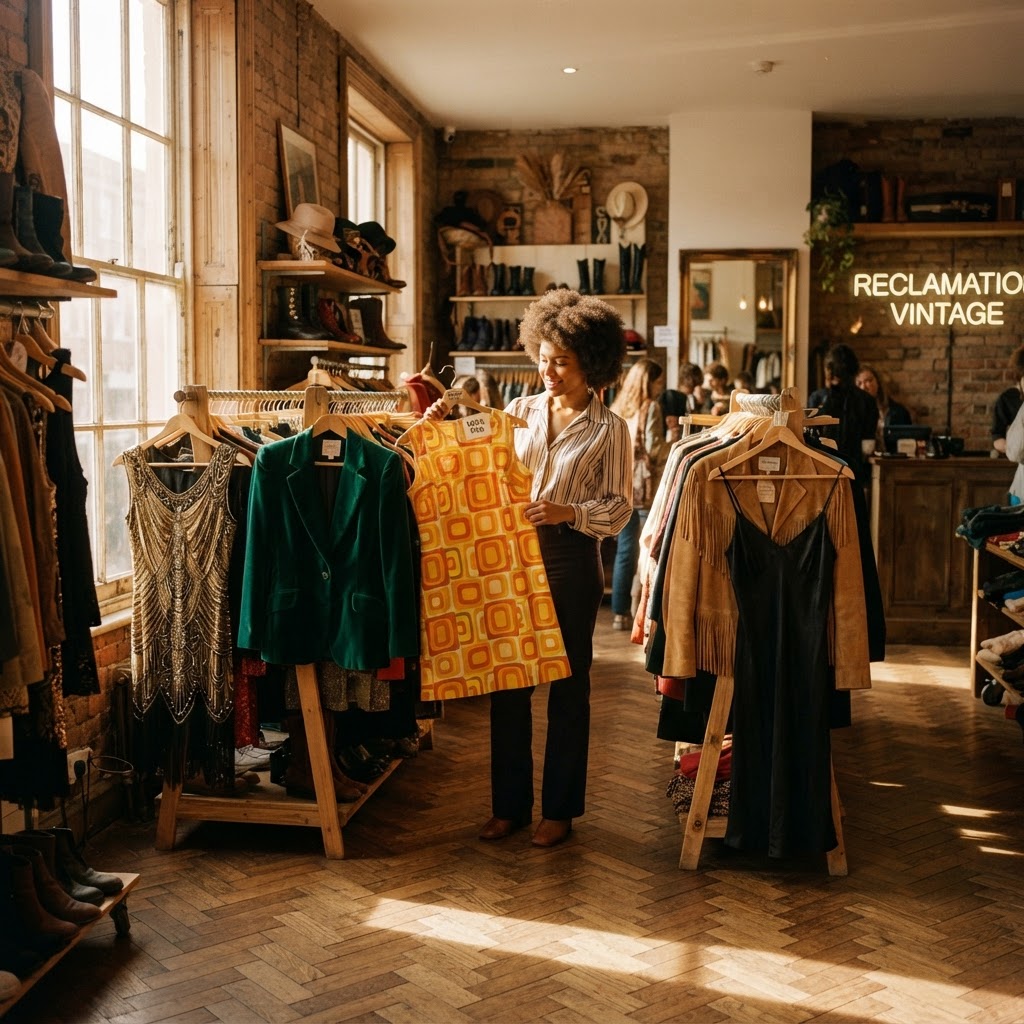
Dress Like You Mean It: Finding Your Personal Style Through the Magic of Vintage Fashion
Your personal style isn't something you find in a single shopping trip — it's something you excavate, decade by decade, like a fashion archaeologist with great taste. Vintage clothing gives you a time machine to try on different eras, aesthetics, and attitudes until something clicks. Here's how to use the rich history of fashion from the 1920s through the 2010s to build a wardrobe that's unmistakably, unapologetically you.
Why Vintage Fashion Is the Ultimate Style Laboratory
There's a reason stylists, designers, and fashion editors have always haunted thrift stores and vintage markets. Vintage clothing carries something modern fast fashion simply cannot manufacture: soul. Every decade produced its own visual language — shaped by war, music, politics, technology, and culture — and wearing pieces from those eras means plugging into something bigger than a seasonal trend cycle.
But beyond nostalgia, vintage fashion serves a deeply practical purpose for anyone on a style journey: it offers an enormous, diverse catalog of silhouettes, fabrics, and aesthetics to experiment with. Rather than being funneled into whatever a single brand decides is relevant this quarter, you get to draw from nearly a century of human creativity.
Let's walk through the decades and what each one might reveal about your personal style.
The 1920s–1940s: Structure, Elegance, and Intention
If you find yourself drawn to pieces from these foundational decades, you likely have an appreciation for deliberate dressing — the idea that clothing is armor, art, and identity all at once.
The 1920s brought drop-waist silhouettes, beaded embellishments, and the radical freedom of the flapper aesthetic. If you feel alive in a beaded drop-waist dress or love the geometry of Art Deco accessories, your style vocabulary includes glamour with a rebellious edge.
The 1930s and 1940s introduced bias-cut gowns, padded shoulders, and tailored suits that communicated power through precision. Women dressed with an almost architectural intentionality. If structured blazers with strong shoulders or swingy A-line midi skirts feel like a second skin, you likely gravitate toward what stylists call "old Hollywood" dressing — timeless, commanding, and quietly luxurious.
Style tip for sellers: When listing pieces from these decades, describe the construction details — hand-stitching, boning, lining quality. Buyers who shop this era care deeply about craft.
The 1950s–1960s: Optimism, Rebellion, and Identity
Few decades offer more stylistic contrast than the 1950s and 1960s, which is exactly what makes them so useful for self-discovery.
The 1950s gave us nipped waists, full skirts, and a candy-colored optimism that practically hums with energy. If a circle skirt or a twin set makes you feel like the best version of yourself, you likely resonate with feminine romanticism — a style rooted in joy, proportion, and sweetness without apology.
Then the 1960s arrived and blew everything up. Mod cuts, shift dresses, bold geometric prints, and the miniskirt redefined what a body was allowed to do in clothing. If you're drawn to clean lines, graphic prints, and pieces that feel almost futuristic, your instincts lean toward modern minimalism with an edge — a style that's confident, uncluttered, and sharp.
The late 1960s also birthed bohemian fashion: peasant blouses, fringe, florals, and flowing silhouettes influenced by global folk traditions. This aesthetic has never really left, and for good reason — if effortless, earth-connected dressing speaks to you, pieces from this era are your foundation.
The 1970s–1980s: Self-Expression Turned Up to Eleven
If the earlier decades were about discovering elegance and identity, the 1970s and 1980s were about broadcasting it at full volume.
The 1970s perfected the art of cool. Wide-leg trousers, wrap dresses, suede fringe jackets, and silk blouses with exaggerated collars defined a decade that balanced earthiness with disco glamour. Diane von Furstenberg's wrap dress alone could be the cornerstone of an entire personal style. If you feel most yourself in relaxed-but-intentional pieces with tactile, natural fabrics, the 1970s is your decade.
The 1980s declared that more is always more. Power shoulders, bold prints, metallic fabrics, oversized everything — this was fashion as performance. But beneath the maximalism was a genuine philosophy: dress to be seen, dress to be powerful, dress to take up space. If you're drawn to statement pieces, vibrant color, and clothing that enters the room before you do, lean into 1980s references without shame.
Style tip for sellers: 1980s pieces photograph beautifully against clean, minimal backgrounds — the contrast lets the boldness of the garment speak for itself.
The 1990s–2000s: The Decades That Keep Giving
For many shoppers under 40, the 1990s and 2000s occupy a strange middle ground between memory and nostalgia — close enough to feel personal, far enough to feel fresh again.
The 1990s gave us minimalist grunge (think slip dresses over band tees), sharp-edged minimalism (Calvin Klein's clean lines), and streetwear's first golden age (oversized flannels, bucket hats, track jackets). If your instinct is to look effortless — like you got dressed in five minutes and somehow look cooler than everyone who tried for an hour — 1990s pieces are your cheat code.
The 2000s are the decade that fashion is currently rehabilitating with great enthusiasm. Low-rise denim, velour tracksuits, logomania, micro bags, and butterfly clips are back — and this time, they're being worn with irony and affection in equal measure. If you enjoy playful, poppy, nostalgic dressing, the 2000s archive is a goldmine.
The 2010s: Vintage in Real Time
It may feel strange to call the 2010s "vintage," but pieces from this decade are increasingly collectible — particularly limited-edition streetwear drops, early-decade indie aesthetic pieces (floral dresses, ankle boots, oversized cardigans), and the athleisure revolution's early artifacts. Knowing what to preserve and sell from this era is an emerging skill that savvy Ensemble sellers are already developing.
How to Build a Cross-Decade Personal Style
Here's the secret that experienced vintage dressers know: the most interesting personal styles rarely come from one decade. They come from understanding what each era does best and combining them with intention.
Ask yourself these questions as you shop:
- What silhouettes make me feel most like myself? (Structured vs. fluid, fitted vs. oversized)
- What fabrics do I actually want to live in? (Silk, denim, wool, velvet?)
- What's my relationship with color and print? (Bold and graphic, soft and tonal, or pattern-mixed?)
- How much effort do I want my outfit to communicate? (Undone ease vs. precise, considered dressing)
Once you know your answers, you can shop across decades with clarity. A 1940s structured blazer over a 1990s slip dress with 1970s platform sandals isn't a costume — it's a personal uniform built from the best of human fashion history.
Conclusion: Your Style Story Starts at Ensemble
Finding your personal style through vintage fashion is one of the most rewarding — and sustainable — ways to build a wardrobe. It takes time, experimentation, and a willingness to try on identities until one fits just right. But that's the beauty of it.
At Ensemble, we've built a marketplace that makes this journey possible. Whether you're a seller curating decades of authentic finds or a buyer searching for the piece that finally makes your wardrobe make sense, Ensemble is where style history meets personal discovery. Browse our collections spanning the 1920s through the 2010s, and start building the wardrobe that's been waiting for you.