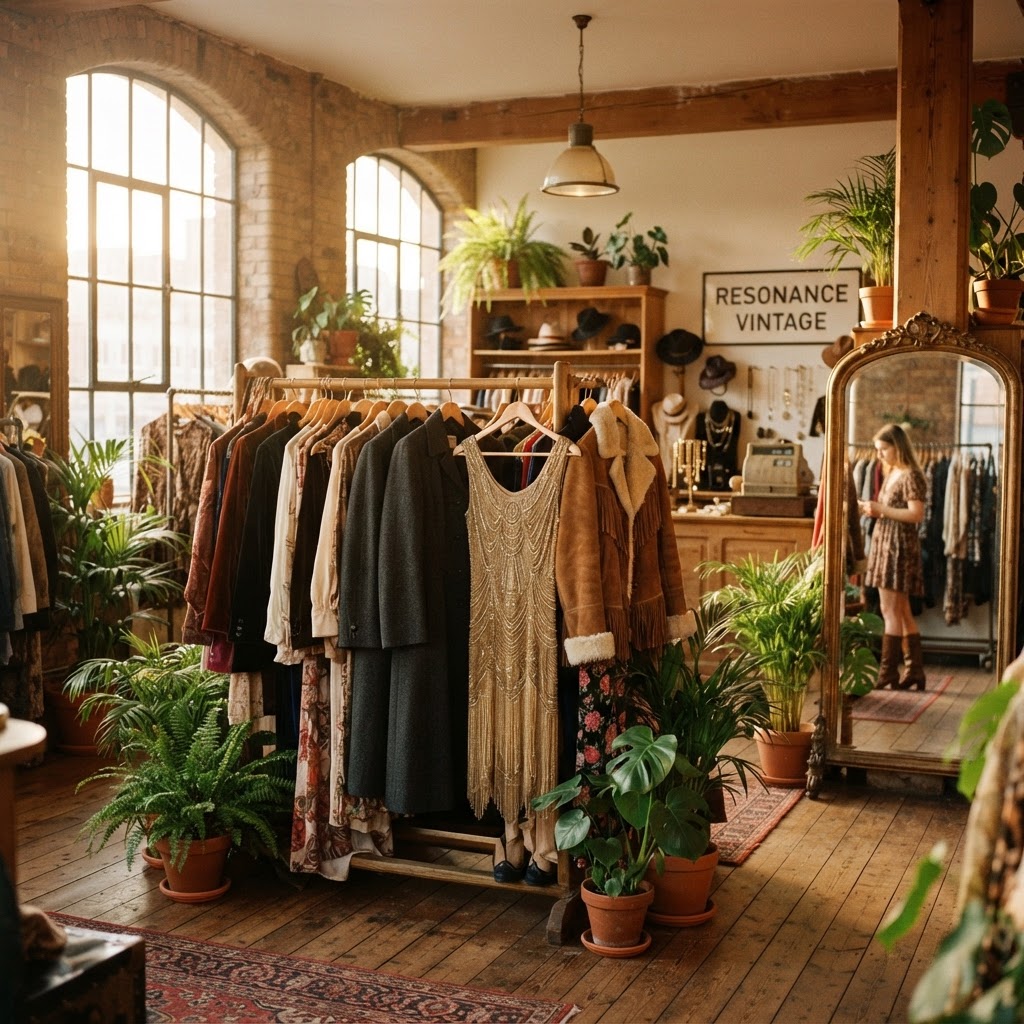
Dress Green, Dress Vintage: How Secondhand Style Is Saving the Planet One Decade at a Time
Fast fashion may dominate the headlines, but a quieter revolution is unfolding in the wardrobes of eco-conscious style lovers everywhere. Vintage fashion isn't just about looking good — it's about doing good, too. Discover how choosing authentic pieces from the past is one of the most powerful sustainable choices you can make today.
The Hidden Cost of "New"
Every time a brand-new garment rolls off a factory line, it carries an invisible price tag that never appears on the swing ticket. The global fashion industry is responsible for approximately 10% of annual carbon emissions worldwide, consumes enormous quantities of freshwater, and generates millions of tons of textile waste each year. A single pair of jeans requires roughly 1,800 gallons of water to produce. A polyester blouse can take more than 200 years to decompose in a landfill.
These numbers are staggering — and they're prompting a growing community of style-forward, environmentally aware shoppers to look backward for answers. Vintage fashion, it turns out, is one of the most elegantly simple solutions to one of the modern world's most complex problems.
What Makes Vintage Fashion Inherently Sustainable?
At its core, sustainable fashion is about reducing demand for new production. Every vintage piece you wear is a garment that already exists in the world. Its cotton was already grown, its dye already processed, its seams already sewn. When you give it a new life in your wardrobe, you're participating in what environmentalists call the circular economy — a system designed to eliminate waste by keeping materials in use for as long as possible.
Unlike recycled or "upcycled" fashion, which still requires industrial processing to transform materials, vintage clothing arrives ready-to-wear. There's no new manufacturing footprint, no additional water consumption, no fresh carbon cost. The garment simply continues its journey from one era and one wearer to the next.
The Decades as a Sustainability Roadmap
One of the most compelling arguments for vintage fashion lies in the craftsmanship standards of earlier decades. Prior to the mass-market explosion of fast fashion in the late 1990s and 2000s, clothing was largely built to last.
1920s and 1930s pieces were handcrafted with extraordinary attention to detail. Bias-cut silk gowns and hand-beaded flapper dresses represent hours of skilled labor — and they've survived nearly a century precisely because they were made so well. These aren't throwaway garments; they're heirlooms.
1940s and 1950s fashion was shaped by wartime rationing and postwar pragmatism. The "make do and mend" ethos of the 1940s produced structured, durable silhouettes from quality wool, cotton, and rayon. Fit was paramount, and tailoring was meticulous. A 1950s circle skirt or a sharply constructed day suit was designed to be worn season after season.
1960s and 1970s pieces introduced new synthetic fabrics alongside natural fibers, but the era also celebrated individual expression and longevity of style. A well-preserved 1970s wrap dress or suede jacket has already outlasted dozens of fast-fashion equivalents.
1980s and 1990s fashion brought bold experimentation with texture, volume, and color. Power blazers, denim jackets, slip dresses — these pieces defined generations and have proven remarkably resilient. Their return to trend in recent years is a testament to enduring design rather than disposability.
Even 2000s and 2010s vintage is now entering the conversation, with Y2K aesthetics and early-aughts minimalism finding enthusiastic new audiences. Buying these pieces secondhand rather than chasing contemporary knockoffs is an easy, immediate sustainable choice.
Vintage vs. "Sustainable" Fast Fashion: A Honest Comparison
The marketplace is flooded with brands claiming eco-friendly credentials — organic cotton lines, recycled polyester collections, carbon-neutral shipping pledges. While some of these initiatives are genuinely meaningful, many fall into the category of greenwashing: the practice of marketing products as environmentally responsible without substantive change to the underlying production model.
Vintage fashion sidesteps this problem entirely. There is no marketing budget required to certify its sustainability. The proof is in the provenance. A 1965 wool coat didn't generate a single gram of new carbon to reach your wardrobe. A "sustainably sourced" new coat, however well-intentioned, still required raw material extraction, manufacturing, international shipping, and retail packaging.
This isn't to dismiss the efforts of genuine sustainable fashion innovators — but it is an honest acknowledgment that the most sustainable garment is always the one already made.
The Joy of Slow Fashion
Beyond the environmental calculus, vintage shopping naturally encourages a slow fashion mindset — a more deliberate, considered approach to building a wardrobe. When you're hunting for an authentic 1970s shearling coat or a perfect 1950s cocktail dress, you're not impulse-buying. You're researching, curating, and investing.
This intentionality has a compounding sustainability effect. Wardrobes built slowly and thoughtfully tend to be worn more fully. A piece you searched for and genuinely love doesn't end up at the back of the closet — it becomes a cornerstone of your personal style. Fewer, better pieces worn with more frequency is exactly the equation the planet needs.
There's also a profound satisfaction in wearing something with a history. When you slip into a 1940s evening gown or a 1980s leather jacket, you're connecting with the craftspeople who made it, the people who wore it before you, and the cultural moment it came from. That connection is something no brand-new fast-fashion garment can replicate.
Practical Tips for Building a Sustainable Vintage Wardrobe
Ready to make the shift? Here are some practical principles to guide your vintage journey:
Start with what you already love. If you're drawn to structured tailoring, explore 1940s and 1950s pieces. If you love fluid, bohemian silhouettes, the 1970s is your era. Aligning your vintage search with your genuine aesthetic preferences means you'll wear what you buy.
Learn to assess quality and condition. Check seams, examine fabric weight, look for signs of wear that can be repaired versus damage that cannot. Vintage pieces at their best are built to outlast modern alternatives — but buying a piece in poor condition and never wearing it isn't sustainable either.
Think in terms of cost-per-wear. A $120 vintage blazer worn 150 times costs less per wear than a $30 fast-fashion equivalent worn 10 times — and the vintage piece won't end up in landfill at the end of its run.
Embrace minor alterations. Don't let an imperfect fit deter you from an otherwise exceptional piece. A skilled tailor can transform a near-perfect vintage find into a genuinely perfect one — extending its life for another generation.
Care for what you own. Vintage pieces often benefit from hand-washing, air drying, and proper storage. Treat them well, and they'll reward you with decades more wear.
A Style Revolution Rooted in the Past
The conversation around sustainable fashion can sometimes feel overwhelming — full of impossible choices, imperfect alternatives, and systemic problems too large for any individual consumer to solve. But vintage fashion offers something rare: a genuinely joyful, aesthetically rich, and immediately accessible way to participate in real change.
Every vintage garment chosen over a new one is a vote for a slower, more thoughtful fashion system. Every decade of design celebrated and reworn is a small act of resistance against the culture of disposability.
At Ensemble, we believe that the most exciting wardrobe is one that spans eras, honors craftsmanship, and wears its sustainability lightly — in every sense of the word. Whether you're drawn to the glamour of the 1930s, the boldness of the 1980s, or the effortless cool of the 1990s, our curated marketplace of authentic vintage pieces from the 1920s through the 2010s is your starting point for style that's as good for the planet as it looks on you. Explore our latest arrivals and find the piece that tells your story — and continues someone else's.