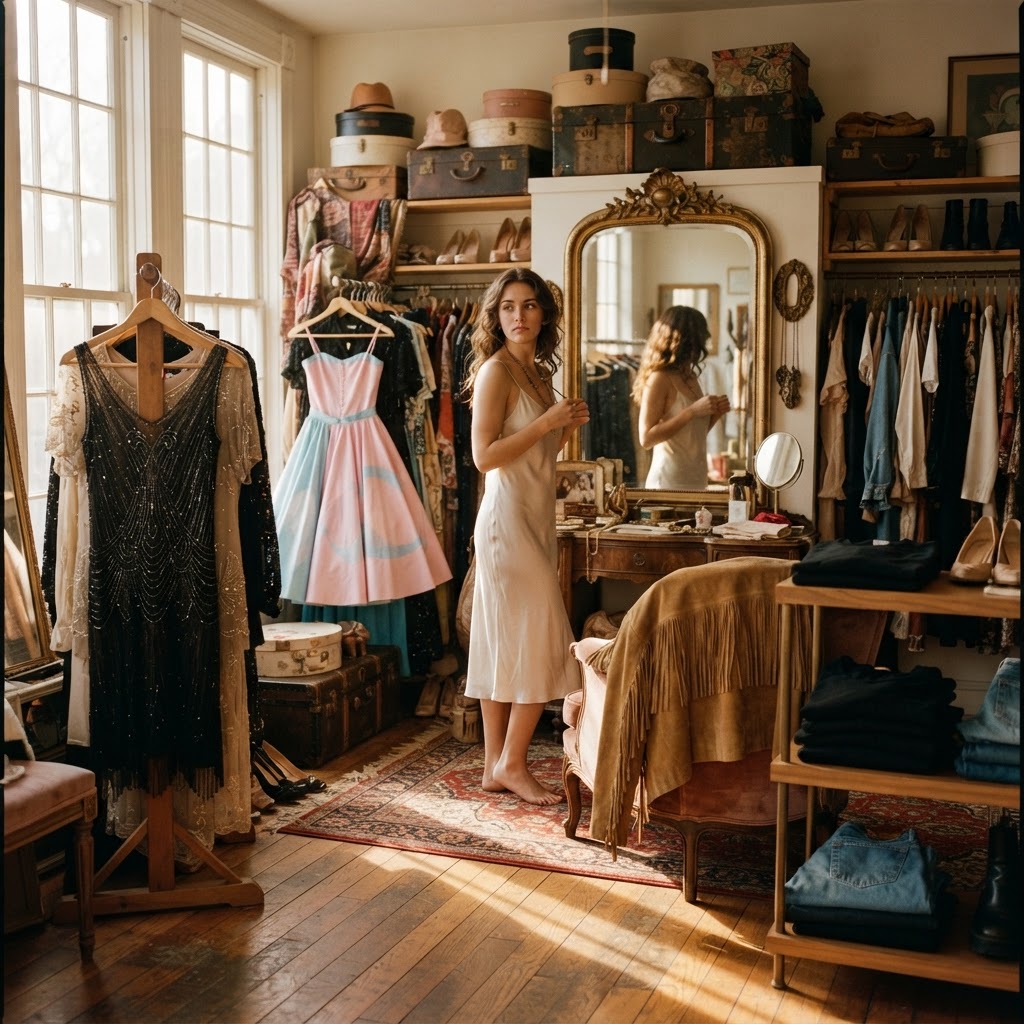
Dress Across the Decades: How Vintage Fashion Can Help You Discover Your True Personal Style
Finding your personal style can feel overwhelming in a world of fast fashion and fleeting trends—but what if the answer lies in the past? Vintage clothing from the 1920s through the 2010s offers a treasure trove of silhouettes, fabrics, and aesthetics to help you define exactly who you are. Here's how to use the decades as your guide.
Why Vintage Fashion Is the Ultimate Style Laboratory
Personal style isn't something you buy off a rack in a single afternoon. It's something you discover, refine, and evolve over time. And there's no better place to do that exploring than the rich, varied world of vintage fashion. Unlike fast fashion, which nudges everyone toward the same trending silhouette, vintage clothing spans nearly a century of radically different aesthetics, construction techniques, and cultural attitudes toward dress.
When you try on a 1940s wrap dress or slip into a 1970s suede fringe jacket, you're not just wearing a garment—you're stepping into a fully realized visual world. That feeling of recognition, of this is me, is exactly the kind of signal that helps you build a wardrobe with real identity and longevity.
Start With a Decade That Speaks to You Emotionally
Before you think about what looks good, think about what feels right. Flip through vintage lookbooks, old films, and decade-specific photography. Notice where your eye lingers. Do you feel drawn to the sharp geometric prints of the 1960s mod movement? The languid, oversized ease of 1990s minimalism? The ornate glamour of 1920s Art Deco beading?
Emotional resonance is the first clue. Many people find themselves consistently pulled toward one or two eras, even without knowing why. That pull is worth following. It often reflects deeper values—a love of structure and elegance, a desire for playfulness and color, or a preference for effortless cool.
A quick decade cheat sheet:
- 1920s–1930s: Drop waists, bias cuts, art deco embellishments, old Hollywood glamour
- 1940s–1950s: Tailored silhouettes, full skirts, nipped waists, polished femininity
- 1960s–1970s: Mod geometry, bohemian florals, wide lapels, earthy tones and fringe
- 1980s: Power shoulders, bold color blocking, athletic-inspired cuts, maximalism
- 1990s–2000s: Grunge, minimalism, slip dresses, logomania, denim everything
- 2010s: Normcore, streetwear fusion, vintage-inspired revivals
Use Silhouette as Your Style Compass
Once you've identified an era that excites you, the next step is understanding silhouette—the overall shape a garment creates on your body. This is where vintage shopping becomes a genuine style education.
Try on pieces outside your comfort zone. A 1950s circle skirt teaches you whether you love volume at the hem. A 1980s power blazer tells you something about how you feel in structured shoulders. A 1930s bias-cut slip dress reveals whether you prefer clothing that skims or clothing that shapes.
Personal style is essentially a consistent answer to the question: what silhouette makes me feel most like myself? Vintage fashion gives you decades of options to test against your own body and personality.
Mix Decades Intentionally to Create a Signature Look
One of the biggest misconceptions about vintage dressing is that you need to commit to a single era head-to-toe. You don't. In fact, the most compelling personal styles are almost always a cross-decade conversation.
Consider pairing a 1970s peasant blouse with 1990s straight-leg trousers and a crisp 1960s structured handbag. Or layering a 1940s gabardine blazer over a simple 2000s slip dress. These combinations feel fresh precisely because they're unexpected—and they force you to make deliberate choices about what you're keeping from each era.
When you mix decades, ask yourself:
- What do these pieces have in common? (Color palette, fabric weight, mood)
- Does the combination feel cohesive or chaotic?
- Which decade is doing the most work in expressing you?
Over time, your answers to these questions will reveal your true aesthetic DNA.
Pay Attention to Fabric and Craft
One of the quiet revelations of vintage shopping is the quality of construction and fabric in older garments. A 1960s wool shift dress is likely cut more precisely and sewn more durably than most of what's available today at any price point. A 1940s rayon blouse drapes in a way that modern polyester simply cannot replicate.
As you explore, notice whether you're drawn to the structure of woven fabrics or the softness of knits. Notice whether you prefer natural fibers—silk, wool, cotton, linen—or the particular nostalgia of vintage synthetics like Qiana nylon or Lurex. Your fabric preferences are another layer of your personal style, and vintage shopping makes those preferences impossible to ignore.
Build a Vintage Style Mood Board
Before you start adding pieces to your cart, it helps to get visual. Create a style mood board using images of vintage looks that genuinely excite you—not looks you think you should love, but ones that make you feel something.
Look for patterns in your board:
- Are the colors muted and earthy, or bright and saturated?
- Are the silhouettes relaxed or structured?
- Is there recurring texture—lace, leather, velvet, denim?
- Do the looks feel dressed-up, casual, or somewhere in between?
Your mood board is essentially a map of your style instincts. Use it as a filter when you're browsing vintage pieces so that you're shopping with intention rather than impulse.
Start With Versatile Vintage Anchors
If you're new to building a vintage wardrobe, resist the urge to go all-in on statement pieces right away. Instead, start with versatile anchor pieces that can carry a lot of outfit weight.
Great starting points include:
- A 1970s camel coat that works over almost anything
- A 1990s oversized blazer in a neutral tone
- A 1950s or 60s silk scarf that adds instant polish as a neck tie, headband, or bag accent
- A simple 1980s wool sweater in a great color
- Well-cut vintage trousers from any decade
These pieces integrate easily with what you already own, letting you test vintage pieces in real life rather than committing to an entirely new wardrobe at once.
Trust the Process—Style Takes Time
It's worth saying plainly: personal style is not an overnight achievement. It's a practice. You will buy things that don't work. You will discover you thought you loved a certain decade and actually find it uncomfortable to wear. That's not failure—that's information.
Vintage fashion is particularly good at accelerating this process because every piece comes with such a distinct point of view. There's very little neutral ground in a 1960s mod minidress or a 1970s pantsuit. These pieces make demands, and your reaction to those demands teaches you something real.
Conclusion: Let Ensemble Be Your Guide Through the Decades
Building a personal style through vintage fashion is one of the most rewarding things you can do for your wardrobe—and for your sense of self. It slows you down, makes you more intentional, and connects you to a much larger story of how humans have dressed and expressed themselves across generations.
At Ensemble, we've curated authentic vintage pieces from the 1920s through the 2010s precisely because we believe the best wardrobe is one built with knowledge, curiosity, and a genuine love of craft. Whether you're just beginning to explore your style or you're a seasoned vintage collector refining your eye, Ensemble is here to help you find the pieces that feel like you—whoever that turns out to be.