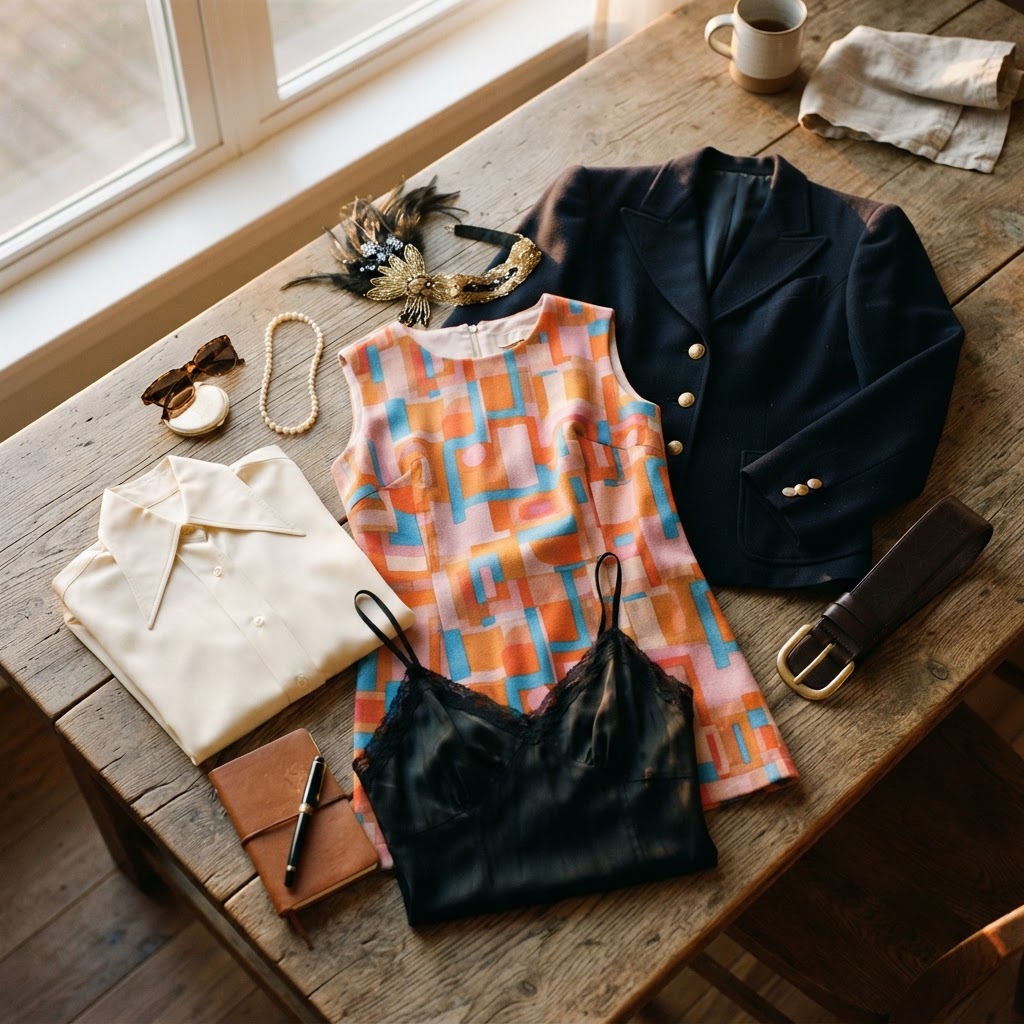
Decode Your Style DNA: How Vintage Fashion From Every Decade Can Help You Find Your Signature Look
Your personal style isn't something you stumble upon in a single shopping trip — it's a story told through decades of design, silhouette, and culture. Vintage fashion offers a living archive of every aesthetic that has ever captivated the human imagination. Here's how to use it to finally figure out what makes you feel most like yourself.
Why Vintage Is the Ultimate Style Laboratory
Walking into a modern fast-fashion store can feel oddly limiting. Despite the sheer volume of product, everything tends to orbit around the same seasonal trend. Vintage shopping, by contrast, drops you into a time machine. One rack might hold a 1940s utility blazer, a 1970s prairie blouse, and a 1990s minimalist slip dress — three completely different philosophies of beauty existing side by side.
That diversity is exactly what makes vintage fashion such a powerful tool for discovering your personal style. When you try on pieces from different decades, you're not just trying on clothes — you're trying on worldviews. And the ones that make your eyes light up in the mirror? Those are clues.
Start With a Decade Audit
Before you buy anything, spend some time doing what stylists call a decade audit: a relaxed, judgment-free browse through clothing from each era to see which silhouettes and details make your pulse quicken.
Here's a quick emotional cheat sheet for each major decade in the vintage canon:
- 1920s: Dropped waists, art deco beading, and a radical rejection of the corset. If you're drawn to androgynous shapes and maximalist embellishment, this era might be calling your name.
- 1930s & 1940s: Bias-cut glamour meets wartime pragmatism. Wide-leg trousers, padded shoulders, and luxurious drape. The person who loves old Hollywood and doesn't mind a little drama will feel right at home.
- 1950s: Nipped waists, full skirts, and a color palette that looks like a candy store. Classic femininity at its most polished — but also surprisingly playful.
- 1960s: The decade of the silhouette revolution. Mod shifts, bold geometric prints, and the rise of youth culture. If you love clean lines and graphic energy, the '60s are your people.
- 1970s: Perhaps the most stylistically diverse decade in history, spanning bohemian peasant blouses, Studio 54 disco jumpsuits, and sharp menswear-inspired suiting. The '70s reward the eclectic dresser.
- 1980s: Power shoulders, neon brights, and unapologetic maximalism. If subtlety bores you, the '80s were made for your wardrobe.
- 1990s: The great pendulum swing toward minimalism — but also grunge, logomania, and slip dresses worn over t-shirts. The '90s are for those who prefer their cool understated but intentional.
- 2000s & 2010s: Close enough to feel familiar, far enough to feel fresh. Low-rise denim, logomania part two, and the rise of athleisure as aesthetic.
Pay Attention to Your Gut Reactions
When doing your decade audit, resist the urge to edit yourself based on what you think you should like. The goal is to notice your unfiltered reactions. Did you linger on every 1930s bias-cut gown you found? Did the sight of a perfectly preserved 1960s Mod shift dress make you feel a little electric? Those aren't accidents.
Conversely, notice what leaves you cold. Maybe 1950s full skirts feel costumey to you, or 1980s shoulder pads feel like too much to integrate into real life. That information is equally valuable. Personal style is as much about knowing what isn't you as it is about knowing what is.
Build a Mood Board Across Decades
Once you've done your audit, create a visual mood board — digital or physical — of the vintage pieces and styling moments that genuinely moved you. Don't worry if they span wildly different decades. A 1940s wide-leg trouser, a 1970s peasant blouse, and a 1990s structured blazer might all appear together, and that's perfectly fine.
Look at your mood board as a whole. You'll often start to see threads: maybe everything you chose has clean lines and a neutral palette, pointing toward a classic minimalist identity. Or maybe every piece is maximalist and printed, pointing toward eclectic maximalism. Your board doesn't lie.
Use Key Pieces to Anchor Your Wardrobe
Personal style becomes wearable when you identify anchor pieces — versatile vintage items that can carry multiple outfits and serve as the backbone of your look. Here are some decade-specific anchors worth hunting for:
- A 1940s or 1970s wide-leg trouser in a neutral tone. Endlessly versatile and flattering on nearly every body type.
- A 1960s shift dress in a bold print. Wear it as a dress or over wide-leg pants as a tunic.
- A 1980s oversized blazer. The silhouette has never really left, and an original is far more interesting than a contemporary version.
- A 1990s slip dress in silk or satin. Layer it, dress it up, dress it down — few pieces are more adaptable.
- A 1950s or 1970s leather belt with an interesting buckle. Accessories from these decades are among the most well-crafted you'll find at any price point.
Mix Decades With Intention
One of the most common misconceptions about vintage dressing is that you have to commit to a single era. You absolutely don't — and in fact, some of the most compelling personal styles are built on deliberate decade mixing.
The key word is deliberate. Mixing a 1930s bias-cut skirt with a 1990s ribbed tank and a structured 1980s blazer works because each piece is chosen consciously. The silhouettes complement each other; the proportions are considered. Contrast that with throwing together pieces from different eras without thought — the result tends to feel more chaotic than curated.
A useful rule of thumb: anchor your outfit in one dominant decade, then accent with one or two pieces from other eras. Let one era lead, and let the others support.
Don't Overlook Fit and Fabric
Vintage sizing is famously inconsistent. A 1950s size 14 bears little resemblance to a contemporary size 14. This is one reason why fit literacy — understanding your own measurements and how garments should fall on your body — is so important for vintage shopping.
Beyond sizing, pay close attention to fabric quality. One of vintage fashion's greatest gifts is access to natural fibers and construction techniques that are increasingly rare in modern clothing. A 1970s wool crepe trouser or a 1940s silk charmeuse blouse will drape in ways that synthetic modern fabrics simply can't replicate. When you find something that fits beautifully and is made from exceptional fabric, that's a piece worth investing in regardless of whether it fits your current style narrative — because quality always finds a way into a wardrobe.
Style Is a Practice, Not a Destination
It's worth remembering that personal style isn't something you arrive at once and maintain forever. It evolves as you do. The beauty of building a wardrobe through vintage fashion is that each piece carries genuine history — it existed in the world long before it found its way to you, and it will likely outlast trends many times over.
Approach the process with curiosity rather than pressure. Experiment. Wear the 1960s shift dress to a grocery run. Pair the 1970s blazer with jeans on a Tuesday. The more you live in vintage pieces, the more you'll understand what truly resonates and what was just a passing flirtation.
Find Your Next Signature Piece at Ensemble
At Ensemble, we've built our marketplace around exactly this kind of discovery. Our carefully curated collection spans authentic pieces from the 1920s through the 2010s, each authenticated and described in detail so you can shop with confidence. Whether you're deep into your decade audit or ready to add your next anchor piece, Ensemble is the place to explore, experiment, and ultimately find the vintage items that feel unmistakably, entirely you. Start browsing today — your style story is waiting.