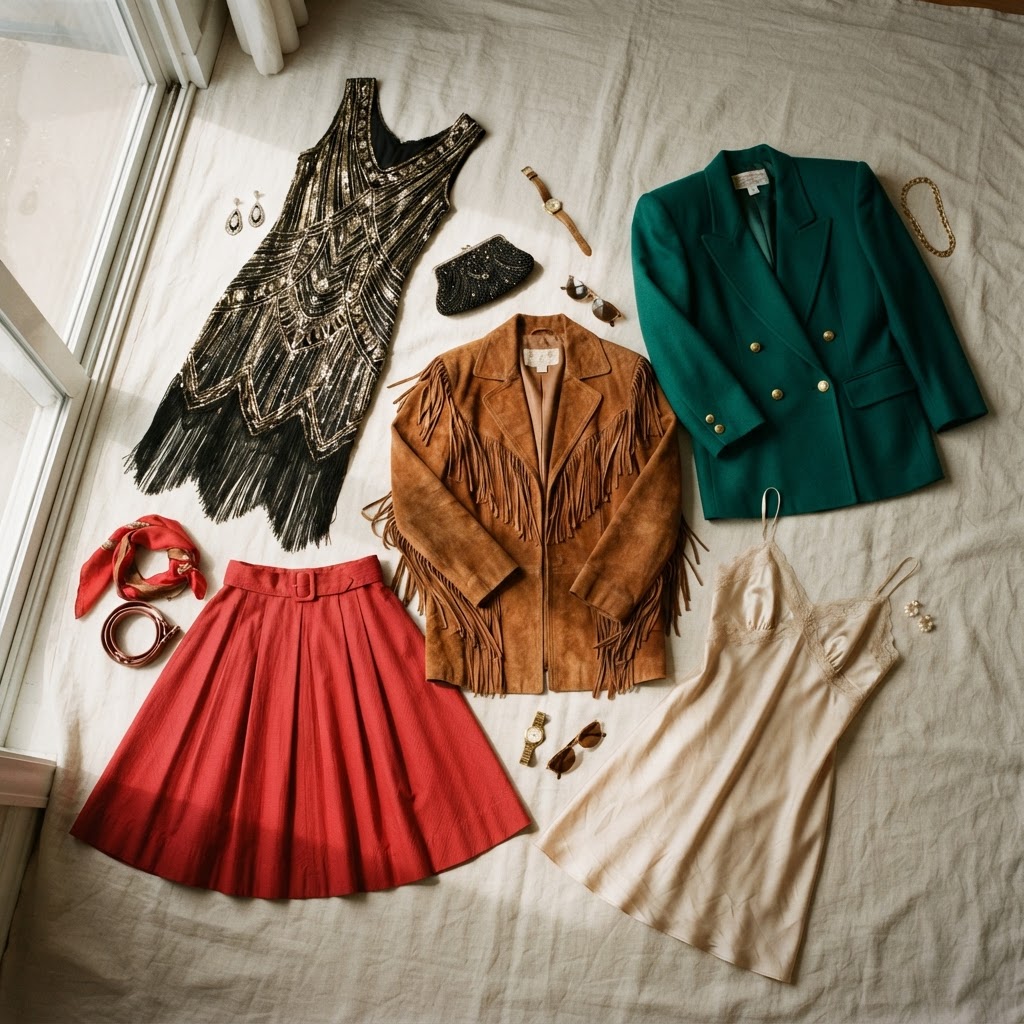
Decade by Decade: How to Find Your Personal Style Through Vintage Fashion
Your personal style isn't something you stumble upon in a single shopping trip — it's a conversation across time, stitched together from the boldest, most beautiful moments in fashion history. Vintage clothing gives you access to nearly a century of distinct aesthetics, each decade offering its own visual language. Here's how to use that rich archive to build a wardrobe that's unmistakably, authentically you.
Why Vintage Fashion Is the Best Style Laboratory
Walking into a vintage shop — or scrolling through a curated marketplace like Ensemble — feels fundamentally different from browsing a fast fashion retailer. Instead of being handed a single, trend-dictated aesthetic, you're handed a century's worth of options. The 1920s flapper silhouette, the 1970s bohemian maximalism, the 1990s minimalist grunge — these aren't just costumes from another era. They're fully realized visual philosophies, each one developed in response to the culture, politics, and desires of its time.
Finding your personal style is really about identifying which of those philosophies resonates with who you are — or who you want to become. Vintage fashion lets you try on identities with intention rather than impulse. And because every piece has already lived a life, there's a depth and specificity to vintage clothing that modern mass production simply can't replicate.
Let's take a decade-by-decade tour and explore what each era can teach you about yourself.
The 1920s–1930s: Structure Meets Liberation
The interwar decades gave us two distinct but complementary energies. The 1920s exploded with the joy of liberation — dropped waists, beaded fringe, and hemlines that scandalized an entire generation. The 1930s pulled back into elegance, introducing the bias cut, which draped the body in fluid, sculptural waves.
If you're drawn to pieces from this era, you likely value craftsmanship and intentionality. You appreciate clothes that feel like art objects. A 1930s bias-cut satin gown or a beaded 1920s flapper dress isn't something you throw on — it's something you inhabit. Ask yourself: Do I want my clothing to feel ceremonial? Do I love the idea of a single statement piece built around a whole evening's outfit? If yes, the interwar decades are your spiritual home.
The 1940s–1950s: The Power of Polish
WorldWar II rationing created an unexpected design revolution. With fabric scarce, 1940s fashion became an exercise in precision — structured shoulders, nipped waists, and clean lines that communicated competence and resilience. After the war, Dior's New Look swept in with full skirts and hourglass silhouettes, and the 1950s became synonymous with polished femininity.
If mid-century pieces call to you, you may be someone who finds power in presentation and polish. You understand that dressing intentionally is a form of self-respect. A 1950s circle skirt or a 1940s tailored blazer signals that you've thought about how you want to move through the world. This aesthetic works beautifully for people who love contrast — pairing vintage 1950s structure with modern, casual elements creates an effortlessly chic tension.
The 1960s–1970s: Rebellion as a Wardrobe Choice
Few decades were as visually explosive as the 1960s and 1970s. The 1960s brought us mod culture — bold geometric prints, shift dresses, and the kind of graphic simplicity that looked like pop art made wearable. The 1970s responded with maximalism: wide lapels, earth tones, peasant blouses, platform shoes, and a general celebration of texture and volume.
If you're gravitating toward pieces from these decades, rebellion and self-expression are probably central to your style identity. You're not interested in blending in. A 1960s mod minidress in a bold color-block print or a 1970s suede fringe jacket makes a statement before you've said a word. These pieces also reward creative mixing — a 1970s printed blouse tucked into modern straight-leg trousers, or a 1960s shift dress layered under a contemporary oversized coat, bridges eras in a way that feels genuinely original.
The 1980s: Confidence Dialed to Maximum
Love it or critique it, 1980s fashion was never timid. Power dressing gave us broad-shouldered blazers that commanded boardrooms. Pop culture gave us neon, animal prints, and sequins before 8 PM. Athletic wear crossed over into everyday fashion for the first time in a major way.
If 1980s pieces speak to you, you likely have a high tolerance for visibility. You're not shy. A vintage 1980s oversized blazer in a jewel tone or a sequined top worn to brunch communicates a kind of joyful fearlessness. The current fashion moment has enthusiastically reclaimed the 1980s shoulder, making this one of the most wearable vintage decades right now. The key is editing with intention — one strong 1980s piece anchors an outfit; three compete with each other.
The 1990s–2000s: The Eras You Might Underestimate
Nineties and early 2000s fashion has gone from being dismissed as "too recent to be vintage" to being among the most coveted categories on the resale market — and for good reason. The 1990s perfected minimalism: slip dresses, clean-lined blazers, simple knitwear, and a coolness that came from restraint. The 2000s swung toward logomania, low-rise silhouettes, and an experimental maximalism that fashion is currently re-examining with great enthusiasm.
If these decades feel right, you're probably someone who moves between irony and sincerity with ease. You can wear a 1990s slip dress with genuine elegance or style a 2000s logo bag with knowing wit. These are also the most accessible vintage decades for newcomers — pieces are relatively abundant, sizing tends to align more closely with contemporary standards, and the learning curve for styling them is gentler.
How to Actually Use This: A Practical Style-Finding Framework
Knowing which decades resonate intellectually is only the beginning. Here's how to translate that resonance into a real wardrobe:
Start with one anchor piece per decade you're drawn to. Don't try to build a complete 1970s wardrobe overnight. Find one exceptional piece — a great suede coat, a printed blouse — and learn how it lives in your existing wardrobe.
Pay attention to how vintage pieces make you feel, not just how they look. Personal style is ultimately about embodied confidence. If a 1940s tailored jacket makes you feel authoritative and alive, that's data. If a 1960s shift dress makes you feel exposed rather than bold, that's data too.
Mix decades deliberately. The most interesting personal styles aren't curated entirely from one era. A 1950s full skirt with a 1990s simple turtleneck; a 1970s printed blouse with 1980s tailored trousers. The juxtaposition is where your individual style signature emerges.
Think about the story you want to tell. Every decade of fashion was a response to something — a war, a social movement, a technological shift, a collective mood. When you wear vintage, you're in conversation with that history. Which chapters of that story feel like yours?
Conclusion: Your Style History Starts Here
Personal style isn't a destination — it's an ongoing, evolving act of self-definition. Vintage fashion gives you the richest possible toolkit for that process, offering nearly a century of distinct aesthetics to draw from, combine, and make your own. Whether you find yourself in the sculptural elegance of the 1930s, the confident volume of the 1980s, or the cool restraint of the 1990s, there's a decade that speaks your language.
Ensemble exists precisely for this kind of discovery. With authenticated vintage pieces spanning the 1920s through the 2010s, Ensemble is where you come not just to shop, but to explore — to try on different versions of yourself until you find the one that fits. Your personal style is out there, waiting in a piece that was worn and loved long before you found it. Start the conversation.